
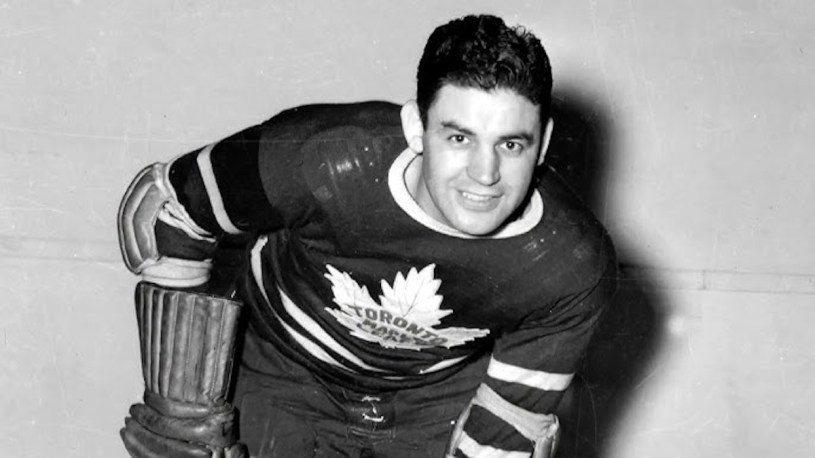
We are near the end of this NHL Saturday miniseries on the Original Six awards analysis. In the middle of World War II, the league soldiered on with the best players available. This was a year where the Montréal Canadiens dominated the regular season, finishing atop the standings by a whopping 25 points in a 50-game season. It does make you wonder about Canadian military service, though, for sure, in these years.
1944 Hart: Babe Pratt, Toronto (original); Doug Bentley, LW, Chicago (revised)
The vote winner here was Toronto Maple Leafs defenseman Babe Pratt, which means we have to figure out who the best forward was, as has been our mindset since we started these analyses years ago. The top sabermetric-value forwards were Detroit Red Wings left wing Carl Liscombe (6.4 PS); Leafs right wing Lorne Carr (6.4); and Chicago Black Hawks LW Doug Bentley (6.3). This was a year for defense? See below.
Detroit finished second with 58 points, while Toronto came in third (50 points). The Black Hawks were fourth (49 points), with a six-point playoff cushion. This automatically makes us believe Bentley is the Hart winner, as without him, perhaps Chicago cedes its four seed to to the fifth-place Boston Bruins (43 points). With 38 goals, he led the NHL in that category on his way to 77 points overall, which did not lead the league.
Bentley’s brother Max won the Hart vote in 1946, coincidentally, which we confirmed. Max served in World War II, but we cannot find any record of Doug’s service or a reason why he did not serve.
1944 Norris: Pratt
We have two candidates here, really, in Pratt (8.7 PS) and Montréal’s Leo Lamoureux (7.6). All other defensemen finished at least 0.9 PS behind Lamoureux, so we have to draw the line somewhere. However, the next three defensemen were also in the league Top 10 for Point Shares—two of them Canadiens and the third another Maple Leaf. With the standings in mind, we have to go with Pratt here, no question.
There is no record of military service for Pratt, and there is no information on any reason why he could not have served, either. However, he was at the center of a gambling probe in January 1946, although he was not permanently suspended from the NHL for it.
1944 Vezina: Bill Durnan (original, confirmed)
Canadiens goaltender Bill Durnan posted 15.0 Point Shares, more than double the next goaltender, so we will confirm his Vezina win. This was the first of his six Vezina wins in seven years, all of which we have confirmed. Somehow, though, he did not win the Calder vote (see below), despite leading the league in sabermetric value by 6.3 PS. He posted 38 wins and a 2.18 GAA to lead his peers in both categories.
1944 Calder: Gus Bodnar, C, Toronto (original); Durnan (revised)
Maple Leads center Gus Bodnar (4.5 PS) won the Calder vote, posting 62 points in 50 games. That’s a nice rookie season, to be sure, but it pales in comparison to what Durnan did. Seems rather absurd to even have to explain this, which we honestly cannot. So, we will just let this sit and move on quietly to the next trophy.
1944 Conn Smythe: Durnan
Montréal rolled to the Cup championship, beating the Leafs in five games before sweeping the Black Hawks in the Finals. And this is a tough one, as two skaters were outstanding—left wing Toe Blake (18 points, 11 assists) and right wing Maurice Richard (17 points, 12 goals)—while Durnan was also nails in the net (1.53 GAA). The Canadiens did not get much scoring from their defensemen, so we’re inclined to go with Durnan.
Blake and Richard fed off each other, with Blake topping all skaters in postseason assists and points, while Richard led all postseason skaters in goals scored. Meanwhile, Durnan logged just one shutout, but he clearly was on top of his game, even winning Game 4 of the Finals in overtime. Good enough for us, and this is his great achievement: winning three of these trophies in a single season. That’s historic, really.
Yet this was his only Conn Smythe in our estimation. We didn’t realize that until this moment, and now we are glad he finally got one, although we really didn’t factor that into our decision-making process, obvi.
 Daily McPlay: (mostly) Historical Sports Analysis with TENACITY & VERVE