
Time has come today on NHL Saturday: we’re down to our final three entries in this Original Six miniseries analyzing award winners from the past. The season assessment below features players who did not fight in World War II, for whatever reason. We did this in baseball historical analysis, too, of course, and while we do not question the situations below, we always try to provide clarity and a rationale. Keep that in mind …
1945 Hart: Elmer Lach, C, Montréal (original); Maurice Richard, RW, Montréal (revised)
This was just a flat-out error on the part of the voters, as Montréal Canadiens center Elmer Lach won the Hart on the basis of 7.7 Point Shares—fourth best on his own team. Also, his PS mark was second best among forwards on the Canadiens’ roster, as right wing Maurice Richard (9.2 PS) posted the best sabermetric value of any skater in the NHL this season. So, if anyone from the Habs gets it, it’s the Rocket.
Other candidates? We have to consider, because Montréal was loaded and ran away with first place in the regular season, making each of their stars slightly less valuable. Yet no other player in the league’s Top 10 for Point Shares can match Richard, or even come close, really. This was the season, by the way, that the Rocket scored 50 goals in 50 games on his way to legendary status at age 23. The rest is history, basically.
This is the fourth Hart we’ve given to Richard (1947, 1950–1951); only seven other players in league history have achieved this, although that number does seem kind of high to us. Anyway, for the record, Richard was injury prone in his youth (leading to his first rejection from the Canadian military) and suffered so many injuries that one of his ankles was permanently deformed (leading to his second rejection). Wow.
1945 Norris: Flash Hollet, Detroit
The Habs posted a 38-8-4 record to finish first by a whopping 13 points in a 50-game season. They had the top PS goaltender (see below) and the top four defensemen in the Defensive Point Shares rankings. That combo makes it rough for us to choose a Montréal blue liner here. Alas, we’re going with Detroit defenseman Flash Hollet here, who was the top overall sabermetric player in the league at his position.
The Red Wings finished second behind Montréal, and Hollet posted 8.4 PS to finish fourth in the league there, overall. He also tied for fifth in DPS (4.2), behind that quartet of Canadiens defensemen. Sure, Detroit itself ended up 15 points of ahead of third-place Toronto, but Hollet was doing a lot more on his own, especially considering the Red Wings used three different goaltenders throughout the regular season.
Again, for the record, Hollet scored 20 goals as a defenseman, which was a record that would stand for a quarter of a century or so, until Bobby Orr came along. We can’t seem to find the reason why Hollet wasn’t serving in the military, as he was in his age-29 season when World War II came to North America in 1941. We see Hollet was a non-commissioned officer at some point, but we don’t know why he never deployed.
1945 Vezina: Bill Durnan (original, confirmed)
Canadiens goalie Bill Durnan (13.2) topped the league in Point Shares, while also leading his peers in wins (38) and GAA (2.42). He only posted one shutout, however, which is odd since the top four defensemen in the league (in terms of Defensive Point Shares) were playing in front of him. The only other goaltender we can consider here, though, is Toronto Maple Leafs rookie Frank McCool (10.1 PS). Can Durnan keep this?
McCool topped the NHL in shutouts (four), despite a 3.22 GAA. Two Maple Leafs defensemen finished tied for eighth in the DPS rankings. Overall, Toronto finished 28 points behind the Canadiens, as the Leafs scored 45 fewer goals and gave up 40 more goals than Montréal did. The Habs still would have finished first without Durnan, and Toronto still would have made the playoffs without McCool. Durnan, it is, therefore.
This is his fifth Vezina from us, and we can verify multiple sources noting a lifelong nervous condition that probably rendered Durnan unfit for military service. It did lead to his early retirement from the NHL, too, although it’s hard for us to believe he could be this good at hockey in spite of his condition yet not be fit for military desk duty, etc. Alas, we’re not experts in that area, so we will let it go. Still, it’s an interesting bit.
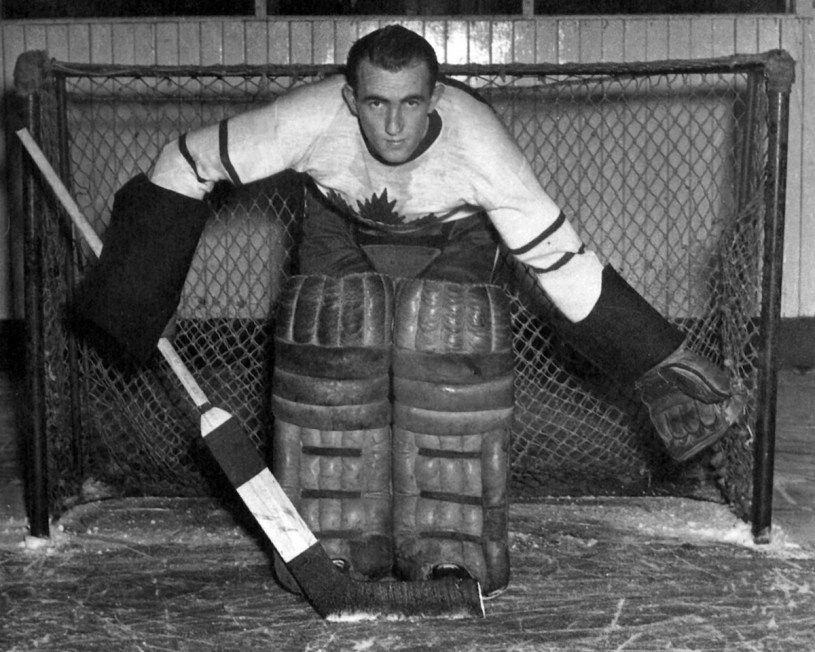
1945 Calder: Frank McCool, G, Toronto (original, confirmed)
This is an open-and-shut case as McCool finished second overall in the NHL for Point Shares as a rookie. Montréal D Frank Eddolls (5.3) was the next-best first-year player, but we know how loaded the Canadiens were during this specific season. As far as military service goes, McCool was enrolled at Gonzaga University through 1942 and then served in the Army for a time before being discharged as medically unfit. Weird, eh?
However, it tracks, as McCool retired after the 1945-1946 NHL season due to severe ulcers. We confirm his Calder vote win here, of course, but it’s a shame he only got to play two years in the league, overall. He came very close this season to winning three different awards, which is pretty incredible for a first-year player.
1945 Conn Smythe: McCool
The Leafs won the Stanley Cup with a shocking upset of the Canadiens in the semifinals (six games) and another upset in the Finals over the Red Wings (seven games). McCool posted another four shutouts in the postseason to easily run away with our Conn Smythe honors, as he was clearly on fire in a way that no one could match—not even Durnan. Sure, McCool took the five losses, but all were against superior teams. Duh.
Note that this was the Finals where the Maple Leafs went up 3-0 on the Red Wings before Detroit fought back to force a Game 7 on its home ice. McCool had dealt three shutouts in a row for Toronto to take that insurmountable lead, and then he coughed up eight goals in the next three games—including Games 5 and 6 where the Leafs were shutout themselves. Alas, he recovered to win Game 7 by a 2-1 margin on the road.
 Daily McPlay: (mostly) Historical Sports Analysis with TENACITY & VERVE