
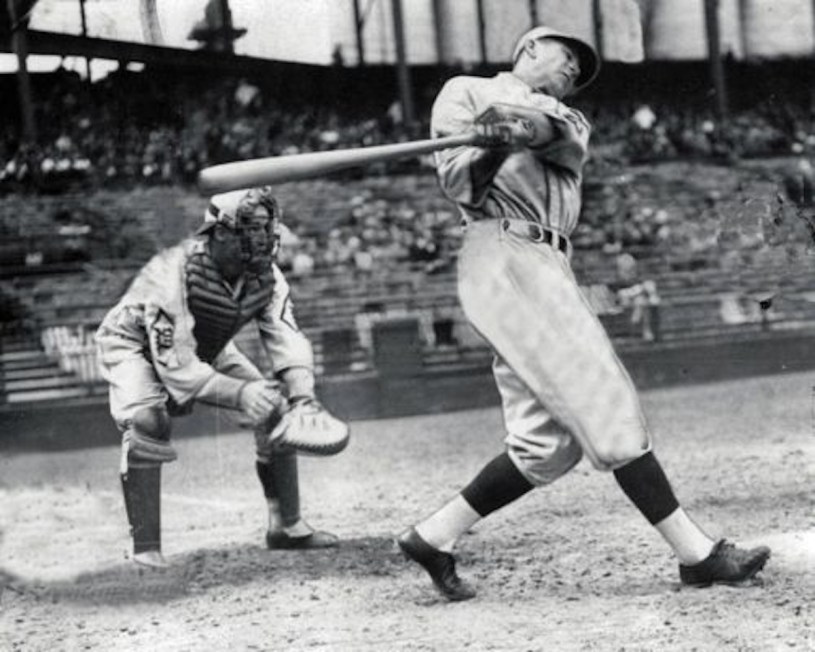
Our Friday Funday action returns today with a look at one of MLB’s past stars: Lefty O’Doul. He’s a legend in San Francisco, and despite his lifetime .349 batting average, he was never voted into the Hall of Fame. Why? Well, initially, we assume it’s because he only played in 970 games over his career, across parts of 11 seasons, which wasn’t enough for most voters. But why the Veterans Committee? We will never know, eh?
He started his MLB career as a pitcher for the New York Yankees (1919-1920, 1922 for a total of less than 25 innings combined) and the Boston Red Sox (1923 for 53 innings) before becoming a full-time left fielder for the New York Giants in 1928. After hitting .319 for the NL club that season in 114 games, though, he was traded to the Philadelphia Phillies, where he hit a combined .391 across 294 games in 1929 and 1930. Wow!
The 1929 NL batting title (.398) was his first of two such crowns, as he was then traded to the Brooklyn Robins before the 1931 season—where he compiled a .340 batting average in 325 games through June 1933, including a second NL batting championship in 1932 (.368). But he was only stroking .284 in his age-36 season for the 1933 campaign, when the newly named Dodgers traded him to the Giants (imagine that!).
With New York from June 1933 to the end of the 1934 season, O’Doul hit .310 with 18 home runs and 81 RBI in just 161 games. He was aging at that point (37), and he took the job managed the San Francisco Seals of the Pacific Coast League—a gig he held for 17 years. His contributions to both the City by the Bay and the nation of Japan are well chronicled elsewhere, so we do not need to rehash them here. He is a legend, yo.
The S.F. Giants helped get a bridge near the ballpark on the waterfront named after him (the same bridge that was a key backdrop for Hollywood films like The Enforcer and A View to a Kill—long before The House that Steroids Built was constructed). But it’s really his status as a plus-.300 hitter and non-Cooperstown member that intrigues us to this day, considering he’s in the Japanese Baseball Hall of Fame. Odd, huh?
His career WAR mark is only 25.3 which is very low in terms of the “average” Hall of Famer, so we can understand why he was not voted in the front door on ballots. But the committees that have existed to admit special contributors to the game from among the ranks should have gotten O’Doul in a long time ago. The lifetime batting average, the two batting titles, and a few other meaningful realities are enough, really.
What’s more was his unique bat control: he struck out just 122 times in 970 games as a hitter, while walking 333 times. His .413 OBP is exceptional, showing he wasn’t just a great hitter but also an excellent commander of the strike zone. The .945 OPS and the 143 OPS+ marks are incredible, even if he only played in 970 games. That’s the equivalent of six seasons in today’s 162-game schedule reality. Six great seasons.
Usually, the Hall wants players to be active for 10 seasons, and O’Doul fell short of that, of course. Yet his 162-game averages speak volumes: .349 BA, 19 HRs, 91 RBI, 56 walks, and 20 Ks. If he played today with that production line, he’d be a $25M/year player, easily. His dWAR (-5.3) hurts him a bit, but again, spread out over his seasons, O’Doul rates out as only a slightly below average left fielder. It’s not a huge negative.
Honestly, too, if you take out his hitting stats (.194 in 72 ABs) during his pitching years with the Yankees and the Red Sox, his overall BA rises (.353). The fact he dropped out of the majors for four years after his pitching days ended is also incredible, since his “peak” hitting years came from ages 31-37. Imagine what he could have done if he’d only been a left fielder from the start. Then he’d certainly be in Cooperstown today.
Regardless, he’s a local hero in San Francisco—the good kind, deserving and worthy. He belongs in the Hall.
 Daily McPlay: (mostly) Historical Sports Analysis with TENACITY & VERVE