
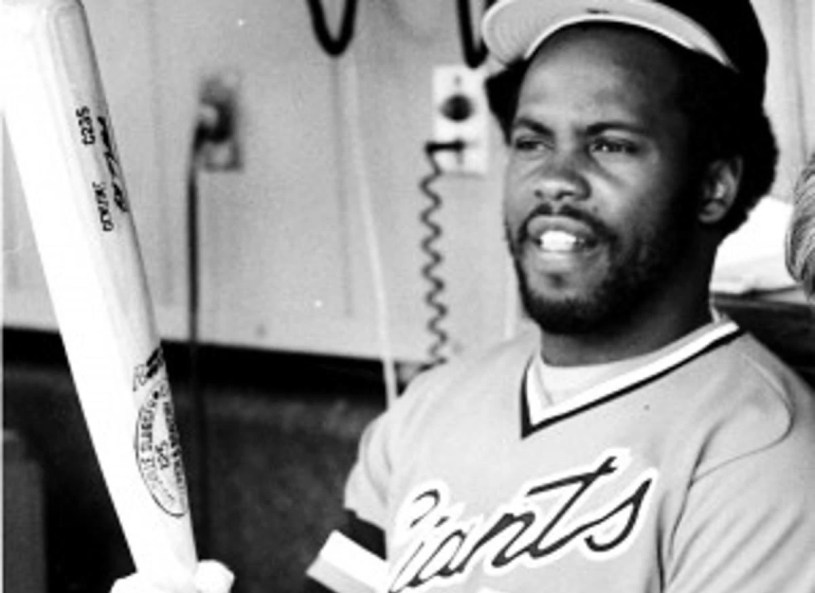
Our Friday Funday piece today returns to baseball, which really is our favorite pastime. And within our favorite pastime, we have favorite players, including today’s subject: Bill Madlock. He first caught our attention when he spent 331 games in his career with the San Francisco Giants, before being traded to the contending Pittsburgh Pirates on June 28, 1979. He would go on to win his only World Series that October.
Madlock was never a star, though, and we’re not sure why. He won four batting titles in his career: in 1975 and 1976 with the Chicago Cubs, as well as 1981 and 1983 with the Pirates. Yet he was an All Star in only three of those seasons, getting left off the roster in 1976 for who knows what reason(s). Strangely, after winning those back-to-back batting crowns, the Cubs shipped him off to San Francisco in a dumb trade.
In his three seasons with Chicago, he hit .336 with an .872 OPS and a 139 OPS+, but his greatness coincided with the onset of free agency. His salary with the Cubs in 1976 was only $80K (not a typo), but he received a five-year, $1.3M deal from the Giants. In San Francisco’s unfriendly-to-batters Candlestick Park, Madlock still managed to hit .296 with a 120 OPS+ mark before he was sent to the Pirates in that deal noted above.
He had started his MLB career in 1973 with the Texas Rangers, hitting .351 in limited action, managed by both Whitey Herzog and Billy Martin, but the club traded him to Chicago for Ferguson Jenkins. As an official rookie with the Cubs in 1974, Madlock hit .313 and finished third in the NL Rookie of the Year vote. So, despite all his talent, he got traded three times by age 28, but it ended up with that ring in 1979, so …
Overall, he spent five more full seasons in Pittsburgh before being traded, again, this time at age 34, to the Los Angeles Dodgers in 1985. There, he hit .360 down the stretch to help the team reach the 1985 playoffs, where he also put up a .333 average and a 1.083 OPS in the NL Championship Series. He stayed with the Dodgers through the end of the 1986 season, where he hit .280 at age 35. Not bad for an “old man” then.
Time caught up to Madlock at the start of the 1987 season, though, and L.A. released him in May after a slow start at the play. But the Detroit Tigers gave him a shot, and his .811 OPS in 87 games helped the Tigers win the American League East. But at age 36, he got just one start in the postseason matchup against the Minnesota Twins, and that was the end of his pretty noteworthy career: .305 BA, .807 OPS, and 123 OPS+.
He never hit 20 home runs in a season, and his RBI high was 95 during the 1982 season; Madlock didn’t have the impressive counting stats that all the “stars” of his time period did, so he wasn’t as valued or well known. His 163 career HRs and 174 career stolen bases are modest totals, and his OBP was never high since he didn’t walk a lot (just 605 times). But as an excellent contact hitter, he only struck out 510 times overall.
Perhaps what held him back from Cooperstown as the only four-time batting champ not enshrined in the Hall of Fame yet (Miguel Cabrera certainly will be soon) was his defense: Madlock finished with negative-8.7 dWAR, rarely finishing above the 0.0 mark for a full season during his 15-year career. But there are worse glove men in the Hall, so it perhaps does come down to the lack of relative power and speed here.
However, we love him, anyway. He may not have won much more than those four batting titles and that one World Series, but to young kids growing up in the 1970s and 1980s, he certainly was a model hitter: contact all the time. And even though he only played in three postseasons total, Madlock was a guy that teams traded for because he brought a lot to the table for a team. We respect that madly, and we hope he does, too.
 Daily McPlay: (mostly) Historical Sports Analysis with TENACITY & VERVE