
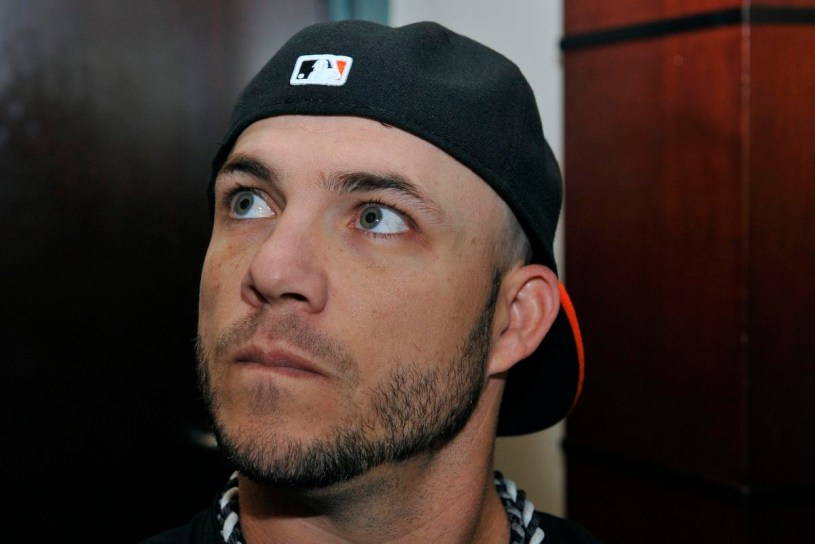
This edition of Tuesday Teasings look at the MVP of the 2018 World Series: some guy named Steve Pearce. We did not agree with the pick in our revisionist analysis, but the question remains about who this guy was, in terms of an MLB legacy. Probably one of the most rando WS MVP vote winners ever, he played in the majors for 13 years amid relative anonymity, and he discovered how to hit finally in his age-31 season.
He was never an All Star; he never won a Gold Glove. His career 10.4 WAR is not impressive, for that length of a career. His best season? He posted 5.8 WAR at age 31 for the Baltimore Orioles, which then opened the door for him to make $27.2M in his final five seasons. That 2014 season came out of nowhere, as well, since in the combined 2007-2013 seasons, Pearce managed to post just 0.8 WAR combined as a AAAA-type guy.
So … normally, we’d just assume a desperate guy started doing PEDs at age 31 to hang on to his MLB lifeline. The Orioles had given him 44 games to prove himself in 2013, and he managed 0.7 WAR with a .782 OPS. They retained him for the 2014 season, but after a slow start, they waived him in late April—and then signed him again two days later for whatever reason, and he had his career year (.930 OPS) out of nowhere.
It’s highly improbable for a player to suddenly figure it out like that, but it is what it is. After making $3.7M in 2015 and falling back down to 0.0 WAR and a .711 OPS, the Orioles parted ways with Pearce, probably feeling robbed. So, how did Pearce lose it so quickly? The usual guess would be he did not like the way the PEDs made him feel (mentally or physically), so he stopped using. Either way, he cratered out there. Ouch.
Then what is a guy in his position to do? Bite the bullet, perhaps. The normally fiscally reserved Tampa Bay Rays signed him for the 2016 season, giving him $4.75M in hopes of a return to his 2014 form. Now in his age-33 season, the likelihood of a recovery was minimal, so this seems out of characters for the Rays front office. Lo and behold, he posted a .908 OPS in 60 games for Tampa Bay before they dealt him in August …
Back to Baltimore, where he immediately crashed again, putting a .729 OPS up in just 25 games. Being burned twice now, the Orioles chose not to re-sign him, and Pearce somehow got a three-year deal from the Toronto Blue Jays for $18.75M! He was entering his age-34 season, and whatever he chose to do in the first part of 2016 out of desperation to extend his career worked in securing that one last final MLB payday.
With Toronto in 2017, his OPS dropped back down to .757 in 92 games, as if Pearce were riding the PED rollercoaster again, with his money secured. He must have felt bad, though, because at in his age-35 season (2018) with the Blue Jays, he started out hot enough (.868 OPS in 26 games) to get himself traded to a contending team: the Boston Red Sox. And we know how this works with the history of the Fenway Frauds.
The Boston front office certainly wasn’t going to stop him from doing whatever he needed to do to succeed, and this was also the sign-stealing season for the Red Sox. Whatever Pearce did, he improved his OPS t0 .901 in 50 games with Boston for the rest of the regular season before putting up a 1.083 OPS in the postseason and winning the WS MVP as noted above. That certainly brought some more financial rewards.
Come 2019 now in his age-36 season, the final one of that large deal he secured with Toronto, and with a World Series ring and hero legacy in his hands, Pearce just gave up suddenly: a .503 OPS in just 29 games, followed by an outright release. He never played in the majors again, but he certainly must have laughed himself silly all the way to the bank cashing all those checks. His career arc defies data and logic, unless …
We accept the probability he was a PED user. The patterns are clear as we know from our PED case studies with the Boston and San Francisco organizations. Obviously, many players not associated with those two notorious franchises experimented with the juice, too, since the financial rewards could be so high—as Pearce demonstrated. He had no future at age 31 … until he suddenly did, and the risk paid a high reward.
 Daily McPlay: (mostly) Historical Sports Analysis with TENACITY & VERVE