
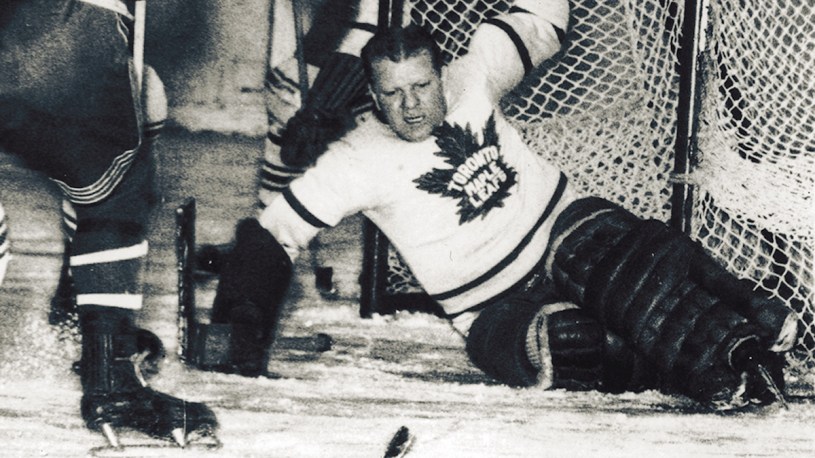
It’s a hot, hot day nationally on NHL Saturday, so we are cooling off with some hockey time. We have just six more seasons of the Original Six era to cover here, so we will be taking our time on those entries in order to reach the fall start of the upcoming NHL season. We are now amid a ten-season stretch where the Toronto Maple Leafs won six Stanley Cups between 1942-1951. Pretty incredulous, eh? We think so, too. Mon dieu!
1948 Hart: Buddy O’Connor, C, New York (original, confirmed)
Three forwards finished in the league Top 10 for Point Shares, and none of them won the Hart vote. Instead, New York Rangers center Buddy O’Connor did with 6.3 PS. His team finished fourth in the standings, just four points ahead of the Montréal Canadiens, so perhaps O’Connor did make the difference between an early summer vacation and the playoffs. But what about the three more productive skaters on the list?
Well, two of them played for the Habs, so they’re out of consideration. That leaves us with just Detroit Red Wings left wing Ted Lindsay (7.0 PS), who won our nod last week. His team finished 17 points ahead of New York in the standings, and it was in no danger of missing the postseason in a hypothetical world without Lindsay’s contributions. So, surprisingly, we confirm this award—the first time since 1952 we have done.
1948 Norris: Jimmy Thomson, Toronto
Not only was he the only defenseman in the league Top 10 for Point Shares, but Maple Leafs blueliner Jimmy Thomson (6.4 PS) also topped the NHL in Defensive Point Shares (4.8). With Toronto topping Detroit by five points in the standings to finish first, this means Thomson’s contributions meant the difference, perhaps, between the top seed in the postseason and the second playoff berth. Winner.
1948 Vezina: Turk Broda, Toronto (original, confirmed)
This award comes down to the winner—Turk Broda of Toronto—and the only competition within shouting range, Detroit’s Harry Lumley. The former topped the whole league with 13.2 PS in 60 games, while the latter was close enough behind (12.7 PS) to make this a conversation. Both backstops played in every game, with Lumley leading the NHL in shutouts (seven) and Broda leading in wins and GAA (2.38).
Interestingly, both teams finished plus-39 in scoring differential, so we’re going to confirm Broda’s nod here, since his teammates scored less for him than Lumley’s did, and that meant he had to be more on his game, generally speaking. He also played more minutes, overall, so … we approve the Vezina hardware.
1948 Calder: Jim McFadden, C, Detroit (original); Red Kelly, D, Detroit (revised)
The top rookie in terms of Point Shares was Detroit defenseman Red Kelly (6.1), but the vote went to his teammate (C Jim McFadden with 5.7 PS) for some reason. Kelly finished second in DPS, too, with a 4.7 mark. The third rookie to consider here is Boston Bruins LW Pete Babando (4.0 PS), playing for the third-place squad. First, we don’t like the fact McFadden was in his age-27 season, which is hardly “rookie” time.
While that’s not his fault, he also had a lower PS mark than his own teammate, Kelly, who was just in his age-20 year. We’d give this Kelly long before we ever gave it to McFadden. But they were also teammates, so how much more valuable could one have been than the other, beyond the pure PS mark overall? Babando trails them both by a lot, although his team didn’t really need him to stay in playoff contention, in reality.
We’re giving this to Kelly for being the best rookie, straight up, in pure PS value and in age context.
1948 Conn Smythe: Ted Kennedy, C, Toronto
Toronto won the Cup with an 8-1 run through the playoffs, including a four-game sweep of Detroit in the Finals. Center Ted Kennedy dominated with 14 points in the nine games, including league-best numbers in goals (eight) and points. He was just in his age-22 year, which is impressive. In net, Broda “only” posted a 2.05 GAA with a single shutout, so we’re inclined to give this nod to Kennedy for a more-impressive outing.
 Daily McPlay: (mostly) Historical Sports Analysis with TENACITY & VERVE