
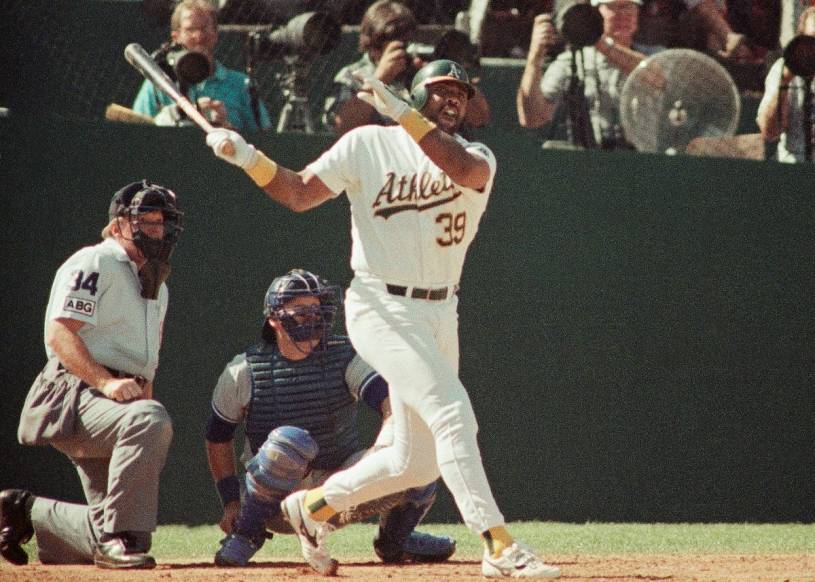
Our Gold Glove analysis on MLB Monday gets the week off today, as we pay respects to one of our favorite ballplayers ever: Dave Parker. While we didn’t agree with his Cooperstown admission, objectively, he still was one of those players who always put a smile on our face. Plus, when your nickname is “Cobra”? You are some kind of bad ass, period. Parker was always a threat at the plate, and he had a fearsome arm in the field.
He passed away Saturday at age 74, and we’d like to do his career a little more justice than was done last November in anticipation of his ballot exposure for the MLB Hall of Fame. In 19 seasons, he only compiled 40.1 WAR overall, as his defensive liabilities hurt: at six-foot-five and 230 pounds, his mobility in the outfield was limited. He was a born designated hitter, in truth, with that 41.7 oWAR career number.
Parker won two batting titles in the 1970s with the Pittsburgh Pirates (1977, 1978), while hitting .290 overall for his career with a 121 OPS+ mark, too. He finished with 2,712 hits—including 339 home runs, 526 doubles, and 75 triples. Twice, he topped the National League in doubles, once with Pittsburgh (1977) and the second time with Cincinnati (1985). He definitely was one of the most feared hitters of the late 1970s.
About that defensive arm? From 1975 to 1979, he threw out 72 runners, including 26 in 1977. As he hit his 30s, though, his mobility really took a hit as is wont to happen to a baseball player who is built like an NFL tight end. The years of playing on AstroTurf, too, with both the Pirates and the Reds must have taken their toll as well. However, Parker did win the first-ever HR Derby at the All-Star Game in 1985, which is cool.
He spent the final four years of his career (1988-1991) as a DH, primarily, which helped him extend his career—and win a second World Series, too. He’d won the title in 1979 with the Pirates (“We Are Family”), and he was a solid contributor to the Oakland Athletics in 1989, as well, when they swept the San Francisco Giants in the World Series. As we noted last year, his leadership in the clubhouse is not quantifiable, either.
The nickname? Well, again, from 1975-1979, he was one of the best hitters (26.3 oWAR combined), if not the best, in the NL, dressed in those black Pittsburgh unis. And he really could strike at any time. In those five years, Parker successively hit .308, .313, .338, .334, and .310 while delivering 114 HRs and 490 RBI in the middle of a lineup that got the Pirates to the postseason in 1975 and 1979 in a tough division. Impressive.
Parker didn’t dominate in the postseason at all, hitting just .234 in 30 playoff games with a .647 OPS. But he did hit .341 in the 1979 postseason with the Pirates, and he did hit three HRs in the 1989 postseason with the A’s. So there were moments of magnificence amid the overall mediocrity. Considering he started out 1-for-18 in his first two NL Championship Series appearances, Parker adjusted to hit .269 in the rest of his Octobers.
Again, we loved the guy for his smile and his fearsome hitting when we were kids. He also stood out to us un our teens when we watched the A’s win three straight AL pennants. We put him in the category of “very good” without putting him in the Cooperstown pantheon of “excellent”—and there’s nothing wrong with that, at all. Most current MLB players would give their left testicle to be this good, and that’s a fact, Jack.
 Daily McPlay: (mostly) Historical Sports Analysis with TENACITY & VERVE