
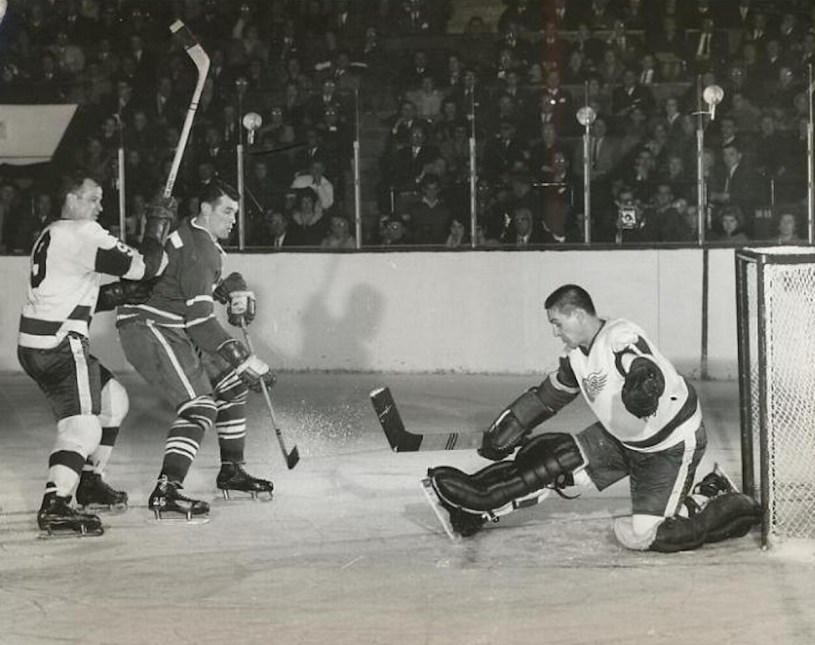
Our NHL Saturday takes us back another year today, as we move closer to the first season(s) of the Original Six. We have come to the year where the Legend of the Octopus begins, actually, and for those of you in the know already, we won’t provide any spoilers to those who get to learn it now for the first time ever! That’s most of the fun, after all, in exploring the past, right? Needless to say, we never have smuggled one in, either.
1952 Hart: Gordie Howe, RW, Detroit (original, confirmed)
In a 70-game season, the Detroit Red Wings won 44 games and posted 100 points in the standings to finish first by 22 points over the second-place Montréal Canadiens. Detroit right wing Gordie Howe (13.1 Point Shares) was the top forward in the NHL, based on sabermetric value, by 3.8 PS. Such a clear margin, for both team and player, makes this easy: Howe won the Hart vote, and we will confirm it … his sixth Hart to us here.
1952 Norris: Red Kelly, Detroit
Red Wings defenseman Red Kelly (11.8 PS) topped all other blue liners by 3.2 PS, so the same logic applies here—even though there was no official Norris Trophy at the time. It didn’t start until 1954, as we noted previously. In our eyes, this would be the fifth Norris hardware piece for Kelly in his Hall of Fame career. In the real world, he only won a single Norris—the first one ever awarded in 1954. Go figure the bad timing!
1952 Vezina: Terry Sawchuk, Detroit (original, confirmed)
Here we have a different circumstance: Detroit goaltender Terry Sawchuk (16.6 PS) topped all other goalies in sabermetric value, but his margin of superiority over the next-best netminder was just 2.3 points. Toronto Maple Leafs youngster Al Rollins (14.3) helped his team to a third-place finish, with a 15-point cushion for a postseason spot. Maybe Rollins was the difference between the postseason and nothing?
Not really. Any goaltender in the NHL at this time would post a lot of Point Shares, due to the work distribution and small league size. And with Rollins finishing more than 1 PS ahead of the next goalie, well … it just highlights Sawchuk’s dominance, even if surrounded by the best talent. The combination of team and individual gaps over the next-best entities here mean a clean sweep of these three awards by Detroit.
This is the third Vezina we’ve given to Sawchuk (1955, 1958). He won four in real life. Everything is eventual.
1952 Calder: Bernie Geoffrion, RW, Montréal (original, confirm)
With 7.0 Point Shares, Canadiens RW Bernie Geoffrion won the Calder vote as he finished tenth overall in the NHL for value. Without him, Montréal would have finished third in the standings, rather than second. They’ve have had to face the Red Wings in the first round of the postseason instead of facing the fourth-place Boston Bruins. Only New York Rangers D Hy Buller (6.7 PS) was close, and his team finished fifth.
1952 Conn Smythe: Sawchuk
The Red Wings won the Cup after sweeping Toronto in the semifinals and then sweeping Montréal in the Finals, a perfect 8-0 run through the playoffs. Hence, the Legend of the Octopus. We can only imagine how bad that would smell, smuggling a sea creature into the Joe within our pants. No way! Either way, we have to choose a Conn Smythe winner here, and Sawchuk will be hard to beat (8-0, 0.62 GAA, four shutouts).
With no Detroit skater posting even a point a game, we readily hand this piece of hardware to Ukey for the second time in three years.
 Daily McPlay: (mostly) Historical Sports Analysis with TENACITY & VERVE