
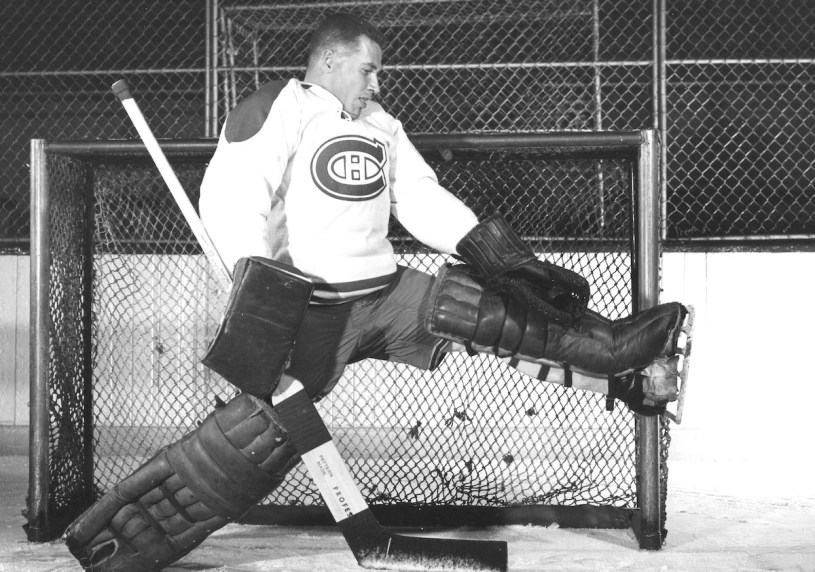
We’re going back in time again on NHL Saturday as we move closer to the first seasons of the Original Six. It’s time for the 1952-1953 season, the last one without an official Norris Trophy winner. That’s right: the league only started the Norris tradition in 1954, so we’re on our own here, just as we have been with the Conn Smythe for awhile now. Generally, we are fine with that, and we hope that you are, too. On with it!
1953 Hart: Gordie Howe, RW, Detroit (original, confirmed)
The Detroit Red Wings finished 15 points clear of the other five teams in the league, and their right wing, Gordie Howe, won the Hart vote after leading the NHL in Point Shares (15.5). That was five PS better than the next forward, and it was such a dominant performance, it’s hard to overlook. He led the league in goals, assists, points, and three other goal-scoring categories. It’s easy to just confirm this award now, in reality.
1953 Norris: Red Kelly, Detroit
Red Wings defenseman Red Kelly posted a PS mark (12.2) that was 3.7 PS better than the next-best defenseman, also demonstrating some serious dominance at his position. He tied for the league high in Defensive Point Shares (5.8), so he was logging time at both ends of the ice. Sure, without him, Detroit still probably wins the regular-season league standings, but it’s the gap between the next guy that always shocks.
1953 Vezina: Terry Sawchuk, Detroit (original); Gerry McNeil, Montréal (revised)
Five of the six teams had a goaltender in double-digit PS, which was impressive. Detroit legend Terry Sawchuk won the Vezina under the rules of the time, and he also topped his peers in PS (14.0). However, Montréal Canadiens backstop Gerry McNeil (13.1) was not that far behind, considering his team finished 15 points below the Red Wings in the standings—and just eight points ahead of the fifth-place team. Hmmm.
The Canadiens could have missed the playoffs without McNeil. Detroit still would have been golden without Sawchuk. McNeil topped the NHL in shutouts (10) and ties (18), which enabled Montréal to secure its valuable postseason positioning. We give this nod to McNeil, who would be all but out of the league within two seasons, really, despite being only in his late 20s.
1953 Calder: Gump Worsley, G, New York (original); Gord Hannigan, C, Toronto (revised)
The best contenders for this award were all from teams that missed the postseason, and the winner—goalie Gump Worsley of the New York Rangers—played on a squad that finished dead last by 17 points. That doesn’t seem right when two members of the fifth-place team, which only missed the postseason by two points in the standings, also were in the same PS neighborhood. We’re not giving this trophy to Worsley.
Sabermetrically, Worsley (4.4 PS) finished right between two Toronto Maple Leafs rookies: defenseman Leo Boivin (4.8) and center Gord Hannigan (4.1). The former’s main value seems to have come from PIMs, while the latter actually had a decent combo of scoring and PIMs. The statistics being limited, we’re going to go with Hannigan here for his balanced game, despite the PS marks.
1953 Conn Smythe: McNeil
After dropping the Chicago Black Hawks in a seven-game semifinal series, the Canadiens caught a break when the Boston Bruins upset the Red Wings in the other semifinal. Montréal then rolled over the Bruins in five games to win the Cup unexpectedly. Les Habs used two goalies in the postseason for whatever reason, not trusting McNeil entirely, perhaps? Jacques Plante got four starts, even though he was green in 1953.
So, we look to the skaters for our Conn Smythe nod: no skater scored more than 10 points in 12 games. We either go with RW Bernie Geoffrion, who topped the team with those 10 points while also leading the league in postseason power-play goals (two) and game-winning goals (two). Or we go with McNeil, who got eight starts and posted a 5-3 record overall, with two shutouts in the Cup Finals. This is tricky; here is why.
McNeil lost all three games in the semifinals against Chicago, and Plante replaced him for two games—the wins in Games 6 and 7, where he coughed up just one combined goal. Then, in the Finals, Plante started the first two games, giving up six goals and losing Game 2. After that, the team went back to McNeil, who won three straight starts, including two via shutout, to win the Cup. Considering the Habs could not score …
We’re giving this to McNeil, even though Plante did his yeoman’s work as well in just getting Montréal to the Finals. When McNeil lost three straight games to Chicago in the semifinals, all looked lost for the Canadiens, and all was not lost when the team benched Plante. But McNeil almost single-handedly delivered the Cup at that point. Overall? His 1.85 postseason GAA is very shiny, including the shutouts.
Geoffrion wasn’t dominant on offense, and McNeil was a bit more dominating in net, even with the three losses to the Black Hawks (where he only gave up eight goals, anyway, and lost Game 3 in overtime on the road). This is a tough call, but we’re going with McNeil. However, Plante’s appearances certainly set the stage for his eventual ascendance, even as McNeil earned one more season as the starter with the Cup win.
 Daily McPlay: (mostly) Historical Sports Analysis with TENACITY & VERVE