
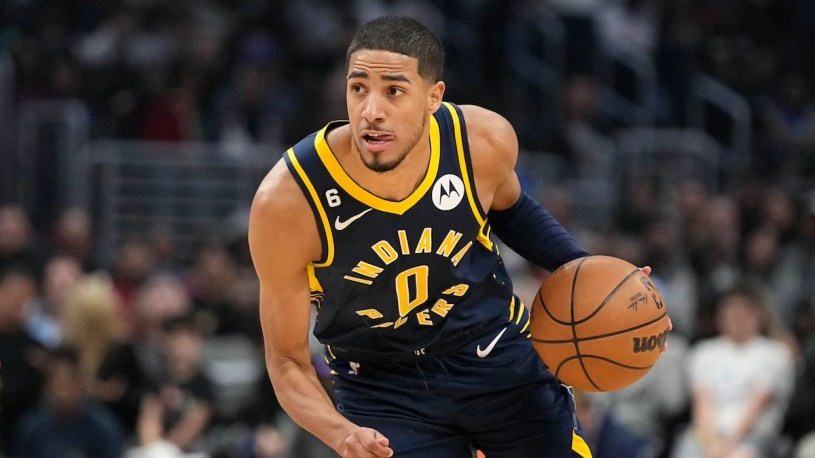
We like to use Sunday Surmising to share factual information, most of the time, and today is one of those times as we have finally arrived at the NBA Finals. It’s taken 45 days to get through the first three rounds of the playoffs, believe it or not, and the Finals themselves won’t start until June 5. So, really that’s 48 days then to complete three best-of-seven rounds. The NBA sure knows how to milk the TV revenue here, huh?
[Editor’s Note: assuming the ratings are “good” … see what we’re going for here, already?]
How did we get here? The Indiana Pacers (!) have enjoyed some serious good fortune and luck in going 12-4 against three better teams in the Eastern Conference playoffs. The Pacers were the sixth-best team, sabermetrically, in this side of the bracket. Math is based on an 82-game season, of course, and anything can shift just enough in a 7-game series scenario to present as an anomaly. And Indiana has defied the odds.
What happened? Well, the Pacers held serve to start out against the Milwaukee Bucks, and the Bucks also lost nine-time All-Star Damian Lillard for Games 1 and 5 after he only played 58 games in the regular season. Of course, Indiana won both those games, and when you’re the sabermetric underdog, those are the breaks you need to advance in the postseason elimination game. Lillard played 75 minutes total in this series.
It’s the kind of luck that never happens to your team … just the the team your team is playing, of course! Not that we care about the Bucks, or the Pacers’ opponent in the second round: Cleveland, the best team in the conference all season, coming off a first-round sweep themselves. And then the Cavaliers got unlucky, too, with injuries. All-Star Darius Garland played just 85 minutes across three games in the matchup. More?!
Midseason acquisition De’Andre Hunter missed a game; Defensive Player of the Year vote winner Evan Mobley also missed one of the contests (his team lost). It was pretty good fortune, again, for the Pacers should have been 7-point underdogs on a neutral court against the Cavs. But no, Indiana won the first two games on the road against the seemingly always-down-an-injured-man Cleveland roster. And it happened.
In the Eastern Conference Finals, there was a lot of amusement going on as the same formula, basically, that sunk the Boston Celtics in their second-round series against the New York Knicks turned around and sunk the Knicks in the next round against the Pacers: the Knicks never learned that pride cometh before the fall. Indiana overcame fourth-quarter deficits in Games 1 and 2 on the road to control everything, yet again.
Despite another sabermetric disadvantage, the Pacers got really lucky against the Knicks, just as New York did against Boston. Same sequence of W/L results, too, in the series. The script flipped itself on an arrogant Knicks team, and Indiana took advantage. We give the team credit for taking advantages of its chances, and that is a sign of a good team, perhaps a better one than the math suggested (13th-best in NBA regular season!).
Luck is the result of preparation meeting opportunity; every fan and sportswriter should know this. But the Pacers’ luck cannot continue against an 11-point neutral court favorite in Oklahoma City, can it? Those odds would be astronomical. The collective sabermetric deficits Indiana faced against Milwaukee, Cleveland, and New York is still less than the singular deficit it faces against the Thunder. Do the math. OKC is too darn good.
And there’s the rub: it will take a colossal collapse by Oklahoma City to not win this title. And the Pacers just aren’t good enough: not only does the Thunder have the voted MVP on its team, its fourth-through-seventh, sabermetric-valued players are better than Indiana’s third best. OKC has seven players on its roster that posted at least 5.0 Win Shares this season, and Indiana has just two players of that ilk. Ouch. And more?
OKC star Chet Holmgren played only 32 games this year recovering from injury, and he is not one of the seven players noted above. Add a healthy Holmgren to the equation, and this mathematical deficit that the Pacers face is just way too much to overcome. Yes, OKC has lost four games this postseason, too, but that’s the nature of the mathematical beast—and the NBA doing what it does best. You know what we mean.
Yeah, and then there is the TV issue: Indianapolis is the 25th-largest TV market, while you know OKC is pretty far down the list at 47th. What kind of ratings does the NBA need to make this profitable? We believed if OKC made it to the Finals—and they had to, since they were just so much better than everyone else in the Western Conference, mathematically—they’d need a big-market team on the other side. Oops.
Indiana has been crazily luckily to this point, as they didn’t have to face the top team in its conference at full strength (Cleveland) or the second-best team (Boston) at all. Now, again, they face the best team in the league which (for the most part) waltzed through the Western Conference playoffs. The NBA managed to seven games out of the OKC-Denver series during the MVP announcement, basically, for TV ratings.
Will it try to do the same thing with the Finals? We doubt it, as the Nuggets had their own MVP on display—and his international TV following as well. Again, what do OKC and Indiana offer the international viewing community? We don’t think enough to make this series close. The Thunder should sweep, but we’re throwing a bone to the Pacers … for pluck. But there’s no way that team even should have gotten here at all.
Again, the math of an 82-game season is firm, hard data. The anomalies of a short series can upend the math, but expecting that to happy four series in a row like this rates astronomically low probability. The Pacers already have surpassed the realm of low probability at this point; they’re in the minuscule zone. Keep an eye on the officials, though, because the NBA has a history of … yeah, you know what we mean.
 Daily McPlay: (mostly) Historical Sports Analysis with TENACITY & VERVE