
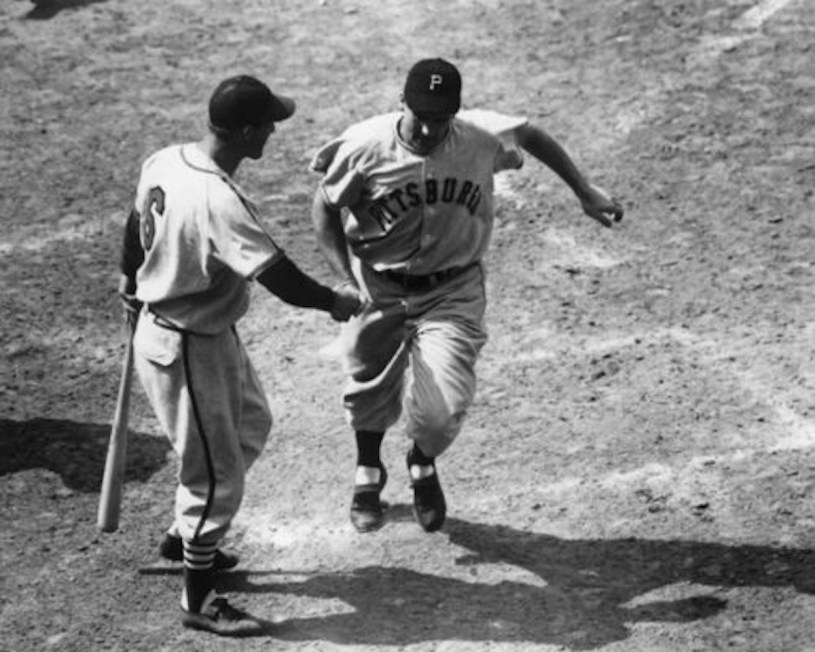
There once was a baseball played named Johnny Dickshot, also known as Ugly.
Welcome back to Friday Funday, and we’re not making a joke of any kind here—because those pretty much write themselves with this subject matter. A major-league outfielder for 322 games spread out over six seasons, including two during World War II, Dickshot is a nobody, really. A .276 hitter, he actually only hit seven home runs in his entire career, while walking 101 times and striking out 97 times overall. Interesting.
He made his debut with the Pittsburgh Pirates in 1936, at age 26, and he didn’t stick. Over the first 20 games of that season, Dickshot appeared in just nine of them, getting 10 total plate appearances. He got two hits, one walk, and one RBI … and that was it, as he mostly saw pinch-hitting duty and late-inning defensive action in right field. There’s not much else to read in his statistical line from that season at this time point.
However, he was back in the majors the following year with the club, this time managing to stay on the active roster for the entire 154-game season. Dickshot made 82 appearances for the 1937 Pirates, a team that finished 86-68, ten games out of first place—despite finishing the season with ten straight victories! Dickshot himself hit .254 with three HRs, 33 RBI, 26 walks, and a mediocre .672 OPS. At age 27, this was it.
His prime didn’t last long, as in 1938, Pittsburgh only used him in 29 games, despite the fact he was with the MLB club all year, really. With an 86-64-2 mark, the Pirates finished second, just two games out of first place. Dickshot was an afterthought only, getting just 43 PAs in those 29 games. He had been relegated to pinch hitting, primarily, hitting .229 with four RBI, three stolen bases, and eight walks. That was it for Pitt.
In three seasons combined, he’d hit .250 with a .660 OPS in 120 games total. The future for Dickshot did not look very promising. However, he got a reprieve, of sorts, when the Pirates traded him to the Boston Bees—the nickname the modern-day Braves franchise used for five seasons only (1936-1940), amid many seasons in Massachusetts. Yet it was the New York Giants in Spring 1939 who came calling for Ugly Dickshot. Really.
The Giants purchased his contract from the Bees before he ever played a game in Boston, yet Dickshot was sent to the minors for most of the 1939 season as the New York club tried to get back to its former glory from 1936 and 1937, unsuccessfully. The team finished fifth in the National League, although Dickshot started the final ten games of the season for the Giants, hitting just .235 with five RBI and five walks. It wasn’t enough.
He had hit .355 with AA New Jersey in the New York organization in 1939, and he spent the entire 1940 season again with the same AA club—this time hitting just .290, however, at age 30. He seemed in decline, and his contract was purchased by a West Coast AA team, the Hollywood Stars. This was a long ways from the majors at that point, and his MLB career seemed all but over. Yet, playing in California was a dream!
In three full seasons with the Pacific Coast League’s Stars, Dickshot played in 508 games and hit a combined .317 with 34 HRs, 272 RBI, 29 SBs, and 243 BBs. His numbers got progressively better each season, 1941 through 1943, due to attrition, really, as more and more talent was siphoned off to the war effort. However, by 1943, Dickshot was in his age-33 season, and he was pretty darn good then: .352 BA, .920 OPS, etc.
With talent needed in the majors, his numbers caught the eyes of the Chicago White Sox organization, who purchased his contract. So at age 34, Dickshot once again found himself in MLB. In 1944, he played in 62 games for the ChiSox, hitting .253 with a .677 OPS. This was roughly on par for his prior years in the majors, adjusted for the loss of pitching talent to the war—and Dickshot’s age and its effect on his physical reflexes.
The 1945 MLB season would be Dickshot’s last one in the spotlight, and it actually turned out to be his best season ever: as the regular starting left fielder in Comiskey Park, he hit .302 in 130 games with four HRs, 58 RBI, 18 SBs, 48 BBs, and a .774 OPS. That OPS mark translates into a 127 OPS+ rating, the only season of his MLB career where he posted an OPS+ over 100. He did all that at age 35, as well, with his best days behind.
Alas, this is where the (baseball) story ends … for the most part. When all the talented MLB players returned from World War II service, Dickshot found himself out of a job, and his contract was sold to the Stars back in California. For whatever reason, it didn’t go well out there for Dickshot: he hit just .214 in 20 games, and he clearly missed the Midwest. Ironically, the ChiSox organization rescued him once again.
While the Pirates had acquired the Hollywood Stars for their minor-league organization, the White Sox had an AAA team in Milwaukee, and that’s where Dickshot went for the remainder of the 1946 season. He proceeded to hit .326 with an .888 OPS in 95 games to end the year. He returned to Milwaukee for the 1947 season, although the minor-league team there was now the AAA stop for the Braves organization.
At age 37, he went out on a lower note, hitting .253 in 37 games for the Milwaukee Brewers. And that was it for Ugly Dickshot and baseball. His Wikipedia page gives a fuller account of his life, which is quite interesting, from his birth name (Dicksus) to the reasons for him being declared “4F” and unfit for military service. He also worked in the offseasons at a steel mill in his hometown, showing himself to be regular guy.
As for that nickname, evidently it was self-bestowed as Dickshot proclaimed himself to be “the ugliest man in baseball” during his career (Wikipedia has the full story on this). His headshot would suggest otherwise, as he was a decent-looking man. But we tip our caps to Johnny Dickshot nonetheless for his sense of humor and his seemingly jovial persona. Don’t we all want a teammate like him? We would say so, Mr. Dickshot!
 Daily McPlay: (mostly) Historical Sports Analysis with TENACITY & VERVE