
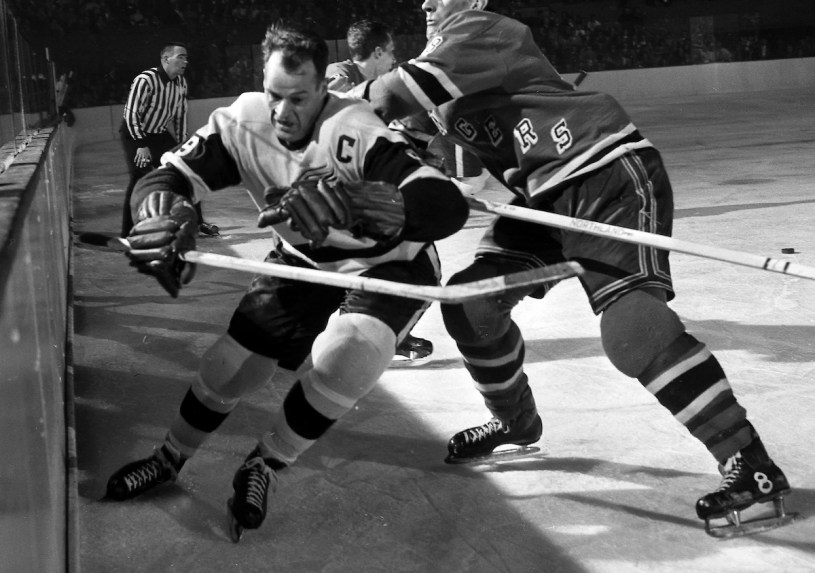
If the latter half of the 1950s belonged to the Montréal Canadiens, then the first half of the decade certainly was dominated by the Detroit Red Wings. This is why it is called Hockeytown, even the team didn’t win another Stanley Cup until 1997. The NHL Saturday entry today examines the 1955 season, and we bet no Wings fan alive then thought it would be another 42 years before their favorite team won it all again. Ouch.
1955 Hart: Ted Kennedy, C, Toronto (original); Gordie Howe, RW, Detroit (revised)
Despite finishing with just 5.3 Point Shares, Toronto Maple Leafs center Ted Kennedy was voted the Hart. This was a sentimental nod to an age-29 player who had won five Stanley Cups prior to this season. Looking back now, it’s a fucking joke—there is no other way to phrase it. With all respect to Kennedy, he didn’t even come close to deserving this nod, while the candidates below did. Mediots have to be better than this, always.
Four forwards finished in the NHL Top 10 for Point Shares, and three of them played for the Canadiens, the second-place team. The fourth, with 8.7 PS, played for the Red Wings, who finished first by just two points over Montréal. This would be right wing Gordie Howe, of course. Meanwhile, the Maple Leafs finished third, 23 points behind the Habs and still 18 points clear of missing the playoffs. Case closed; good riddance.
1955 Norris: Doug Harvey, Montréal (original, confirmed)
Three defensemen were in the NHL Top 10 for PS, and two of them were Red Wings—see how this works? The third was Canadiens star Doug Harvey (9.7 PS); since he was flying solo, we’re going to give him this nod and confirm his vote win. The winner of our hardware here in 1956 and 1957 was Detroit’s Red Kelly, and he once again posted the best PS mark (11.1) among blueliners. Yet he had help in Marcel Pronovost.
So, this is the elephant in the room: this is Harvey’s first win in our minds, because he’s had so much help over the years when he’d previously won this vote. Interestingly enough, this was his first chronological vote win, too, so we’ve stripped him of six other Norris trophies. Since his career started in the 1947-1948 season, we will see if there are more of these in his “future” here. Only time will tell, but we have faith …
1955 Vezina: Terry Sawchuk, Detroit (original, confirmed)
With the Red Wings winning the regular-season crown, Detroit goaltender Terry Sawchuk (15.4 PS) earned the Vezina based on the fewest goals allowed. There is only other contender to consider here: Toronto netminder Harry Lumley (16.2). But the standings matter, and again, without Lumley, the Leafs still make the postseason, but without Sawchuk, the Red Wings do not win the league. It’s that simple; we confirm it.
This is Sawchuk’s second nod from us (the other being in 1958). He won four Vezinas in his career, so we’re behind the ball on his “legend” as well. Again, these things usually even themselves out … most of the time.
1955 Calder: Ed Litzenberger, RW, Montréal and Chicago (original); Jacques Plante, G, Montréal (revised)
This is an interesting situation, as RW Ed Litzenberger won the Calder vote after switching teams midseason. Some reports suggest the Canadiens “donated” him to the Black Hawks, who finished with just 13 wins, to keep the Chicago franchise floating. Either way, Litzenberger (5.8 PS) finished five full Point Shares behind Montréal rookie goalie Jacques Plante (10.8), and that’s where this Calder rightfully belongs.
Plante posted a 33-12-7 mark for the second-place team, while Litzenberger managed just 51 points combined and didn’t play a lot of defense from his wing spot. It is clear that the Habs did fine without their rookie wing, while the Black Hawks still stunk, either way. Litzenberger did go on to play for four straight Cup champions in 1961–1964, the first one with Chicago. He ended up doing just fine for himself, obvi.
1955 Conn Smythe: Howe
Detroit won the Cup after sweeping Toronto in the semifinals and escaping Montréal in the Finals, needing seven games to do so. It’s pretty clear that Howe deserves this Conn Smythe for leading all skaters in goals (nine) and points (20). He also placed second to a teammate in assists with 11, coming up one short of a clean sweep of those categories. Throw in 24 PIMs, and Howe did it all—including the game winner in Game 7.
In our worldview, this is Howe’s second Conn Smythe, after the one we awarded him in 1964.
 Daily McPlay: (mostly) Historical Sports Analysis with TENACITY & VERVE