
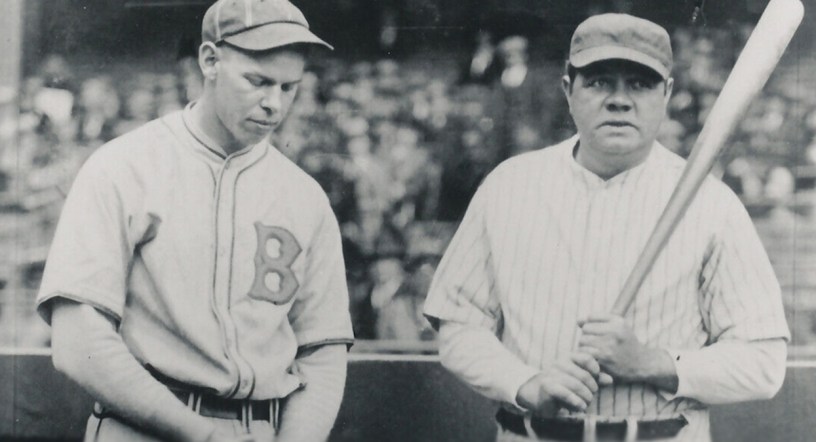
It’s MLB time on Friday Funday, as we take on another player who is in the all-time .300-plus hitters club—but not in the Hall of Fame. These are fun pieces to write, since many of us were raised to believe hitting .300 or better was an automatic ticket to eternal greatness. Well, quite often it still is, yet not always, as in the case of Babe Herman, a first baseman and outfielder who played mostly in the 1920s and 1930s.
[Not George Herman Ruth, a.k.a. The Babe. Two totally different players, interestingly enough.]
Herman hit .324 in a 13-season career that spanned over 1,550 games with Brooklyn, Cincinnati, Chicago, and Pittsburgh in the National League as well as Detroit in the American League (briefly). He never made it to the World Series; he never was named to an All-Star team; and he never won any major awards. All he did was hit, really, compiling 42.9 oWAR in his career while posting a .915 OPS (141 OPS+) in the process.
Why so unsung? Well, never playing in the Series probably has something to do with that, toiling away on teams that weren’t good enough to capture the attention of those watching. He also hit “only” 181 home runs, even though he hit a career-best 35 dingers in 1930 during his age-27 season with the Brooklyn Robins. He didn’t steal a lot of bases, and he didn’t play great defense. So, he’s slipped by many that way.
But not us! That .324 career BA ranks 49th all time, and most of the hitters above him are in Cooperstown—with some interesting exceptions, even beyond Shoeless Joe Jackson. We will explore some of those exceptions here in this space in the months ahead, of course, but it’s not easy hitting .324 for a career. And with 509 combined doubles and triples, Herman certainly was capable of raking the ball any which way.
In five different seasons, he did garner MVP votes, which is notable. He was fifth in that 1930 season among NL MVP candidates as well. Yet he didn’t win a batting title in 1929, despite hitting .381, or in 1930, despite hitting .393 overall. He did top the NL in triples once (1932), and that helped him to a 12th-place MVP vote finish along with his 73 extra-base hits that year. Overall, he walked just 33 times less than he struck out.
So, he profiles as an outstanding hitter, but his career dWAR (minus-9.7) certainly didn’t help him gain additional respect. After playing first base in his first two seasons (1926-1927), he mostly was patrolling the corner outfield positions for the rest of his career. Perhaps he would have been a straight designated hitter in later decades if he had played 50 years later, of course. Either way, there’s enough here to keep him down.
In 12 years on the Hall of Fame ballot, he never earned more than 5.7 percent of the vote. In nostalgic contemporary terms, he was not able to compare to those in his era, despite that impressive OPS+ mark. And he only led his league in a major category once, without winning any awards. Throw in the mediocre defensive reputation, and perhaps it all adds up as to why he is not in Cooperstown. But why not now?
This is what the SABR biography states about him: “[He] is often recalled for zany baserunning, fielding lapses, and off-the-field malapropisms. There are some who contend these kept him out of the Hall of Fame. They seemingly overshadow a 13-year career which produced a lifetime batting average of .324 and an impressive number of Dodger franchise season records still in effect.” Did the Veterans Committee miss?
Possibly. And maybe he just didn’t play at a high enough level for a long enough time; this seems to be the case in our perspective. He only had nine full seasons of play, and his final four seasons in the majors totaled just 291 games combined. It also should be noted that after being active for just 17 games total in 1937 with the Tigers, he came back at age 42 in 1945 to play 37 more games for Brooklyn during World War II.
So, effectively enough, his career was done after his 1936 season with the Reds, when he still posted a quality .806 OPS in 119 games. We are inclined to trust the SABR conclusions here about Herman’s eccentricities as to why he was never inducted into Cooperstown, even in the later years through the back doors available to old-time players—despite two of his top four comparatives being in the Hall already.
Yet … his adjusted OPS+ mark ranks 77th all time in MLB history; that should be good enough for the Hall.
 Daily McPlay: (mostly) Historical Sports Analysis with TENACITY & VERVE