
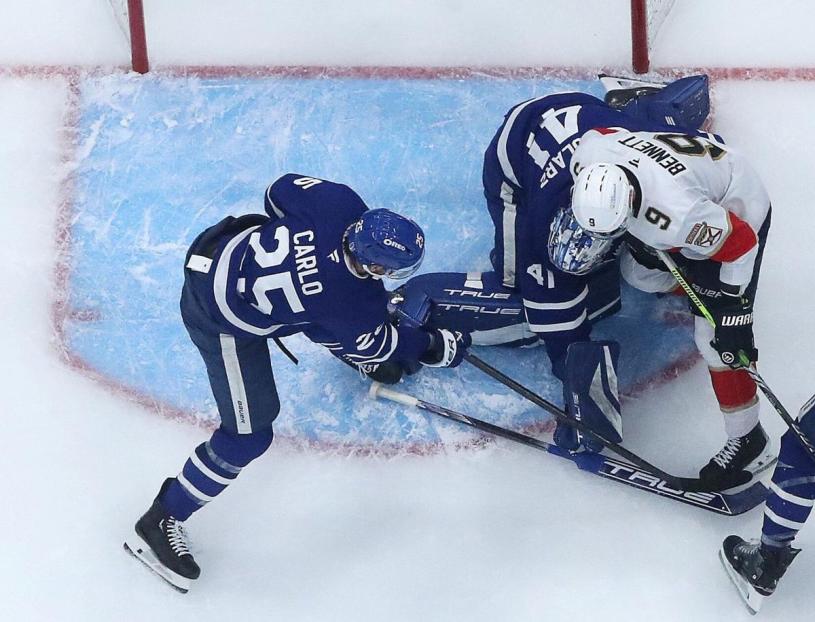
We’re not taking on a new subject here at all on the Wednesday Wizengamot: this idea has been floating around for a very long time. Yet nothing has been done about it, and we feel the time has come yesterday to act. It came up freshly again as we did our usual Stanley Cup playoff predictions earlier this week, and here’s the deal: when any player injures another on a cheap shot/flagrant foul, etc., the price should be high.
When we say “high” we mean the offending player should be suspended for as long as injured player is out. Yes, we’re looking at you right now, Sam Bennett. But this is not something new, and in an era when players are being paid very high sums of money, there also needs to be some accountability for reckless action. We’re not saying this kind of reckless action happens often, but it does occur just enough to matter.
The idea for this form of punishment first came to our attention a long time ago: almost 30 years ago, in fact, when Claude Lemieux hit Kris Draper in the 1996 Stanley Cup playoffs. Then, there was the Todd Bertuzzi–Steve Moore incident, which was undeniably much worse. And yes, these are extreme examples, and that is when extreme measures should be taken to prevent this kind of action in competition, period.
But it’s not just about hockey: cheap shots and flagrant attempts to injure other players happen in baseball, basketball, and football, too. On the diamond, pitchers often throw at hitters; on the hardwood, intentional flagrant fouls happen too much; and on the gridiron, we see countless hits that push the boundaries of legality. The bottom line is that if your action injures another, you’re out, too … for a long time. It’s only fair.
A foul or penalty does not even need to be called in the moment, although that would make the process much cleaner: the offending player get suspended for as long as it takes the victim of their violence to heal. There should be no question about this in any civilized sporting action: baseball, basketball, football, or hockey. Commit the crime, and you do the time—for as long as your victim needs to heal and return.
The Bennett-Stolarz incident in the second round of the NHL playoffs is a mild example, although it still meets the criteria here: cheap shot, penalty called, injured player out, etc. Why is Bennett allowed to keep playing in the Stanley Cup playoffs? One would think hockey had learned its lessons two decades ago, but it has not, sadly. Bennett wasn’t even suspended for this hit, which is the ultimate insult to the sport and fans.
Shenanigans like this must stop, period, and only the leagues themselves have the power to make it so.
 Daily McPlay: (mostly) Historical Sports Analysis with TENACITY & VERVE