
The 2025 playoffs in North American professional basketball have been a wee bit intriguing, for many reasons. On NBA Tuesday today, we look at the Final Four, how we got here, and where we see it going from here on out over the next month (still). Three of the four remaining teams certainly are a surprise, although everything still fits within the parameters we outlined quite awhile ago in anticipating how it all would go.
Let’s begin with the Western Conference, where the two top sabermetric teams from the regular season have advanced to this point: the Oklahoma City Thunder and the Minnesota Timberwolves. We expected the Thunder to be here since they were so mathematically dominant, but the NBA did a good job of extending the Denver series to seven games in order to maximize TV revenue, considering global appeal.
But the overall series stats reveal just how much better OKC was than the Nuggets: the Thunder had the edges in Effective Field Goal Percentage (plus .037), Turnover Rate (plus-5.4), and Scoring Differential (plus-9.1). The latter is key, as the numbers suggested an 8.7-point differential on a neutral court. All in all, despite the matchup going seven games, OKC outperformed Denver just as expected. Same is true for Minnesota.
We already explained why the T’Wolves beating the Lakers should have been expected, although we predicted the Golden State Warriors would beat Minnesota based on the TV revenue edge and a minimal sabermetric disadvantage (much like the Warriors faced in the first round). However, you can never expect an injury to a star player (see below), and the Timberwolves doubled down on the sabermetrics to win easily.
Minnesota had a 1.5-point expectation of winning every game on a neutral court, but when Stephen Curry went down in the middle of Golden State’s Game 1 road win, the series took a sharp turn. Without their superlative offensive leader, the Warriors nosedived—and the sabermetrics won out in the end over TV ratings. Sometimes, the NBA just can’t manipulate such a one-sided math equation, even if it wants to do so.
So, that’s the West: look for OKC to capitalize on its 7.5-point edge over Minnesota and win the matchup to advance to the Finals, despite its small TV market. Since the league really can’t blow enough whistles to stifle an incredibly dominant team like the Thunder, however, the Eastern Conference—which is already upside down now due to key player injuries—will have to provide the television audience needed here.
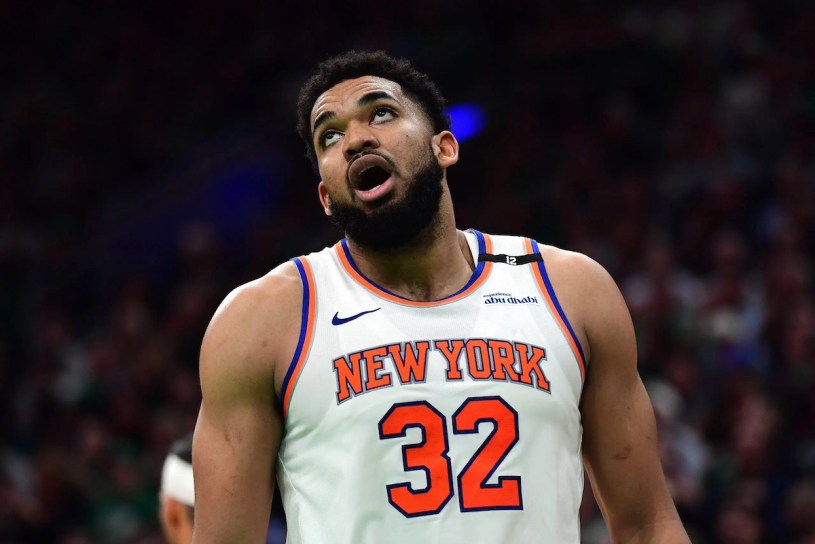
All along, we expected the Boston Celtics to return to the Finals, since the team had the combination of a great TV market and excellent sabermetrics. All that crashed in the second-round matchup against the New York Knicks, especially when the Celtics lost superstar Jayson Tatum to a major injury. Boston blew the first two games on its home court, somehow, despite a 4.7-point edge on the Knicks: bad shooting kills all.
When the Celtics won Game 3 in New York by 22 points, we did expect them to recover, based on the math, But then Tatum went down, and the NBA still had a viable TV product to advance. So, the Knicks lost Game 5 on the road but won Game 6 at home to advance. Meanwhile, the Cleveland Cavaliers had multiple injury issues, and suddenly the Eastern Conference’s two best sabermetric teams—by a mile—were over and done.
What do we make of a Knicks-Indiana Pacers matchup? Two things: first, New York was third sabermetrically in the East, while the Pacers were sixth; and second, the Knicks play in the top TV market in the nation, while Indianapolis is way down the list (No. 25). One team fits the bill here, if we accept the reality that OKC is too sabermetrically strong to “oust” in the West for a better TV-market organization.
And that’s New York. We assumed it would be Boston, but fate intervened. Stay tuned …
 Daily McPlay: (mostly) Historical Sports Analysis with TENACITY & VERVE