
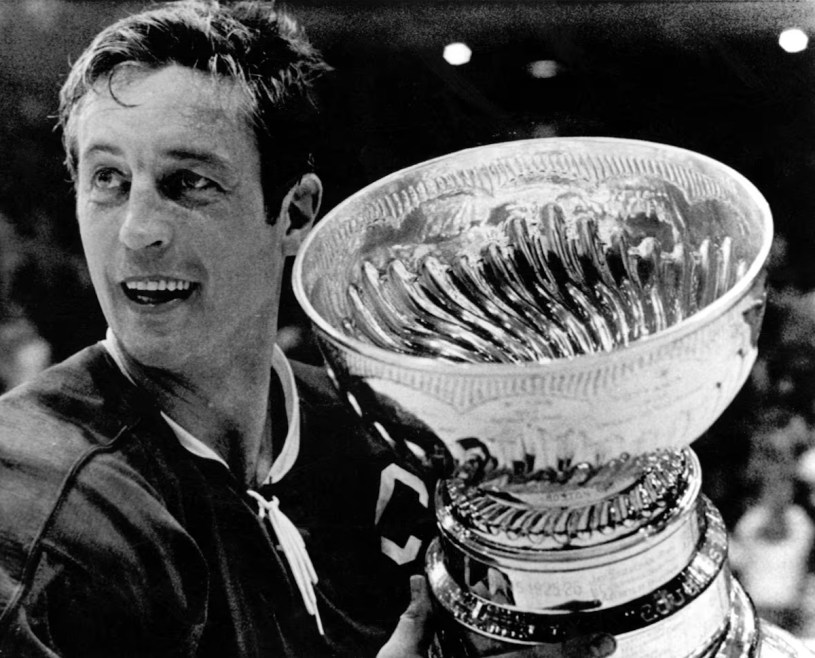
Our NHL Saturday entry today looks at the 1956 awards during the Original Six era, and it’s yet another season of the Montréal Canadiens winning yet another Stanley Cup. This is like our MLB miniseries from the 1949–1953 time period where all we had to work with was a lot of New York Yankees. During this regular season, the Habs finished 24 points clear of every other team in the standings, which is just incredible, eh?
1956 Hart: Jean Béliveau, C, Montréal (original); Tod Sloan, C, Toronto (revised)
Four forwards finished in the Point Shares Top 10, including two from the Canadiens: center Jean Béliveau (13.0) and right wing Maurice Richard (10.2). The other two candidates here are Detroit Red Wings RW Gordie Howe (11.3) and Toronto Maple Leafs C Tod Sloan (9.3). Béliveau won the vote, but Richard’s presence on the same line cancels them both out, and the Red Wings finished second in the standings. So …
The Maple Leafs finished fourth by just two points, though, as Sloan had more value than Howe. Without its star winger, Detroit still would have made the postseason since it finished 17 points clear of the fifth-place team. Meanwhile, without Sloan, maybe Toronto doesn’t make the playoffs. We think Howe’s performance was better, of course, but the Maples Leafs needed their top center here more so: “valuable”! This is fact.
1956 Norris: Doug Harvey, Montréal (original); Red Kelly, Detroit (revised)
The top two defensemen were Detroit’s Red Kelly (11.2 PS) and Montréal’s Doug Harvey (9.6), with the latter winning the vote. Four of the Defensive Point Shares earners in the Top 10 were Canadiens, including the top three (Harvey was third with 5.5 DPS). Meanwhile, the Red Wings held down spots four through seven, with Kelly (5.2) finishing fourth. And we know how the standings played out for the two teams.
So, we have to give this nod to Kelly (again), because he was better straight up despite playing on a lesser overall team with lesser support around him on the blue line. These are the waters for the Canadiens of this era, when they basically played on All-Star teams. That’s a disadvantage when it comes to establishing overall value and achievement.
1956 Vezina: Jacques Plante, Montréal (original); Glenn Hall, Detroit (revised)
Two goaltenders separated themselves here from the rest of the bunch, one from the Habs (Jacques Plante, 15.1 PS) and one from the Wings (Glenn Hall, 14.5). Without meaning to sound like a broken record, we know what the standings tell us, even though Plante won the award based on the decision-making process of the era. Hall clearly played with less in front of him, and his team needed him more as well. That’s value.
This is the eighth time we’ve given Hall this nod, and this pretty much seals the deal for him as the most “valuable” goaltender in NHL history. This also was Hall’s rookie season (see below), and he topped the league with 12 shutouts. That’s just nuts. For the record, this was Plante’s second full season in the the NHL. They were true rivals and all-time greats, to be sure.
1956 Calder: Hall (original, confirmed)
To show you how clueless the voters were at the time, Hall’s 14.5 PS as a rookie were almost 10 PS more than the next-best, first-year player (Henri Richard, C, MTL). Yet somehow, Richard got only four fewer first-place votes for the Calder. That’s ridiculous, especially when just about any Tom, Dick, or Harry could have suited up for the Habs at this point in time and looked “good” with all the support on that loaded roster.
1956 Conn Smythe: Béliveau
The Canadiens beat the New York Rangers in five games before dropping the Red Wings in five games to win the Cup. Detroit was going for a threepeat itself, so this was an impressive effort from Montréal—sound familiar? So, who does we give the Conn Smythe to? Well, it comes down to Béliveau (19 points in 10 games) or Plante (1.80 GAA, .923 S%, two shutouts), really. We’re going with Béliveau in this case, however.
Why? Well, the goalie’s GAA shows that he wasn’t facing a lot of shots, because that .923 S% isn’t insane; it’s just merely great. He faced just 233 shots in the playoffs, so that’s less than 24 per game—nowhere near a high volume of effort in net. Meanwhile, Béliveau notched 12 goals in the postseason to lead all skaters, of course, and he had just enough assists to present a somewhat, well-rounded display of spectacular skills.
Béliveau also won the Conn Smythe in 1965, which was the first official year it was presented.
 Daily McPlay: (mostly) Historical Sports Analysis with TENACITY & VERVE