
We don’t really care a lot about the playoffs on NBA Tuesday, although we occasionally do a piece or four on them every spring. They take way too long to complete—see your champ crowned in the middle of June!—and the league itself is pretty suspect in terms of massaging the outcomes for maximum TV revenue. This has been going on since the mid-1990s, if you haven’t been paying attention. It’s a pretty distinct pattern.
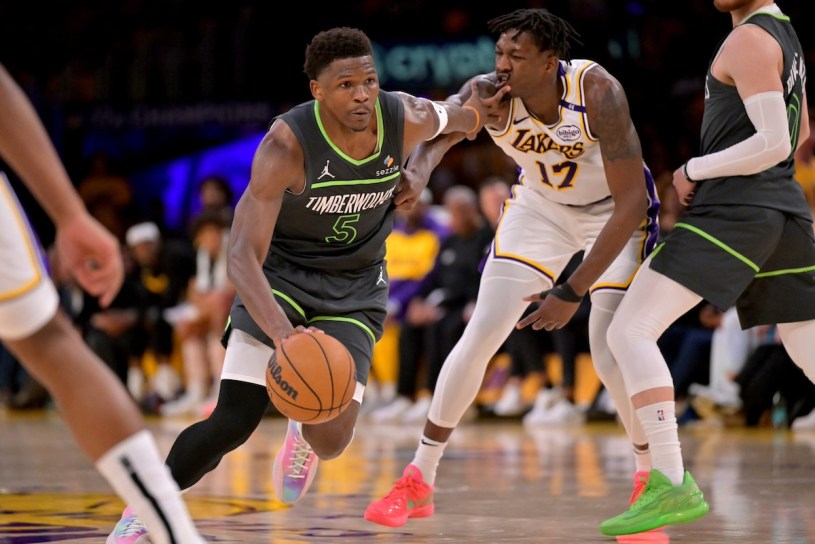
But we digress: today, we’re here to discuss the Minnesota Timberwolves, who play in the No. 16 TV market in the country. They just defeated the “favored” Los Angeles Lakers in the first round of the NBA postseason, and the T’Wolves did it in five games. This surprised too many people, just because L.A. was the third seed in the conference and Minnesota was the sixth. But in reality, the Timberwolves were way undervalued.
The Lakers won 50 games, while Minnesota won 49 games, so the seeding difference was circumstantial. Sabermetrically, the T’Wolves were the second-best team in the West this year, trailing only the Oklahoma City Thunder. On a neutral court, Minnesota should have been favored by about 3.7 points per game against Los Angeles, and that is usually enough to overcome home-court advantage for the team that has it, really.
And that’s what happened, in essence. Nothing to see here, folks, except the media hyping the Lakers due to the star power on their roster, of course—and the L.A. television market. Sabermetric gaps like that are hard for the league to overcome, even when there is TV market-size disparity. So, for example, even though OKC lost Game 1 of the second round at home to the Denver Nuggets, the Thunder still should roll overall.
Why? Because OKC (No. 47 TV market) has an 8.7-point advantage on a neutral court over the Nuggets (No. 17 TV market), and sometimes upsets happen in any circumstance. We wouldn’t count on it happening three more times in that series, unless the NBA really went out of its way to hurt OKC via managed officiating … and that would be too obvious to anyone watching. Oklahoma City is really that good this year, math-wise.
Another example: the Golden State Warriors (No. 7 seed, No. 10 TV market) just beat the Houston Rockets (No. 2 seed, No. 6 TV market) in a seven-game, first-round matchup. We knew this series was going seven games for the TV revenue, and Houston did win four more games than Golden State did during the regular season. But the sabermetric point differential between the two teams was just 1.4 points on a neutral court.
That is easy enough to overcome if the “favored” team has a bad shooting night or two, and that’s what happened as Houston dropped Games 1 and 7 at home thanks to varying shooting percentages. So be it: now, however, the Warriors have to face the Timberwolves without home court, and Minnesota is a 1.6-point favorite here on a neutral court. Can Golden State do it twice in a row? Sure, but the odds are low.
Except for that TV revenue bit.
We have to assume the math will bear out for OKC, and it will beat the Nuggets to advance to the Western Conference Finals. Then, who is the best matchup for the league in terms of TV revenue? Golden State, not Minnesota. It’s not that much of a difference, but the Warriors also have star power—like the Lakers did—yet less of a sabermetric disadvantage than L.A. did when facing the Timberwolves. The equation is clear.
Expect Golden State to win in six games over Minnesota, because the league won’t want to chance a Game 7 in that series and lose the best remaining TV market in the Western Conference too soon. The NBA also doesn’t want to dismiss the Denver market readily, either, especially with the international interest in Nuggets superstar Nikola Jokić. But as noted, an 8.7-point differential is hard to overcome, in math theory.
We’ve made the comments here before that we expect an OKC-Boston Finals matchup, and we’re not deviating from that, even if the Celtics lost Game 1 to the New York Knicks. Boston will win that series, since it has a 4.7-point neutral-court edge there, but why not milk the TV ratings on the East Coast, right? This is the NBA, after all, where 41 percent of league revenue comes from the national/int’l TV contracts.
Follow the money, people—the most important lesson of the twentieth century, by far … sadly.
 Daily McPlay: (mostly) Historical Sports Analysis with TENACITY & VERVE