
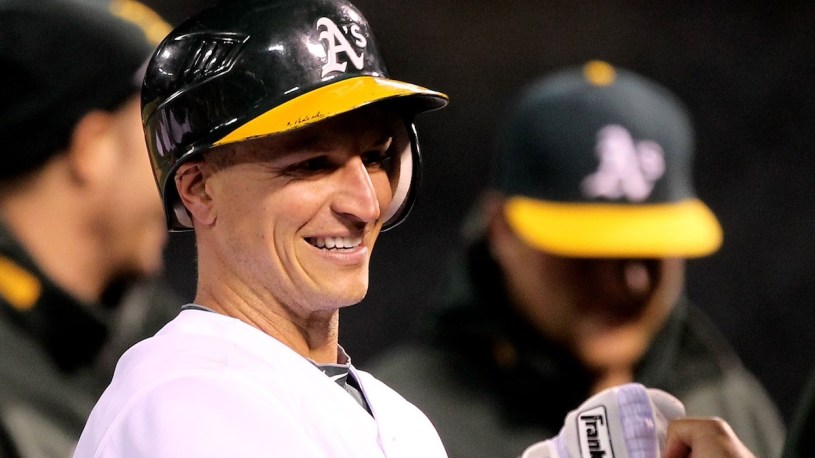
Our Wednesday Wizengamot this week focuses on someone somewhat random in MLB history: former second baseman Mark Ellis. He spent eight-plus seasons with the Oakland Athletics (2002-2003, 2005-2011) before bouncing around the National League for his last three-plus years in the Show. He was one of our favorite players early in his career, as he played the same position as we had when we were young(er).
Also, he was literally the same height (5’10”) and weight (180-190 lbs) as we were as adults. Thus, we had some entertaining times imagining what would have happened if we’d stuck with baseball past the middle-school level (Pony leagues): could we have made it to the majors the way he did? No regrets for us, as we did just fine in other sports, leading us to the U.S. Olympic Trials in 1992 and an Ironman triathlon career, too.
But we digress: the reason we’re here today is to clarify and discuss Ellis’ labrum injury which kept him out of the entire 2004 MLB season … and his “miraculous” comeback from the injury in 2005 that was the first-ever recovery of its kind. Understanding more about baseball now than we did then, with 20-plus years of hindsight, it’s clear to us now that Ellis clearly used some sort of PEDs in his restoration to the MLB level.
In fact, now it seems quite obvious; why we didn’t see it then comes down to ignorance and innocence.
Looking at San Francisco Giants “star” Buster Posey, for example, shows us just how a player recovers from an injury, comes back better than ever, seemingly, yet then never comes close to those numbers again. Toss in the fact that Ellis’ infield teammate with the A’s during his comeback era eventually succumbed himself to the dark side of the force, and it’s kind of a no brainer for us to see now. And it’s sad when we confront it.
In the two seasons before his injury, 2002 and 2003, Ellis was an age-25 rookie, which in itself suggests problems. However, he wasn’t a star by any stretch: he was a serviceable player who posted 2.7 WAR and 3.0 WAR in those first two seasons, respectively. In fact, his 2.1 dWAR in 2003 was seventh overall in MLB—although just third among second basemen. He was slightly above average at the plate, as well. Then, poof!
A 2004 preseason collision with a teammate damaged his shoulder, and he missed the entire season. When he came back in 2005, though, at age 28, he posted 4.7 WAR, a number he only surpassed one other time in his career (at age 30 in 2007, with 4.8 WAR). The splits for his 2005 WAR mark? A career-high 4.0 oWAR, along with a 1.1 dWAR. Considering he posted 0.7 dWAR in 2002, we can see the defensive number fairly.
But that oWAR mark? Was not in Ellis’ normal range, at all, for his career in Oakland: in his full seasons with the A’s, playing in the cavernous Coliseum, he posted anywhere from 0.9 oWAR to 3.5 oWAR in his other years there. The 4.0 oWAR coming off a career-threatening injury is just like Posey’s laughable 2012 campaign (and really, his ridiculous 2021 season, as well, after skipping the 2020 Covid year): not plausible.
Ellis hit a career-high .316 in 2005, the only year of his MLB career where he hit higher than .291, for example. His .861 OPS was the only year of his career where that number was higher than .777, as well. He set many career highs in 2005, numbers he didn’t come close to touching in the rest of his prime seasons (through age 32 in 2009) or when he spent 70 games playing for the Colorado Rockies in 2011, either. Hmm.
There is some irony, as we felt at the time (obliviously) that Ellis was a shoo-in winner for the Comeback Player of the Year Award, which instead went to known PED user Jason Giambi—who boosted his OPS by 255 points after an injury-riddled 2004 season. By this time, the BALCO scandal was full blown, and voters should never have been giving the award to a cheater like Giambi. Alas, Ellis wasn’t deserving, either.
We look at his first two seasons again, 2002 and 2003, and that’s who Ellis was as an MLB player: an elite defender, a passable hitter, and a great teammate by all accounts. His four best WAR seasons, however, came after the labrum surgery and recovery, the first of its kind in MLB history, and it’s pretty clear to us he was using PEDs in his return to the majors—and probably long afterward, too. These are tough truths for us.
No one likes their emotional opinions to be contradicted by hard data. Look at the world we live in today, for example: people choose willful ignorance in a reality-distortion zone created of their own cognitive dissonance … a refusal to accept common sense, ethics, facts, law, logic, math, morality, rationality, reason, and science in their thought processes on what constitutes the real world around them. We won’t do that.
Ellis was a cheater, sadly. That 4.7 WAR in 2005 came across 122 games, which is even more evidence of his decision making. In addition? He saw his $400K salary jump to $2.25M in 2006 via arbitration, so there was a financial payoff for him as well. If you’ve read our House That Steroids Built or Fenway Frauds miniseries, you know this is a pattern. Overall, Ellis went on to make over $40M in his career after 2004.
Maybe we’d all make that choice: career over or unfathomable wealth. For an average guy who was drafted in the ninth round of the 1999 Draft by the sad-sack Kansas City Royals, this MLB path has to be viewed as a minor miracle. He was a part of a very famous trade, too: the one that sent Johnny Damon to Oakland and spawned the Moneyball era for the A’s. Yet now, we see his story is a sham, and that makes us very sad, indeed.
 Daily McPlay: (mostly) Historical Sports Analysis with TENACITY & VERVE
There is one thing missing from your article…evidence. Why all these years later, with no proof, write an article to tear someone down. Shame.
LikeLike
Reading is fundamental ($1).
LikeLike