
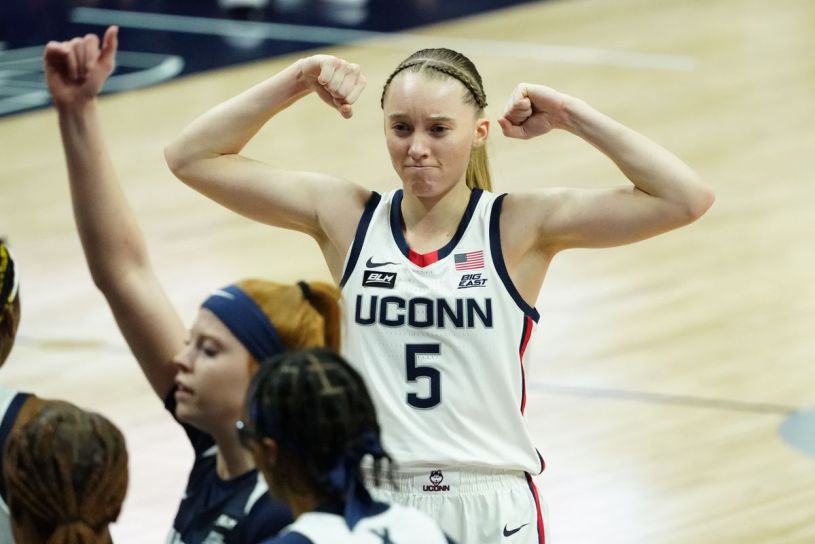
It’s been a few weeks since we posted a WNBA Tuesday piece, but with the league’s annual draft happening last night, we decided to compare and contrast last year’s overhyped No. 1 overall pick with this year’s underhyped No. 1 overall pick. So, it’s time to evaluate Caitlin Clark and Paige Bueckers, respectively, in terms of what they accomplished during their college careers. Sabermetric value is the key here, of course.
Sports mediots hype counting stats, because they’re superficial and easy to digest for the non-sports fan, but advanced analysis has moved well beyond those topical measurements in the last 15 years. Clark got all this hype for scoring a lot of points, but as we explored elsewhere, it’s just because she took a lot of shots. Scoring points is actually the most replaceable skill in the sport of basketball: anyone can score, really.
All you have to do is shoot a lot. But the game involves a lot of other skill sets: defense, passing, efficiency in shot selection, not turning the ball over whether by bad passing or shot selection, movement in conjunction with your teammates, etc. We could go on, but the fact is shooting and scoring are just a small piece of the overall pie, and that’s what sabermetrics do: measure your value to your team based on an entire set of skills.
Without further adieu, let’s look at Clark v. Bueckers across sabermetric categories based on college play, and keep in mind they both play the same position as well:
- Player Efficiency Rating: Clark, 38.97 (23rd all time since 2002); Bueckers, 36.58 (47th)
- We’re a little surprised by this, but mostly because Clark was such a turnover machine in her WNBA rookie season. Her college play was better, of course, because of matchups.
- Effective Field Goal Percentage: Bueckers, .5987 (89th since 1981); Clark, .560 (not in Top 250)
- This doesn’t surprise us when Clark shot just 46.2 percent from the floor as a collegiate player. Remember, her scoring was built on the number of shots she took … not the percentage made.
- True Shooting Percentage: Bueckers, .6278 (77th since 1981); Clark, .6078 (168th)
- Again, Clark’s brutal shot percentage(s) just drag her down here, since she’s not that accurate.
- Offensive Rating: Bueckers, 128.50 (14th since 2002); Clark, 117.89 (106th)
- Why is the all-time “scoring leader” so low in Offensive Rating? It’s pretty obvious that it was her bad shot selection, poor shooting percentage, and turnover rate hurting her overall game.
- Defensive Rating: Bueckers, 76.7 (just outside Top 250, which is 76.59, since 2002); Clark, 94.5 (N/A)
- Bueckers may not be a defensive whiz, but Clark’s number suggests she barely played defense. The sabermetric is based on the number of points allowed per 100 possessions; the higher the number, the worse the defensive value and the higher the defensive liability.
- Offensive Win Shares: Clark, 36.85 (2nd since 2002); Bueckers, 26.03 (22nd)
- This again represents usage/volume, but it also reflects teammate quality, and we know Bueckers played with better teammates, generally speaking, so she did “less” overall.
- Defensive Win Shares: Bueckers, 11.22 (116th since 2002); Clark, 4.4 (N/A)
- Self explanatory, really. No one should ever argue that Clark played good defense in college.
- Overall Win Shares: Clark, 41.23 (12th since 2002); Bueckers, 37.25 (21st)
- Clark’s usage rate and volume on offense carry her here, while Bueckers played balanced games.
- Win Shares Per 40 Minutes: Bueckers, .3784 (30th since 2002); Clark, .3413 (67th)
- Volume is contextualized here for actual minutes played, so we see Bueckers being much more valuable based on the fact she played fewer minutes while accruing her statistics, etc. Quality over quantity, really. Yes, Bueckers played on better teams, so she could “afford” to play less, of course.
- Offensive BPM: Clark, 13.49 (1st since 2002); Bueckers, 13.15 (2nd)
- These two players are the best in modern college basketball for offensive Box Plus/Minus, which calculates points contributed above average per 100 possessions. Impressive to see both here.
- Defensive BPM: Bueckers, 7.55 (18th since 2002); Clark, 3.3 (N/A)
- Once again, we see Bueckers as a great and possibly elite defender, while Clark … just mailed it in.
- Overall BPM: Bueckers, 20.70 (2nd since 2002); Clark, 16.81 (11th)
- Clark’s offensive volume keeps her in the conversation, despite obvious defensive shortcomings.
So, there you have it: Clark produced a lot of offense, mostly based on inefficient volume, while Bueckers was both a very good offensive player and an elite defender. Clark seems to have taken a lot of time off playing defense in college. The only thing that did surprise us, as noted, was the PER mark, as Clark’s WNBA game was very different due to the talent concentration in the league, compared to college ball.
[For example, Clark’s PER in her rookie WNBA season was 18.8, which ranked second on her own team and well outside the Top 10 of the league, where her better teammate Aliyah Boston was actually tenth (20.37). Clark will have a hard time coming anywhere near the all-time, career PER mark best of Cynthia Cooper (28.72). We expect Clark’s WNBA PER to rise, but at most to a career mark around the low 20s … in time.]
Thus, Bueckers has the edge here in most sabermetric measurements. But the shooting percentages and the WS/40 mark really show which player is the better one, even before you throw in the defensive realities. Bueckers was, hands down, a better overall college basketball player. Clark scored more, because she took more shots, but Bueckers was more efficient with her shot selection and a significantly better defender.
And last time we checked, this wasn’t football: players have to play both offense and defense on the court.
 Daily McPlay: (mostly) Historical Sports Analysis with TENACITY & VERVE