
Our NHL Saturday miniseries moves another year backward in the Original Six era, as 1960 saw the Montréal Canadiens win a fifth consecutive Stanley Cup. This is why the Chicago Black Hawks didn’t win any from 1938 to 1961, of course. And it’s why the Habs earned the equivalency of the New York Yankees in the MLB and the Boston Celtics in the NBA (or even the Green Bay Packers in the NFL). Dynasties unite!
1960 Hart: Gordie Howe, RW, Detroit (original); Bobby Hull, LW, Chicago (revised)
This is weird, as Detroit Red Wings right wing Gordie Howe (7.4) didn’t finish in the league-wide Top 10 Point Shares—but won the Hart vote, anyway. Five other forwards were in the Top 10, however, and three of them again played for the Canadiens, leaving us fewer options. In fact, it only leaves us with Chicago Black Hawks left wing Bobby Hull (9.2 PS) as the fifth guy’s team did not make the postseason. Seems clear, then?
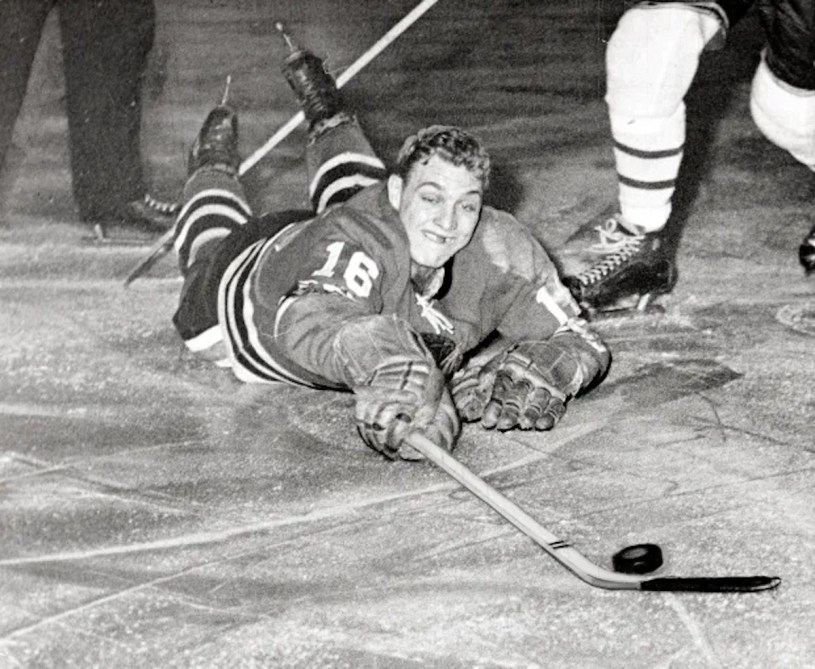
Chicago finished third, just two points ahead of Detroit—which in turn was just three points ahead of Boston. So we can see the value Howe brought; without him, the Wings don’t make the postseason, although the same can be said of Hill and the Black Hawks. And Hull was clearly superior to Howe, in terms of value. So all things being somewhat equal here, we will re-assign the Hart to Hull (39 goals, 81 points).
1960 Norris: Doug Harvey, Montréal (original); Pierre Pilote, Chicago (revised)
So Doug Harvey won seven Norris votes in an eight-year period (1955-1962), but we’ve already stripped him of the last two, chronologically. Will the Montréal blue-line legend keep this trophy? Well, unlike the 1961 and 1962 campaigns, he actually shows up on some Top 10 sabermetric lists this time! Shocker, we know. Harvey was No. 7 in DPS (4.6), as he posted 6.4 PS overall. But there was a defenseman in the overall Top 10.
Black Hawks star Pierre Pilote (8.3 PS) was the top blueliner in value, and he also topped Harvey in DPS (4.8). Chicago ended up 23 points behind Montréal, so the value edge is clear in a straight-forward sense as well as in a contextual nature. At times, it seems like we may be penalizing individual Canadiens due to their team dominance, but it’s just context and critical thinking, folks. You should be used to this by now.
1960 Vezina: Jacques Plante, Montréal (original); Glenn Hall, Chicago (revised)
Here we go again, as Canadiens goaltender Jacques Plante (14.0 PS) won the Vezina. All four playoff-bound starting netminders finished with at least 11.0 PS, too. Technically, Chicago G Glenn Hall (14.0) finished first in sabermetric value, which puts him above Plante in two ways. Meanwhile, Toronto’s Johnny Bower (12.4) was leapfrogged by Hall again, just like last season. Detroit’s Terry Sawchuk (11.0) was fourth.
There’s nothing else to be said here. Plante benefitted from much more roster support than Hall did, and yet … yeah. This is the fifth time in a row we’ve given this nod to Hall, and there was just one vote win for him there. He is turning out to be one of the most underrated players in the entirety of NHL history, no joke.
1960 Calder: Bill Hay, C, Chicago (original); Murray Oliver, C, Detroit (revised)
Three of the Top 5 vote getters here were on the Black Hawks: center Bill Hay (4.9 PS); RW Murray Balfour (2.8); and C Stan Mikita (1.4). Hay won the vote, but in retrospect, we can’t give it to any of these rookies—because they weren’t alone at all! The best of the bunched seemed to be Detroit C Murray Oliver (4.0), as his team finished lowest among playoff qualifiers, and his sabermetric value was second best. We re-assign.
And once again, just like in 1961, we have rejected all four vote winners. Will this be a pattern? We shall see.
1960 Conn Smythe: Plante
The Canadiens went 8-0 against Chicago and Toronto combined, and Plante got all eight victories to go along with a 1.35 GAA, a .950 S%, and three shutouts. He allowed just 11 goals in the eight games, and even if some skater had 20 points in those same eight games, they couldn’t wrestle this hardware away from Plante. For the record, three skaters notched between 10-12 points in the postseason—not enough, of course.
We gave Plante the same nod to close out the decade, too, back in 1969. Not a bad way to bookend, eh?
 Daily McPlay: (mostly) Historical Sports Analysis with TENACITY & VERVE