
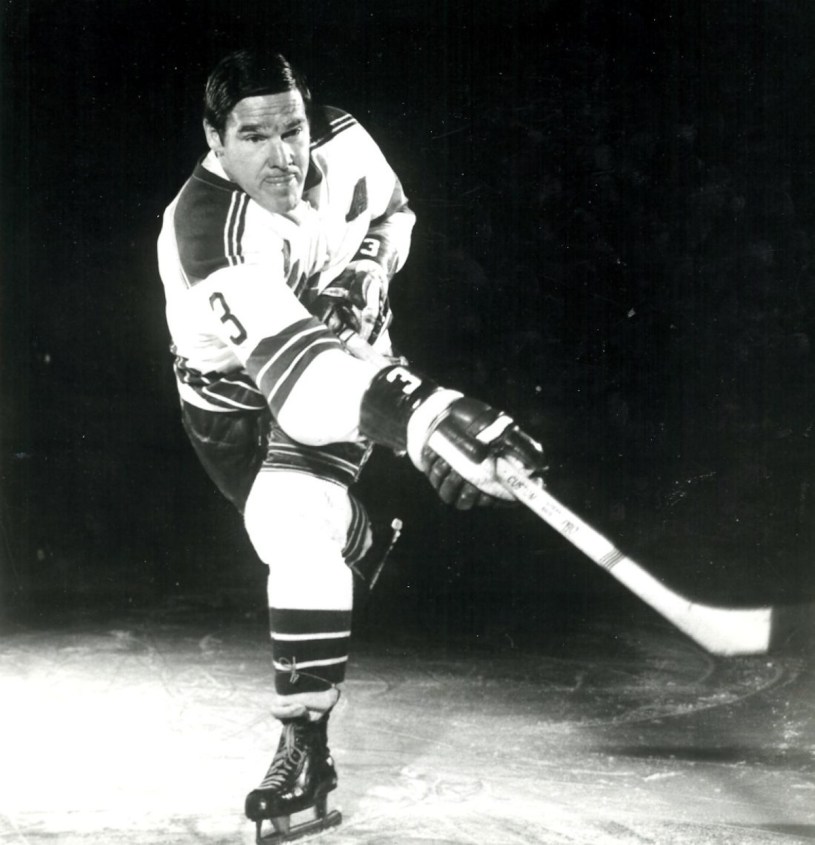
“Where were you in ’62?“, asks our NHL Saturday miniseries today. Well, we were not alive, that’s for sure, and our parents hadn’t even gotten married yet. That being said, it’s more of the Original Six era on this awards analyses journey, going back in time. The Toronto Maple Leafs somewhat dominated the decade under examination today, and it all started with this season’s Stanley Cup Playoffs. This is not a typo.
1962 Hart: Jacques Plante, G, Montréal (original); Andy Bathgate, RW, New York (revised)
Well, for the first time in our OG awards analyses, we have a goaltender winning the Hart vote. Of course, from the start, we have reserved this trophy for forwards, since the other positions have their own hardware already. So, who are our real contenders here? There were four forwards in the league-wide Top 10 for Point Shares, yet only three of them played for teams that made the postseason. That is an Original Six mandate.
Chicago Black Hawks left wing Bobby Hull (10.0), New York Rangers right wing Andy Bathgate (7.9), and Toronto Maple Leafs LW Frank Mahovlich (7.8) are the finalists in our view. With the Leafs finishing 10 points above Chicago in the standing, and the Black Hawks ending up 11 points ahead of the Rangers, we safely can eliminate Mahovlich, for two reasons: best team and lowest PS mark. So, now it’s down to two.
New York made the playoffs by just four points, meaning Bathgate made a difference. However, Hull’s double-digit threshold in PS matters, too, as does the fact he is so far ahead of Bathgate in that category. Considering this was also just a 70-game regular season, the double-digit PS mark is even more impressive. They tied for the league high in points (84), with Hull topping his peers in goals and Bathgate his in assists.
Those assists are huge, as clearly the Rangers needed every one of them to make the postseason, and Hull could have passed the puck a lot more. Yes, we have a subjective respect for those who pass the puck/rock, more so than for those who just shoot. We see Bathgate as the less-selfish player here, and the value is clear, too, despite Hull’s higher PS mark on a better team. Again, without Bathgate, New York doesn’t advance.
1962 Norris: Doug Harvey, New York (original); Tim Horton, Toronto (revised)
Rangers veteran blueliner Doug Harvey (6.2 PS) won the vote here, and we’re not sure why (yet?). He isn’t on any of the three key Top 10 lists for PS in this analysis, while two other defensemen are in the overall Top 10: Maple Leafs veteran Tim Horton (8.3) and Canadiens stalwar Jean-Guy Talbot (9.1). Harvey isn’t even in the Defensive Point Shares Top 10, while Talbot is No. 1 on that list—and Horton is No. 3 right behind.
Harvey also is not in the Top 10 for Offensive Point Shares, so we’re struggling here to see his value, although perhaps it lay in the Rangers’ finish. At age 37, Harvey joined New York after starring in Montréal for 14 seasons. Since New York improved 10 points from the year prior to make the postseason, we assume the media decided to give Harvey all that credit even though his play decline from the year before. Hmmm.
We get that kind of sentiment, but the numbers may not back it up here. Talbot seems to be the best defenseman, easily, but the Canadiens finished first by 13 points in the tables. The Maple Leafs also ended up way ahead of the Rangers, reducing values for both our top candidates. However, Harvey is so far off the radar of “excellent” play that we can’t really buy into this sentimentality. We compromise with Horton here.
1962 Vezina: Jacques Plante, G, Montréal (original); Glenn Hall, Chicago (revised)
The Vezina went to Canadiens star netminder Jacques Plante (15.8 PS), who topped his peers in value. But he played on the best team in the league, and every primary goaltender for every playoff team made it into double-digit PS value, too: Chicago’s Glenn Hall (13.8), Toronto’s Johnny Bower (12.1), and New York’s Gump Worsley (10.0). One might assume Montréal could have made the playoffs with anyone in the crease.
It’s hard to rationalize giving Worsley an edge on Plante here, but Hall’s PS mark is hard to ignore when his team finished third, way behind Toronto with Bower in net. That sort of juxtaposition is impressive, and it tells us just how valuable Hall was to his team. For that reason, we’re going with Hall here, who topped the league in shutouts (nine) and minutes played (every single one, actually). He was iron, and we applaud that.
For the record, this is third straight time we’ve given him our hardware here (1962-1964). Impressive.
1962 Calder: Bobby Rousseau, RW, Montréal (original, confirmed)
As far as we can tell, the rookie crop was mediocre this season, and Canadiens RW Bobby Rousseau (4.3 PS) was the best option on a team that made the postseason. He posted just 45 points, but he did top the league as a whole in short-handed goals (four). We’re sure he had a lot of support on that Montréal roster, but circumstances being what they are, we confirm the vote here. He later made three All-Star teams.
1962 Conn Smythe: Dick Duff, LW, Toronto
Toronto took home the Stanley Cup after beating New York in six games and then Chicago in six games. The offensive scoring was spread out among four or five key players—including Horton (16 points in 12 games) and Mahovlich (12 in 12)—while Bower went 6-3 in the postseason, splitting time with his backup. This really does seem to be a group effort, and it’s hard to pinpoint one skater since Bower didn’t dominate all.
But we’re going with LW Dick Duff, who finished with 13 points in 12 games, 20 PIMs, and a plus-6 rating. Overall, he was the best skater on a team that truly had a group effort in winning the Cup. Horton posted an odd minus-2 rating, for example, as did Mahovlich (to go with his 29 PIMs). We’re not thrilled with the options, but we think Duff is the best one. So be it. This was the Leafs’ first of four Cups in the 1960s.
 Daily McPlay: (mostly) Historical Sports Analysis with TENACITY & VERVE