
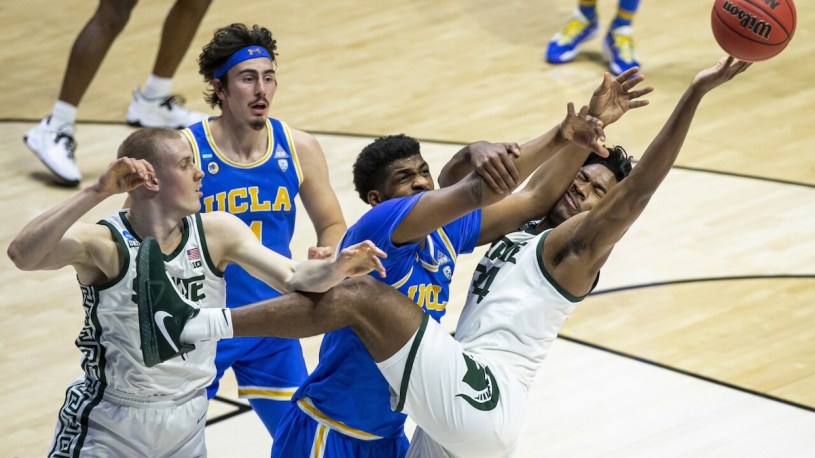
Of course, with March Madness underway, this Wednesday Wizengamot focuses on the NCAA Tournament to decide the men’s collegiate championship. We commented a few weeks ago about not needing to increase the number of teams participating, and now we weigh in on the most recent expansion: the First Four play-in games. While we find these games (mostly) entertaining, the issue is the seeds involved in the games.
Currently, the First Four consists of “two games contested between the four lowest-ranked teams in the field (usually the four lowest-ranked conference champions), and two games contested between the four lowest-seeded ‘at-large’ teams in the field, which determine the last four teams to qualify for the 64-team bracket that plays the first round.” And there in lies the issue, as all the 16 seeds should be decided here.
In the history of the 64-/68-team era of the NCAA Tournament, only two 16 seeds have ever won their first-round game against a No. 1 seed: in 2018 (Maryland-Baltimore County over Virginia) and in 2023 (Fairleigh Dickinson over Purdue). There had/have been some close calls in these games since the 1980s, where the games went down to the wire, but these were the only times it actually happened. Not that often, obviously.
The reality is that usually the play-in games from “the four lowest-seeded ‘at-large’ teams in the field” involve 11 or 12 seeds, depending. And those teams often upset the 5 or 6 seeds they face in the first round. In fact, those are “popular” upset picks for many a expert and mediot every year—not to mention fans. But basically, no one but the alums of the 16 seeds pick those teams to win in the first round. See the point?
All four play-in games should be for the eight lowest-ranked conference champions, which basically means bumping the 15 seeds down to 16 seeds and squeezing in those extra 11 or 12 seeds to the first round proper. While not as rare as the singular 16 seed win, only a handful of 15 seeds have ever won games in the opening round against 2 seeds: it’s happened just 11 times since 1985, when the tournament expanded to 64 teams.
So, basically, it happens about once every four years, although the first time was not until 1991. And it’s happened to some big-name programs, too: Syracuse (1991); Arizona (twice, in 1993 and 2023); Duke (2012); Michigan State (2016); Ohio State (2021); and Kentucky (2022). Yet, imagine if the 15 seeds were 16 seeds instead and played an extra game in the First Four before facing the No. 1 seeds in the first round. Effect?
Well, we might get more 16 seeds winning, and we’d definitely get more 15 seeds winning, as well. So, it’s more chaos for everyone, and you generally have the teams that really shouldn’t be in the tournament in the first place (you know, the teams with losing records that pull off upsets in their conference’s postseason championships) as the teams that would be losing the First Four matchups, anyway. No one really loses here.
Right now, the losing teams from the last four at-large teams are the ones suffering the most. Remember, we’ve had some teams emerge from play-in games to make the Final Four as well: Virginia Commonwealth (2011) and UCLA (2021). Others to escape the First Four to reach at least the Sweet 16? La Salle (2013); Tennessee (2014); and Syracuse (2018). Those are great stories, so these five teams deserved better, right?
Maybe the First Four served as motivation for them; maybe they could have gone deeper if they hadn’t been so tired. The extra game and surrounding travel surely takes its toll. That 2021 Bruins team almost made it to the Championship Final, in fact. What if UCLA had received a “normal” seed? Maybe it would have upset Gonzaga in the Final Four and reached the title tilt. The issue here of fairness and realism is truly at stake.
The teams that lose the First Four games among the last four at-large schools invited are the ones who also see their potential slashed. Think about Michigan State in 2021, as it lost to those above Bruins in overtime. If the Spartans were good enough to take UCLA to overtime, and then the Bruins were almost good enough to make it to the title game, what does that say about MSU? The Spartans deserved better, obviously, too.
This is no offense to the 15/16 seeds, but only one of them has ever reached the Elite Eight (2022). Simple math and probability tells us that it was an outlier if it’s only happened once since 1985. The fact that two First Four teams have reached the Final Four in the last 15 years makes it very clear that it is a more probable outcome. It’s time for the NCAA to fix this glaring issue, as it provides more opportunity for deserving teams.
[Editor’s Note: We originally overlooked the 2023 upset of No. 1 seed Purdue by No. 16 seed Fairleigh Dickinson. This error has been corrected, thanks to the reader comment below.]
 Daily McPlay: (mostly) Historical Sports Analysis with TENACITY & VERVE
I see you forgot about Purdue losing as a #1 to a 16-seed.
LikeLiked by 1 person
Yes, completely, although in our defense, we had major surgery early that month and might have been in a brain fog when it happened. But no excuses! Appreciate the correction, always.
LikeLike