
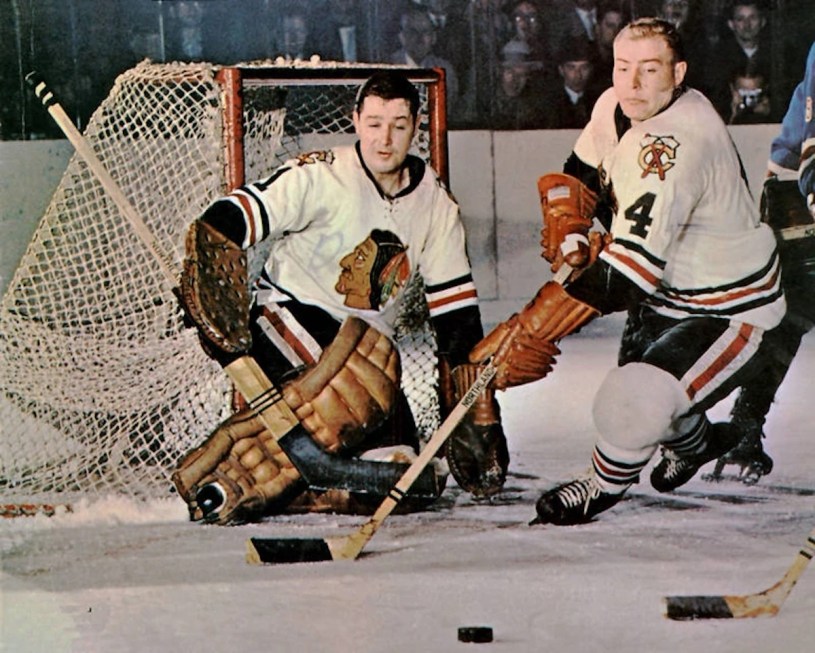
The second phase of our original NHL Saturday miniseries continues with the years of the Original Six Era. One of the challenges we find in a six-team league, when it comes to award analyses, is the stacking of rosters. Some of our established standards have had to be revised. And that’s okay, as adaptability is important, as is flexibility, when it comes to understanding context in statistics. We be wise that way.
1964 Hart: Jean Béliveau, C, Montréal (original, confirmed)
This is an interesting dilemma, as Montréal Canadiens center Jean Béliveau (8.7) won the Hart vote despite being fourth among forwards in Point Shares. The issue is the three skaters above him all played for the Chicago Black Hawks; yet the Habs finished first in the standings by a point, due to overall team effort (see below). It would be silly to choose one of the Chicago skaters over another, so we confirm the vote win here.
1964 Norris: Pierre Pilote, Chicago (original, confirmed)
Black Hawks veteran defenseman Pierre Pilote (9.6 PS) easily netted more value than any other blue liner, and he won the Norris vote for the second time in a row—and he would win it a third consecutive year as well. Pilote also finished with 5.0 Defensive Point Shares, just 0.1 behind the league leaders. With the Canadiens finishing atop the league, it’s clear his contributions were important all over the ice: confirmed.
1964 Vezina: Charlie Hodge, Montréal (original); Glenn Hall, Chicago (revised)
Montréal netminder Charlie Hodge (13.3 PS) won the Vezina designation via the team allowing the fewest goals. However, Chicago creasemaster Glenn Hall (13.5) topped the league in Point Shares. We know the standings; we know the talent levels. But the Black Hawks gave up just two more goals than the Habs did, and each team won 36 games. While Hodge led the league with eight shutouts, Hall topped everyone in wins.
He also earned seven shutouts himself, while posting a .930 save percentage, superior to Hodge’s .920 mark. Generally, it’s clear Hall was better, even if Hodge finished with a slightly better GAA (2.26 to 2.30). Hall was doing more with less; he also was identified at the time as first-team All NHL. We reassign this hardware to Hall, and this is the second time in three years we’ve done this. We may end up giving him more, too.
1964 Calder: Jacques Laperrière, D, Montréal (original, confirmed)
One of the reasons Hodge thrived so much was Calder vote winner Jacques Laperrière (6.7 PS), a rookie defenseman for the Canadiens. But fellow rookie blueline Terry Harper (5.6) was also a factor, as he topped the league in DPS (5.1). However, Laperrière was more balanced: 2.0 OPS, 4.7 DPS. Combined with his overall edge, we will confirm the vote without much more discussion. Oh, to be in Montréal, right? Indeed.
1964 Conn Smythe: Gordie Howe, RW, Detroit
It was an exciting postseason as all three playoff series went the distance, with the Toronto Maple Leafs beating the Detroit Red Wings in the Stanley Cup Finals. This was the final season without a Conn Smythe winner, so we’re on our own from here on out. The Leafs had one skater with 15 points in 14 games, and of course, the only Toronto goaltender posted just an 8-6 record, so no one was overwhelmingly dominating.
That leaves us with Red Wings right wing Gordie Howe: 19 points in 14 games to lead the postseason participants, while Detroit cycled through three different goalies in the playoffs. Howe also topped all skaters in the Stanley Cup with nine goals. Plus, he had more assists (10) than goals, which is always the sign of a guy who is making his teammates around him better. So, we give this nod to Howe, despite losing.
 Daily McPlay: (mostly) Historical Sports Analysis with TENACITY & VERVE