
This entry of the Wednesday Wizengamot focuses on the current NBA regular season, where the Oklahoma City Thunder and the Cleveland Cavaliers are dominating their respective conferences. With a 55-10 record, the Cavs have the top record in the East by a whopping eight games; likewise, in the West, OKC has a 53-12 mark, which is 11 games better than the next-best team. Yet, we can all but guarantee a different Finals combo.
Why?
Because the NBA has demonstrated over the years that the money is all that matters in the end. And the TV money is the keystone to it all: it’s all about market size, fan appeal both within and outside a team’s traditional fan base, and the draw of international players—and the TV dollars they bring to the table as well. Cleveland (19th) and Oklahoma City (47th) just do not rate high enough in market size to make it.
Neither franchise really has the social cachet, either, to warrant a matchup between the two. We suspect most NBA fans can’t really name more than one or two players on each team, respectively. And lastly, there are no true international stars of note on the two rosters, either. Despite the significant mathematical edges on the rest of the teams in each conference, we seriously doubt either team brings enough “stuff” to matter.
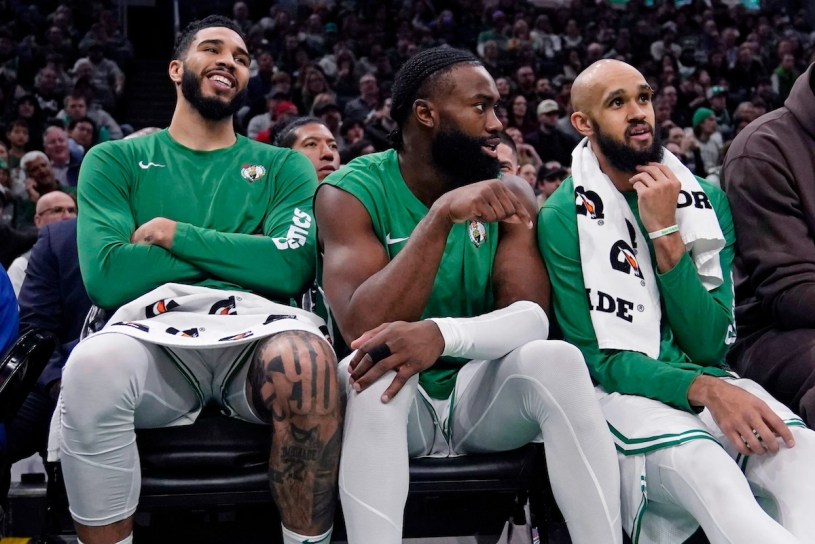
Cleveland’s sabermetric rating is two points higher than the Boston Celtics in the Eastern Conference, and the Celtics are the defending champions, playing in the 9th-largest TV market. And remember, they are the effing Celtics—with 18 total NBA titles and 16 postseason berths in the last 17 seasons—so they bring marquee value to the equation, as well. It doesn’t even matter if they have any international players, in truth.
OKC is in a stronger position among Western Conference contenders, with almost a seven-point edge on the Memphis Grizzlies, sabermetrically. The Denver Nuggets, the Houston Rockets, and the Minnesota Timberwolves are all around a point behind the Griz, when it comes to the math. Memphis is the 51st-ranked TV market, while Denver (17th), Houston (6th), and Minneapolis (16th) are higher. Interesting, eh?
The likelihood of OKC or Memphis in the Finals could be a TV revenue disaster for the NBA. The Grizzlies have a few Canadians on the roster, but that nation won’t be super interested. The Nuggets won the 2023 title, with international love, so they are a true threat here. Houston brings a lot of TV viewers to the equation, and the Timberwolves? They have some international interest, but not like Denver brings it.
The wildcards in the West are the Los Angeles Lakers (2nd-biggest TV market) and the Golden State Warriors (10th), with their big TV markets and their stars’ marquee value. Thus, we’d say one conference is more wide-open than the other, in terms of a Finals participant to face Boston—in all probability. Denver, Golden State, Houston, and L.A. would make our short list of teams to meet the Celtics for the league title.
If all this seems conspiracy oriented, we say check the data, the history, and the patterns of the league since the mid-1990s. See what you find, and then come back to show us we’re wrong. We’ve always argued that after Michael Jordan “retired” in 1993, the league moved to its current mindset of maximizing television revenues via contrived matchups in the NBA Finals, almost without fail: Watergate rules. Follow the money.
[Editor’s Note: We do think the NBA would be sneaky smart to match the Lakers and the Cavs in the Finals.]
 Daily McPlay: (mostly) Historical Sports Analysis with TENACITY & VERVE