
Yes, for WNBA Tuesday, we should use the acronym “MRDF” or something, to represent the four major awards in women’s professional basketball: League MVP, Rookie of the Year, Defensive Player of the Year, and the Finals MVP. But no one would know what we were referencing (yet?). So, instead, we’ve gone with the traditional acronym for the entertainment world’s award dominance: Emmy, Grammy, Oscar, Tony.
With our awards analyses complete now, we can declare our own set of the greatest players in WNBA history, even though we demonstrated that some award winners took home hardware by default, really. Even so, a MRDF is a MRDF, right? Exactly. Thus, here is our list of women’s rock stars of the hardcourt, in order of when they first accomplished the feat:
- Lauren Jackson, F/C, Seattle: ROTY (2001), MVP (2003), DPOY (2003), Finals MVP (2004). She’s the OG of the MRDFs, for sure. She made seven All-Star teams in her 12-year career and set the bar high for all who came after her. Of course, she is in the basketball Hall of Fame. However, she was a victim of the mediots falling for hype in the ROTY vote; we have rectified that error with hindsight analysis.
- Tamika Catchings, F, Indiana: MVP (2002), ROTY (2002), DPOY (2006), Finals MVP (2012). She broke in with a huge bang, posting 9.0 Win Shares as a rookie, yet it took a long time for her to close the MRDF deal, thanks to the ineptitude of her teammates on the Fever. Still, here she is. Again, she is the gold standard for what an amazing player can do in their first year as a professional. Hall of Famer.
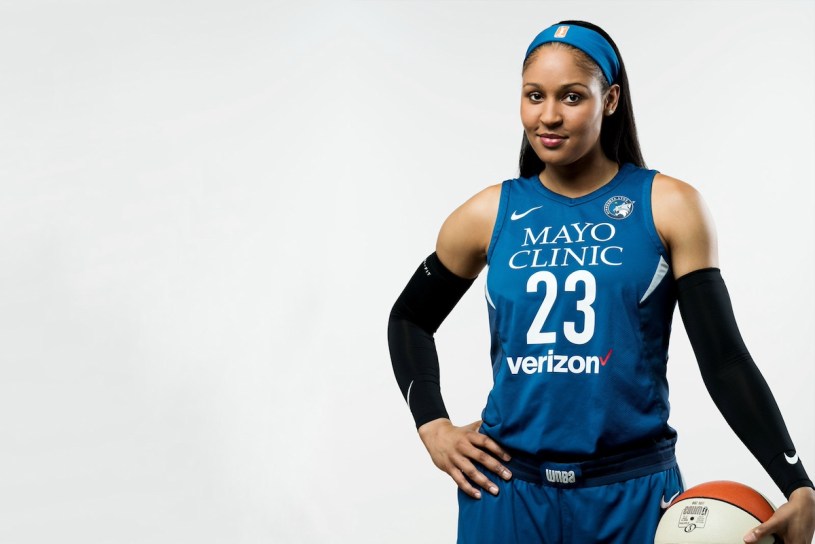
- Maya Moore, F, Minnesota: MVP (2014), ROTY (2011), DPOY (2015), Finals MVP (2013). Her career was brief (just eight seasons total), but like Jackson above, she gathered her MRDF credentials in a short span. She also has a great case for being the GOAT of women’s college ball, too, for anyone who has an ounce of critical-thinking skills. She stands out to us for firmly dominating both levels of play.
- Breanna Stewart, F, Seattle/New York: MVP (2020), ROTY (2016), DPOY (2016), Finals MVP (2018). She completed her MRDF while still with the Storm, although she now plays for the Liberty. Again, she blitzed through the awards in a short period of time, demonstrating her dominance. She even missed a full season to an Achilles injury (2019) and came back strong to clinch her spot here. Wow!
- A’ja Wilson, F, Las Vegas: MVP (2024), ROTY (2018), DPOY (2022), Finals MVP (2023). The latest member of the club, she’s been a dominant player since entering the league. She was able to close out her MRDF in our books last summer with her first MVP nod from us, although it was her third vote win. It’s just the way it goes sometimes, but quality wins out in the end, and all’s well in the universe.
A few notes: Candace Parker won all four awards from the voters, although we disagreed with her Finals MVP win. She clearly gets a mention here for that accomplishment, even if it falls “short” of our standards. Also, many of the early WNBA players had no chance to ever win the ROTY vote, so that is a caveat here we have to acknowledge for pioneer standour players like Sheryl Swoopes, Yolanda Griffith, and Lisa Leslie.
Other players came close to completing the MRDF, like Nneka Ogwumike who only failed to win DPOY, for example. Or Sylvia Fowles, who didn’t win the ROTY. But the list is short, as it should be, for the all-time WNBA greats in this corner of the interwebs. And interestingly, these are all frontcourt players, too, which could be a coincidence, but those players often have more impact on defense than the backcourt players.
Speaking of, no column here would be complete without us throwing more shade at sports mediots and their love for Caitlin Clark. Not only was she buried on the list of the most-valuable ROTY winners, she probably will never sniff this list. Maybe she wins an MVP and/or a Finals MVP someday, sycophantically via vote, but Clark will have to earn it here. And her defense as a rookie? Just 0.7 DWS, which is mediocre.
Her whole team was bad on defense, which is not surprising. But she’s not going to miraculously become a great defensive player in this league, so we’d be willing to bet $1 on the fact she will never be a MRDF elite in WNBA history. Moore is clearly the best modern-day women’s basketball player, when you combine her college dominance in real value-measured sabermetrics and WNBA accomplishments. Moore is the GOAT.
 Daily McPlay: (mostly) Historical Sports Analysis with TENACITY & VERVE