
We continue the second phase of our original NHL Saturday miniseries, now covering the Original Six Era. It’s different than our Expansion Era phase of the same sequence, of course (the one we started at first). But many of the names in these analyses are either really famous—or really obscure … depending on one’s knowledge of old-time hockey. But again, this is why we’re here: to illuminate the past in the sports’ world.
1965 Hart: Bobby Hull, LW, Chicago (original); Norm Ullman, C, Detroit (revised)
There were four forwards in the Point Shares Top 10: two Detroit Red Wings and two Chicago Black Hawks. Chicago left wing Bobby Hull (9.0) won the vote, but we think it should have gone to Detroit center Norm Ullman (10.2). Both teams reached the postseason, and Hull’s teammate in the Top 10 was a full Point Share better than Ullman’s teammate in the Top 10. Ullman finished second in the vote, so we’re good with this.
1965 Norris: Pierre Pilote, Chicago (original, confirmed)
Black Hawks blueliner Pierre Pilote (10.6 PS) finished with 3.2 more PS than any other defenseman, and he won the Norris vote. Only two defensive players finished in overall Top 10, and with Chicago finishing third in the standings, this is an easy award vote to confirm. This was the third Norris in a row that Pilote took home in a Hall of Fame career, so we will have to see if we agree with the prior votes as these weeks unfold.
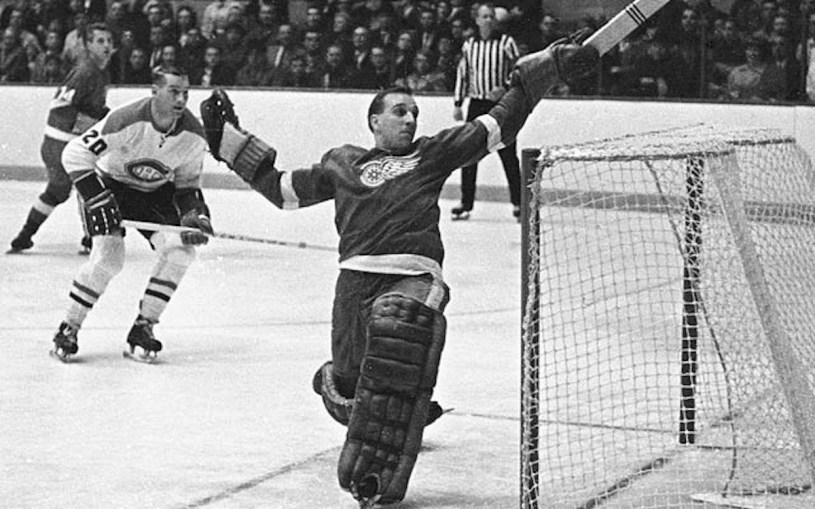
1965 Vezina: Johnny Bower & Terry Sawchuck, Toronto (original); Roger Crozier, Detroit (revised)
The Toronto Maple Leafs gave up the fewest goals in the NHL, so the goaltender tandem of Johnny Bower (7.2 PS) and Terry Sawchuck (7.0) won the Vezina. However, Red Wings backstop Roger Crozier posted 14.4 PS in an unreal season where he made 70 appearances (every game). His 2.42 GAA and .913 S% were good enough for a 40-22-7 record, and Detroit finished in first place. There’s no doubt here about this now.
1965 Calder: Crozier (original, confirmed)
After playing in just 15 games during the prior season (plus two starts in the 1964 playoffs), this was Crozier’s rookie year by NHL standards. This was his age-22 season, too, so he really was a young player. Remember, he won the Conn Smythe vote in 1966 as a member of the losing team, so he was quite an outstanding player. However, he’d never sail so high again after these two seasons. That is the sad part.
1965 Conn Smythe: Jean Béliveau, C, Montréal (original, confirmed)
After knocking out Toronto in six games, the Montréal Canadiens beat the Black Hawks in a seven-game Stanley Cup Final, with legendary C Jean Béliveau (16 points, 34 PIMs in 13 games) winning the Conn Smythe vote. He notched an NHL-best five power-play goals in the postseason while also leading his peers in game-winning goals (four). He was clearly the best skater on the winning roster. But what about goalies?
Gump Worsley was outstanding in net (1.68 GAA, .936 S%, two shutouts), but he only started eight of the 13 playoff games. That’s just not enough to warrant this award. We confirm Béliveau’s vote win, readily. Despite playing on 10 (!) Cup-winning squads, this was his only Conn Smythe—mostly because it was the first time it was awarded. We will be retroactively awarding it, obviously, so stay tuned to see what happens.
 Daily McPlay: (mostly) Historical Sports Analysis with TENACITY & VERVE