
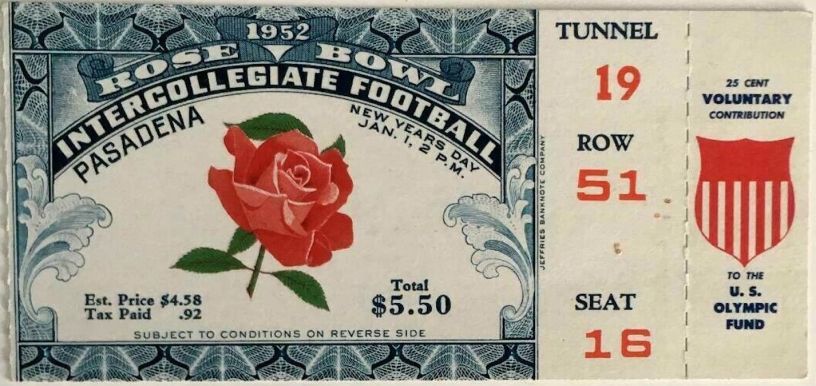
If it’s the end of the week, it must be Rose Bowl Friday time! We return to the miniseries that looks at the Granddaddy of Them All with another matchup between the future B1G and the future Pac-X. After the initial five-year agreement between the two conferences, the deal was extended as the Western Conference continued to dominate the college football landscape. Well, at least the Midwest schools did so, right? Right.
No. 4-ranked Illinois came into Pasadena with a shiny 8-0-1 record, although the Fighting Illini season certainly had its ebbs and flows. After winning six of its first seven games by a combined 170-76 margin, the other three games saw two wins and a tie by just a 10-0 combined margin. That is not a typo! The Illini certainly were hit or miss in 1951. Either way, the SRS was tops in the nation, and the SOS was No. 6, overall.
Impressive, for sure, and the opponent—No. 7-ranked Stanford—seemed a bit inferior in comparison. The Indians were 9-1 on the season, their only loss coming to California at home in the Big Game, the regular-season finale. That 20-7 loss dropped Stanford from No. 3 in the polls to No. 7, and the sabermetrics were even worse: No. 14 in the SRS and No. 15 for the SOS. This is why Illinois was favored in the Rose Bowl.
However, Stanford hung tough into the second half, clinging to a 7-6 lead in the third quarter. But then, the “real” Illini showed up, rattling off 34 unanswered points, including 27 in the fourth quarter alone. The star of the game was Illinois running back Bill Tate, who ran for 150 yards and two touchdowns. As a result, the Indians were thoroughly rocked by the end of the game, which experienced an attendance dip yet again.
This was the sixth-straight loss in Pasadena for the Pacific Coast Conference, and after the stadium had expanded to seat over 100,000 fans two years prior, this game saw a mere 96,000-plus fans show up. Illinois would not return to the Rose Bowl for another 12 years, while Stanford’s next trip was 19 years in the future. Thus this matchup was a rare one in Granddaddy terms, as other teams were more popular.
 Daily McPlay: (mostly) Historical Sports Analysis with TENACITY & VERVE