
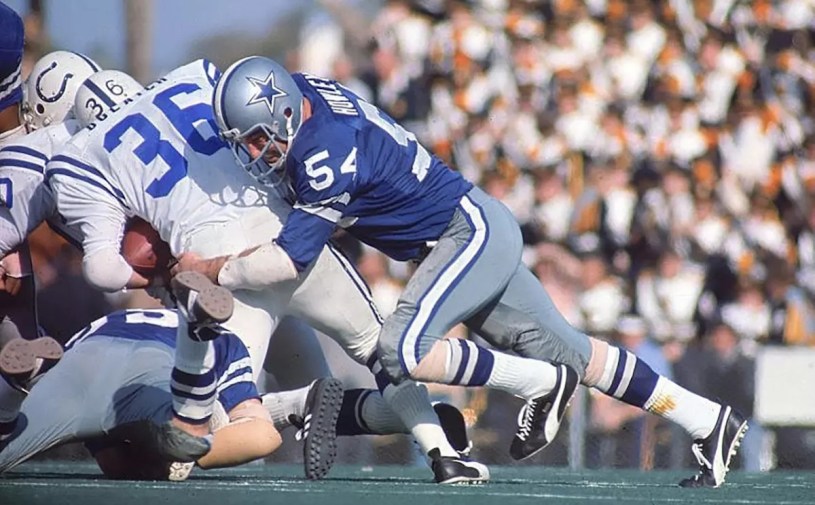
This week’s NFL Thursday entry reflects a little bit of burnout for us. Sometimes we have a plan in advance for what we will write; other times, we do not. Today, we are going to discuss a professional football in America anomaly: Chuck Howley, the only official Super Bowl MVP to be on the losing team. For the record, we did not verify this vote result in our own analysis, but Hogmeat remains in the historical record.
[Editor’s Note: We did choose two losing players for SB MVP in our revisionist miniseries on the matter. Buffalo Bills running back Thurman Thomas and Arizona Cardinals wide receiver Larry Fitzgerald have those honors in our alternate universe.]
In examining the historical record of Howley’s sporting life, one key theme stands out: perseverance. Athletics came easy to Howley, as he lettered in five sports at West Virginia University: football, gymnastics, swimming, track, and wrestling. But when he got to the NFL and played for the Chicago Bears under the legendary George Halas, Howley struggled in his second season (1959), thanks to a serious knee injury.
He took the entire 1960 season off and then made his comeback with the expansion Dallas Cowboys, playing for another Hall of Fame coach (Tom Landry). The rest, as they say, is history. For 12 seasons, Howley was a mainstay in the Dallas defense, intercepting 24 passes in those dozen years and recovering 17 fumbles as well. He made six Pro Bowls in a seven-season stretch from 1965 to 1971, missing out only in ’70.
Ironically, that is the season the Cowboys finally made it to the Super Bowl, only to lose in heartbreaking fashion after so many close playoff losses in the seasons before then. However, Howley was still named to the All-Pro team in 1970, so his Pro Bowl omission can be considered an error of judgment. He was first-team All Pro from 1966-1970 in five consecutive years. That represents an impressive level of dominance.
Another knee injury, late in the 1972 season, ended his career, as Howley played in just one game in his final season (1973). Oddly, he was not elected to the NFL Hall of Fame until 2023, despite being one of the most dominant defensive players of his era and having one of the cooler nicknames the sport has ever known. Imagine how much fun the modern mainstream sports media would have had with a nickname like that!
Beyond Super Bowl MVP trivia bits, Howley also was on the losing end of one of the most famous games in NFL history: the Ice Bowl. In sub-zero temperatures in Green Bay, Wisconsin, the Cowboys lost in the final seconds to the hometown Packers in the 1967 NFL Championship Game. On Green Bay’s winning TD, Howley just missed tackling Packers quarterback Bart Starr before he crossed the goal line. Heartbreaking.
Yet perseverance defined Howley and his team: the Cowboys ascended to the top of the NFL pyramid in 1971, beating the Miami Dolphins, 24-3, in Super Bowl VI. The mere three points scored against Howley and the Dallas defense in that game remain a Super Bowl record for defensive effort—another testament to the spirit of Howley that just would not be conquered, even after multiple defeats over several years: Hogmeat.
Howley was a big part of that Cowboys’ championship victory, recovering another fumble and intercepting another pass, and he is a member of the Dallas franchise Ring of Honor. Howley lives in Dallas and works in the horse-breeding industry as of just a few years ago. Yet there seem to be no books written about him. Howley has been relegated to the margin notes in the history of the Super Bowl, despite his Canton moment.
But we remember.
We watch the video clips on YouTube, and the game we see there is familiar—but Howley and Super Bowl V are from a different era of American football, and as a result, we may never see another Super Bowl MVP from the losing team again. After all, the Internet would explode, no doubt, since the fans themselves make up 20 percent of the voting totals these days for the award, and … well, you know the bandwagon goes. Yep.
Postscript: Some of this piece was recycled from a January 2018 historical blog entry written by the editors during their academic career in sports history (all permissions granted).
 Daily McPlay: (mostly) Historical Sports Analysis with TENACITY & VERVE