
Our original NHL Saturday miniseries started with the 1967-1968 season, the first of the Expansion Era. We chose that launching point for this column and its first sequence, because it seemed like a good idea at the time. A six-team league was too small to really do a legitimate, retrospective analysis—or so we felt at the time. Now? We think we should go back and cover the Original Six Era to be equal and fair. So here we go!
1967 Hart: Stan Mikita, C, Chicago (original); Bobby Hull, LW, Chicago (revised)
The Hart vote went to Chicago Black Hawks center Stan Mikita (10.2 PS), but the reality here is that the Top 4 skaters sabermetrically all came from the same roster! Mikita was third overall, but the teammates issue means we’re not going there. In fact, five of the Top 6 overall and seven of the Top 10 overall in PS were on Chicago’s roster. What the heck? This is the issue with having such a small league, really, so … adjust?
We may have to. Chicago finished 17 points ahead of the other five teams (Boston, Detroit, Montréal, New York, and Toronto). Its team was that good, but we have to find some middle ground. The Canadiens finished second, but they did not have a skater over 7.0 PS in a 70-game season, and we think the threshold here should be 7.0 PS, at least. The only skaters over 7.0 PS were six Black Hawks and one Rangers blue liner.
That means we’re stuck with the Chicago guys, we guess. This has to be the way it is going forward: new paradigms, new parameters. That being the case, left wing Bobby Hull (10.3 PS) gets our vote here instead of Mikita. He played in four fewer games and had a higher Point Shares mark. This is like splitting hairs, though, as we sometimes have to do. No arguments against Mikita fans at all, but we’re doing it our way.
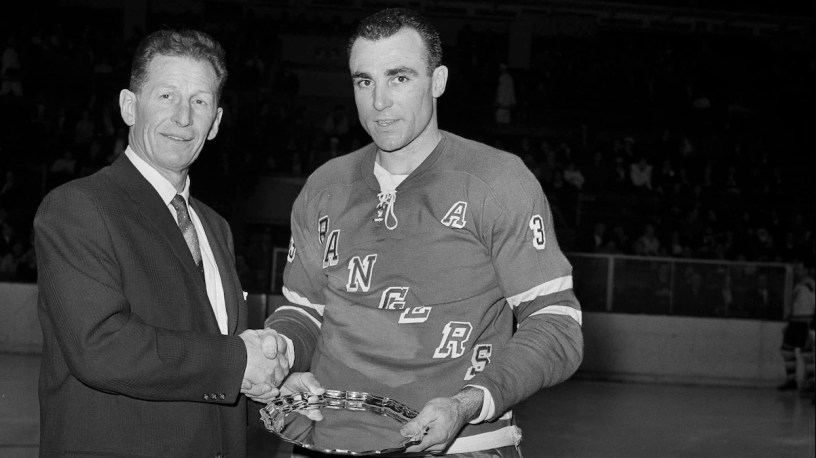
1967 Norris: Harry Howell, New York (original, confirmed)
The vote went to Rangers veteran star Harry Howell (8.2 PS), the only Norris win of his career. Interestingly, the Top 9 guys in defensive PS were from either Chicago or New York, too, so here we go again. Combining all dynamics, though, for defensemen, we’re looking at four finalists: three from Chicago and one from the Rangers—Howell. He was fourth in DWS (4.8), too, behind three Black Hawks. We confirm.
1967 Vezina: Denis DeJordy & Glenn Hall, Chicago (original); Ed Giacomin, New York (revised)
A reminder that the Vezina way back when (1947-1982) went to the team goaltender combination that led the league in fewest goals allowed—not necessarily the best sabermetric performances, as we focus on here. So, the Black Hawks’ tandem of Denis DeJordy (22-12-7, 2.46 GAA, .923 S%) and Glenn Hall (19-5-5, 2.38, .922) won the nod then, automatically. However, sabermetrically, things look a lot different in perspective.
In his second NHL season, New York goaltender Ed Giacomin (13.2 PS) lapped the field in helping the Rangers earn the final playoff berth. He finished 4.2 PS ahead of DeJordy, posting a 30-27-11 record while also putting up nine shutouts to top the NHL in that category. The Chicago duo combined had just six shutouts on a much better team. Let that sink in: without Giacomin, the Rangers don’t make the postseason.
Overall, this would be the fourth Vezina we’ve given to Giacomin (1968-1970), making him one of the most underrated goalies in league history. It’s good he’s in the Hall of Fame, and it’s great he did win a Vezina vote on his own once, too (1971), even though we didn’t agree with that one. This also was the first of five consecutive All-Star seasons for him, so his prime started here, and it shows in the sabermetric evaluation.
1967 Calder: Bobby Orr, D, Boston (original); Ed Van Impe, D, Chicago (revised)
Hockey legend Bobby Orr, the Boston Bruins defenseman, won the Calder vote, although his team finished dead last with just 44 points in the standings, 14 points behind the next-worst team (Detroit). Orr’s 6.0 PS mark was the best by a rookie, but Chicago rookie blue liner Ed Van Impe (5.8 PS) was almost as good. Sure, he had the benefit of a better team, but Orr’s impact made no difference this season for the Bruins at all.
This award isn’t about who would have the greater career; it’s about actual value in the rookie season itself. And a rookie on a last-place team has little value, even if he had a great season; it occurs in a void, basically. This, we give this nod to Van Impe. Because the Chicago roster was so loaded, he would be left off the expansion-protection list, and the Philadelphia Flyers grabbed him—and won two Stanley Cups with him.
Oddly, he may be best known for this hit in international competition. But we digress: this award is his.
1967 Conn Smythe: Dave Keon, C, Toronto (original); Jim Pappin, RW, Toronto (revised)
In the playoffs, the Toronto Maple Leafs upset the Black Hawks in the semifinals, before dispatching the Canadiens in the Stanley Cup Finals. The Leafs have not won a Cup since this season; the Conn Smythe vote went to C Dave Keon (8 points). We’re not sure why: while he led the team in regular-season PS, he was just the fifth-best scorer in the playoffs. The only category he led in the postseason was shorties (one). Strange.
Right wing Jim Pappin deserved this nod, with his playoff-best seven goals and 15 points. He also posted a Cup-best three power-play goals and a 15.9-percent shot rate. How voters could have overlooked this is really beyond our comprehension. The “maybe you had to be there” rationale just doesn’t hold up over time.
 Daily McPlay: (mostly) Historical Sports Analysis with TENACITY & VERVE