
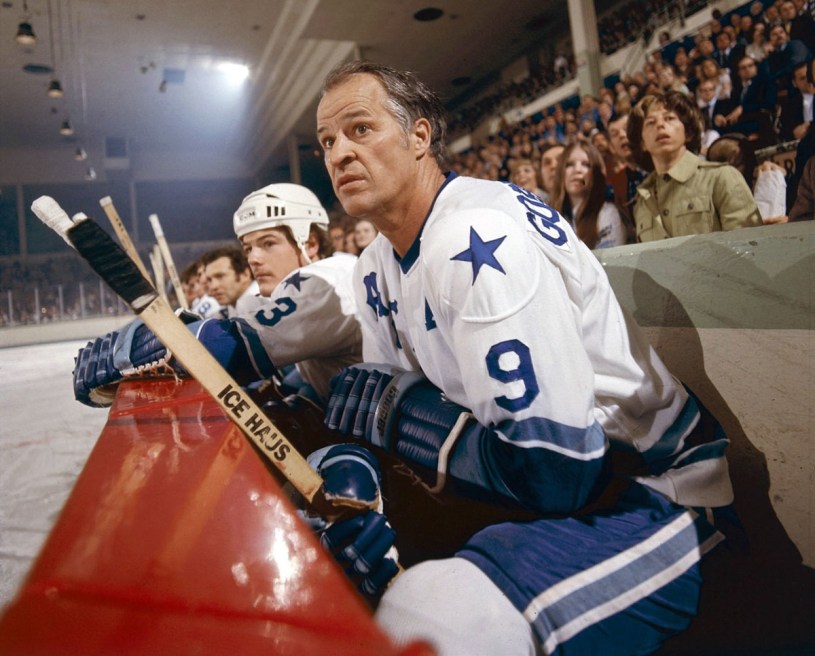
This is a fun exercise for an NHL Saturday piece: let’s compare the hockey statistics of the legendary Gordie Howe in his prime (NHL) against the statistics of Howe in his elder days (WHA). This may provide us with a lot of context for the numbers accrued by skaters and ‘tenders in the upstart 1970s league. We will focus on two statistics, since the WHA archives don’t really translate well to modern sabermetrics for a few reasons.
Our two numbers are Points per Game (PPG) and Goals Created per Game (GCG). In looking at Howe’s numbers in his NHL career, which spanned from 1946-1971 with an extra season at the end in 1979-1980, his marks are 1.047 PPG and 0.423 GCG. Those are Top 50 numbers all time in NHL play, a bit lower than we might expect for the guy who set all the counting-stat records, but we know how this goes with long careers.
Eventually, your level of play declines due to age, but that’s not the reality for Howe. In his final NHL season of his “early” stretch there, he was in his age-42 season and still posted 52 points in 63 games. That’s not too bad. However, in his true finale (1979-1980) at age 52 (!), he was much less effective with 41 points in 80 games. But there is a huge gap in that decade, right? His WHA marks, therefore? He posted 1.212 PPG there.
So, he was “better” from ages 45-50 over six seasons against theoretically “lesser” competition. In terms of GCG, his WHA mark (.471) shows us, again, a little bit better performance, sabermetrically, but we can again attribute this to the lower level of competition, as the WHA mostly featured players either too “old” for the NHL or not “good enough” for the NHL. Howe’s talent level is unquestioned based on his NHL years.
He was able to thrive in the WHA, despite his advanced age, due to his skill set and the level of competition. This is just a singular case study, of course, and a brief one at that, but this does show that the WHA stats should be kept separate, really, from the NHL numbers for all players who participated in both leagues. That is no knock against the WHA lifers, of course: they were playing for money on the best ice they could.
The MLB decision to incorporate Negro League statistics into its archives is a social-justice decision, to compare, whereas the underlying issues with the WHA are very different. Yet the NFL has chosen to merge the AFL data with its own, in a way the NHL has not decided to do with the WHA. Perhaps the different decisions come down to the “merger” question: the AFL proved its worthiness by beating the NFL in Super Bowl III and Super Bowl IV, whereas there is not similar achievement by the WHA over the NHL, really.
Also, the mergers were different in constitution, as well, with the full AFL blending with the existing NFL, whereas the WHA merely offered up some expansion opportunities for the NHL without its full roster of existing teams being invited into the NHL. Either way, we respect all these above decisions, but it is interesting to note the differences in Howe’s sabermetric marks between his NHL and WHA play. It’s clear.
 Daily McPlay: (mostly) Historical Sports Analysis with TENACITY & VERVE