
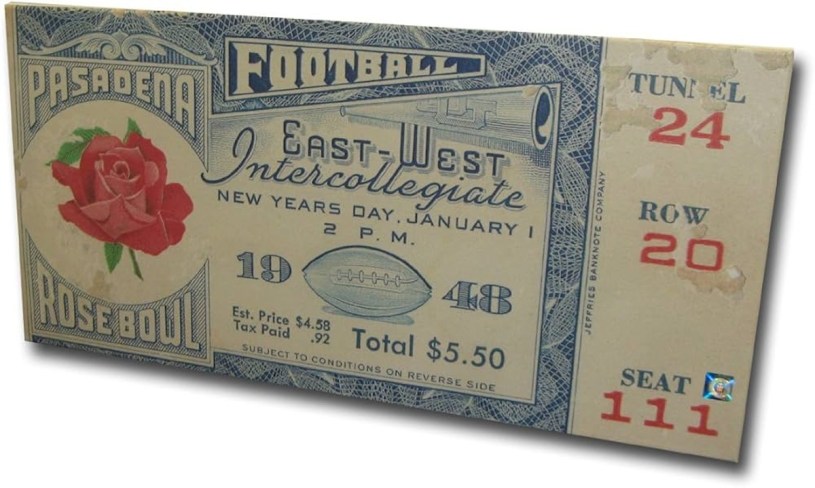
We are in the final Rose Bowl Friday miniseries stretch now, continuing through the 1955 regular season (and the 1956 Granddaddy of Them All). This was a controversial year in college football history, due to the Associated Press poll fiasco, although it didn’t end up changing anything in the grand scheme of the sport, sadly enough. But the Pasadena game result figured heavily into the problems of college football at the time.
The Michigan Wolverines came into the Rose Bowl as the No. 2 team in the country, while the No. 1 team was not playing in a bowl game (Notre Dame). In those days, the AP finalized its champion at the end of the regular season, but all year, the Wolverines and the Fighting Irish had gone back and forth in the top poll spot. Notre Dame started out No. 1 in the first poll, but twice each, the two teams usurped each other’s spot.
Thus, the Fighting Irish returned to the top spot in the polls at the end of the regular season after beating the USC Trojans on December 6 by a 38-7 score. The Wolverines had finished their schedule on November 22 against Ohio State and were ranked No. 1 after that. However, the Notre Dame dominance of USC had voters changing their minds, and to this day, the Irish remain the team of record for the AP poll champion.
However, the Wolverines were out to make a statement in the Granddaddy of Them All against the Trojans. Michigan came into the game 9-0 and ready to prove a point (or 49, as it were). USC showed up with a 7-1-1 record and the No. 3 ranking, its tie coming early in the season against Rice. On paper, it could have looked like a good matchup: Michigan was No. 1 in the SRS against the No. 16 SOS, against No. 6 SRS and No. 7 SOS.
In fact, the “home-field” advantage often enjoyed by the Pacific Coast teams should have been in play here. but somehow, Michigan was favored by 15 points—fueled by fervent fans, no doubt. And clearly that perspective was the right one, as the Wolverines had a unique focus, while the Trojans probably just mailed this in, not caring that much after their loss to the Irish four weeks earlier. The game was a famous blowout.
Michigan won, 49-0, prompting an unprecedented “re-vote” (unofficially) by AP pollsters, who then tried to give the Wolverines an MCN in hindsight (which did not happen, even if it was the correct idea). In truth, USC had been uneven all year, and its inconsistency should have been noted by the voters after that loss to the Irish, but the voters overreacted and overcompensated, and Michigan made them pay for it in shame.
To wit: the Trojans’ second game was the tie against Rice, and after that, USC went on a roll, winning its next five games by a combined 152-20 margin, including a 39-14 road victory against No. 4 California that vaulted the Trojans from No. 10 to No. 5 in the polls immediately. But then the team had a two-week layoff and barely beat No. 18 UCLA by a 6-0 score before another two-week layoff prior to the Notre Dame fiasco.
Interestingly, those five dominant wins in a row were all with one-week layoffs, so considering that USC played just three games from November 9 to January 1, it’s no surprise the Trojans lost their momentum, in retrospect. We see a lot of the same issues today with long layoffs between the end of a regular season and a bowl game often six or seven weeks later. Some teams just get rusty, for whatever reasons. It happened here.
The Wolverines scored three first-half touchdowns to take a 21-0 halftime lead, two times getting a one-yard TD run from Jack Weisenburger. He would add a third one yarder in the second half, as the Michigan offense piled it on, scoring four more times. Three different passers tossed TDs for the Wolverines, and overall, the game made a statement to the audience about many things, including the vapidity of the AP poll.
 Daily McPlay: (mostly) Historical Sports Analysis with TENACITY & VERVE