
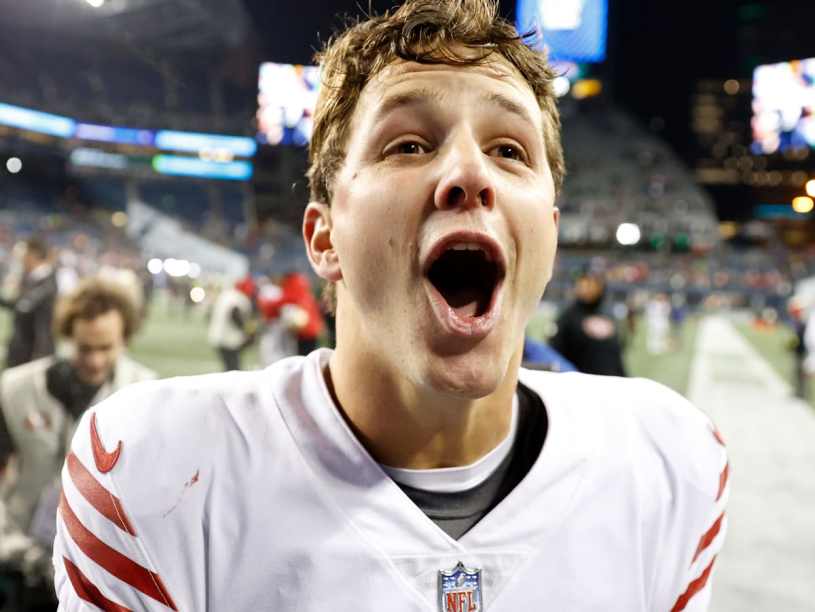
We’re born and raised in the San Francisco Bay Area, even though we’ve lived and worked in numerous other states over the decades. NFL Thursday today looks at a “local” issue: the San Francisco 49ers and their quarterback Brock Purdy. His rookie contract expires after this upcoming season, but the team needs to decide beforehand, in all likelihood, if they’re going to sign him to an extension—and for how much money.
The 49ers have had it easy because Purdy was a seventh-round draft pick who was never expected to play much, let alone start. But he’s put up a 27-15 record in two-plus years as a starter, and now the S.F. organization needs to decide what is best for the team long-term in the position. We will say right now that we like Purdy, having watched him play in the 2018 Alamo Bowl as a freshman for the Iowa State Cyclones.
Yet the NFL salary cap reality is that the more you spend on a quarterback, the less you have to spend on the rest of the team. Since 2019, too, the 49ers have been to four NFC Championship Games thanks to the efforts of many players—a lot of whom have gotten major salary increases in the last few offseasons. How much can the S.F. front office afford to give Purdy? And what should they give him if they decide to extend?
Maybe those questions should be reversed. Is Purdy the piece of the offense that makes it all go ’round? No. He is not a QB that wins games for you; he’s an excellent game manager, but the fact is that the better the team was around him, the better he looked. When the team struggled, so did Purdy. Reality? He was unable to elevate the level of play for those around him like the truly great quarterbacks do on a regular basis. Fact.
These decisions cannot be emotional ones for sports teams, for if they try to keep the “fan favorites” together too long by committing too much money long-term to aging players, then the team crumbles into a down cycle that can takes years to recover from, generally speaking. This where the 49ers are right now: can San Francisco afford to make a mistake with its QB plan right now? Absolutely not, so stay logical.
We’d argue that it’s running back Christian McCaffrey and the receiving corps that make the 49ers offense what it is: that is why the team didn’t miss a beat when Purdy stepped into the starting lineup in 2022, taking over for Jimmy Garoppolo, who in turn had taken over for Trey Lance (!). Sure, Purdy played “better” than those two guys did, but he wasn’t that much better than Garoppolo, in truth. So … dilemma.
McCaffrey is what makes the S.F. offense a threat, since he is a multidimensional weapon out of the backfield. He played in just four games last year, and that’s the primary reason the 49ers went just 6-11 after reaching the Super Bowl the year before, barely losing to the Kansas City Chiefs. The team also was missing one of its starting wide receivers (Brandon Aiyuk), who held out for a raise last season before getting hurt.
Aiyuk missed 10 games; McCaffrey missed 13 games. Purdy missed two games. It’s pretty easy to see that the QB was unable to elevate the team in the absence of its stars around him. In fact, Purdy declined so much in 2024, statistically and sabermetrically, it’s pretty clear that he cannot function as the centerpiece of the offense on his own. Thus, the 49ers should not be paying him like he is the centerpiece of the team.
With everyone healthy in 2023 and the team rolling, Purdy led the NFL in touchdown percentage, QB rating, and ESPN’s QBR measurement, in addition to a few other sabermetric categories. With a lot of injuries all around him in 2024, too many of his numbers dropped to career-worst levels—most noticeably that TD percentage mark, his completion percentage, and the QB rating. The latter was still decent, but …
Now there is the reality that the team lost a bundle of close games it should not have lost: we have examined those blunders already via the coaching lens. Overall, the 49ers lost six games by a combined 25 points, and perhaps if four of those games go differently, San Francisco might have made the playoffs—and that would have put a lot of lipstick on the pig of a season the team actually had: a 1-7 record versus postseason teams.
We don’t put that all on Purdy, but we have to pin a lot of it on him. A few things in his statistical track record stand out, too. First, his interception percentage has remained relatively stable for all three years of his career, so that’s a positive—even though the percentage itself (2.5) would put him in the same ballpark as guys like Marcus Mariota and Mitch Trubisky. That’s not exactly elite company these days, is it?
Second, he has just two regular-season “comeback wins” under his belt in 36 starts. That means both his team has been very good at not being behind (see all the talent around him), but if/when they’ve fallen behind, he’s not exactly the QB who is bringing the team back. We know comparing him to Patrick Mahomes isn’t fair, but in Mahomes’ first three seasons as a starter? Six such victories on better teams.
The 49ers, therefore, cannot give Purdy a contract like Mahomes’ contract, even if the salary cap could let them. If the S.F. front office is smart, it will not sign Purdy to a cap-killing contract extension now; it will wait until the 2025 season is well underway before deciding what to do. If Purdy is playing better than his generic 2024 level, then the team can offer an appropriate extension or decide to franchise-tag him instead.
That latter idea may be the best idea, in truth, giving the 49ers more time to decide their long-term commitment to Purdy. But as it stands right now, the team should not extend him until it absolutely has to do so, and even then, they should probably use that franchise tag to buy more time to assess. By the end of the 2025 season, San Francisco will know what it has in both its head coach and its starting quarterback.
What if the 49ers miss the playoffs again in 2025? It might be time to rebuild, shed salary, and start all over again after the Kyle Shanahan Nepo-Baby Experiment ends. Will the team want to burden its new coach with the old coach’s QB contract extension? Probably not. Trades are less common in the NFL due to the salary cap rules (as compared to baseball, let’s say); the 49ers won’t want to release Purdy and eat money.
We’re not saying we have all the answers, but again, emotions cannot make this decision for the San Francisco franchise. In the end, it’s a business, as all sports are in North America. The 49ers need to make the best business decision here, and that includes the very real possibility that Purdy is not the player that makes this offense work; he, in fact, could be a very disposable piece of the puzzle and not worth the cash.
 Daily McPlay: (mostly) Historical Sports Analysis with TENACITY & VERVE