
As we did with Nick Saban previously, it’s time to tackle the myths surrounding American football coach Jim Harbaugh, who has coached at Stanford (2007-2010) and Michigan (2015-2023) at the college level, as well as in the NFL with San Francisco (2011-2014) and the Los Angeles Chargers (2024). Before we start, we label Harbaugh factually as a liar and a cheater, as the NCAA has confirmed in its assessment.
We stay honest and transparent here to provide context for what follows; any sports mediot outlet that does not do so is lying to its audience. Just as Donald Trump always will be a convicted felon, confirmed fraudsters like Barry Bonds, Tom Brady, and Harbaugh, et al, need to be labeled as such. Facts matter here; if you don’t like that? Please leave; don’t let your laptop laugh at you on the way out. Seriously.
Now, on with the show: Is Harbaugh overrated as a coach? Possibly. His success at Stanford was built on the back of a single recruit; his legacy with the 49ers was set up by the prior head coach and general manager; his achievements at Michigan are forever tainted by his NCAA scandals; and we’re too early in his Chargers tenure to know much yet, other than he did inherit a playoff-worthy roster in his first year. Time will tell.
Today, we take on the San Francisco years: Harbaugh spent four years coaching the 49ers, taking them to three consecutive NFC Championship games in his first three seasons, before losing control of the locker room in Year Four, sinking to a .500 level, and fleeing back to the college ranks at his alma mater. So, what to make of this situation? There was clear success, and there was clear disintegration of that success, as well.
Let’s start with what Harbaugh inherited with the 49ers: the 2010 S.F. team posted a 6-10 record, which based on sabermetrics, which should have been closer to a seven-win roster based on performance. The team was outscored by 41 points in a year where the 49ers fielded the No. 16-rated defense in terms of points allowed (out of 32 teams)—and the 24th-ranked offense, based on points scored. Not terrible, but …
The team wasn’t “good” either, of course. The defense was average, and starting quarterback Alex Smith—a former No. 1 overall pick in 2005—was injured, missing six games. Ironically, Smith should have won the Heisman in 2004, and he was backed up in 2010 with San Francisco by 2006 Heisman vote winner Troy Smith. Clearly, there was talent on the offense, which also included a trio of highly talented young players.
That 2010 offense featured running back Frank Gore (age 27), tight end Vernon Davis (26), and wide receiver Michael Crabtree (23). Toss in Smith (26), and it’s clear the 49ers had the talent in place—but the turnover on the offensive coaching staff was a big issue, as was the fact Head Coach Mike Singletary was a defensive guy. Singletary was fired with one game left in the season, perhaps unfairly, but it happened.
The 2010 team started out 0-5 and ended up losing four of its first eight games by a combined 11 points. This was a roster on the cusp of success that was just unlucky. Defensively, Pro Bowlers Justin Smith and Patrick Willis led the way, with guys like NaVorro Bowman also on the team. You may have heard of them? This was not a typical 6-10 team devoid of merit: it easily could have been a 10-win team, if luckier.
So, Harbaugh got a lot of credit for guiding the team to a 13-3 record in 2011, when the only truly notable addition to the roster was the troubled Aldon Smith (too many Smiths here to keep track of!). Alex Smith was healthy for just the second time in his seven-year career at that point, as well: that stabilized the offense with the pieces already in place, as noted above. Result? The team jumped to 11th in points scored.
The big boost did come on defense (ranked second), as Aldon Smith’s 14 sacks stood out. Does Harbaugh get credit for that? The team’s three regular-season losses came by a combined 15 points, and of course, they squeaked by New Orleans in the divisional playoff round before blowing the NFC title game at home against Eli Manning and the New York Giants—a game the 49ers never should have lost. So, why the hype?
Fame. Nothing else to be said: Harbaugh inherited a great roster; he didn’t personally draft Aldon Smith; and he still blew close games that the team never should have lost, including in the playoffs at home to a vastly inferior team. But he took all the credit for the “turnaround” when anyone can see he had very little to do with it all. This is the nature of the mainstream sports mediots: Harbaugh had a “reputation” … play it up.
Move on to 2012, when the 49ers “regressed” to an 11-4-1 record: the defense remained stout at No. 2 overall, while the offense stayed 11th in points scored. The 49ers won the NFC West again, but the seeds of failure were brewing by the end of the regular season: Alex Smith was injured, and while Colin Kaepernick came on to the scene with a flurry of highlight-reel plays, the Seattle Seahawks dismantled the 49ers in Week 16.
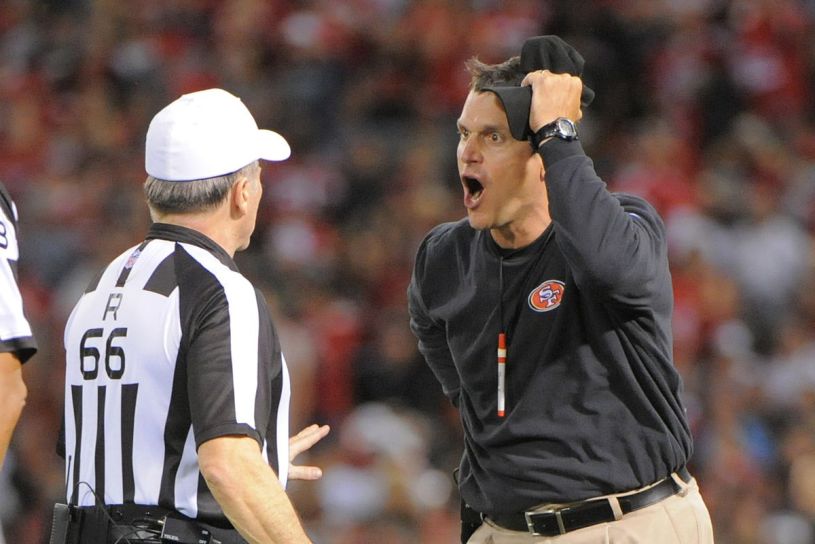
Harbaugh got a lot of credit for Kaepernick’s arrival, and we cannot gauge that, since Kaep was both a comet and a harbinger. The comet part? Got the 49ers to the Super Bowl; the harbinger element lost them the Super Bowl, when they could have won. Harbaugh can’t have it both ways, getting credit for Kaep’s successes and shirking ownership of his failures. Meanwhile, everyone mocked him for his sideline whines.
The truth is the 49ers were lucky to dodge a rematch in those 2012 NFC playoffs with the Seahawks, who would prove their superiority over Harbaugh during the next two seasons. Russell Wilson was a better QB than Kaepernick in almost all ways, and Pete Carroll was a better coach than Harbaugh, as well. Yet, if the 49ers had managed to win that Super Bowl against the Baltimore Ravens, this entire narrative is different.
Onto 2013: with a 12-4 record, the 49ers finished second in the NFC West to Seattle, based on the No. 11 offense (stagnant now, despite the handover to Kaepernick) and the No. 3 defense (slipping). San Francisco got blown out at Seattle in Week 2 before squeaking out a two-point win at home over the Seahawks in Week 14. Either way, the 49ers lost to Seattle in the NFC Championship Game in a classic, big-time battle.
That was basically the end of Harbaugh’s success in San Francisco. Missed opportunities defined his tenure with the 49ers, really: in games decided by one possession or less, Harbaugh went 21-11-1 from 2011-2014, but every playoff loss came by less than a TD. That’s coaching mismanagement right there when in crunch time. By 2014, the offense dropped to 25th in the league as the 49ers had traded Alex Smith to Kansas City.
The offense went downhill, basically, after the team switched to Kaepernick, and that comes down to coaching since we all know Kaep was a tremendous physical talent. The defense slipped to 10th in the league, too, by 2014, due to age, injuries, and Aldon Smith’s off-the-field troubles. Again, if we give credit to Harbaugh for Aldon Smith, then we have to assign blame to him, too. He doesn’t get it both ways, upsides.
In the end, we see Harbaugh inherited a good roster, barely made it any better, and eventually lost control of it after three straight playoff defeats that were all winnable games if they had been coached better. So, the myth of his S.F. 49ers’ success really is a double-edged sword. If we give him credit, we have to give him blame, too. And there’s a lot more blame to go around here than there is credit, based on the factual context.
We wonder if Kyle Williams hadn’t fumbled multiple punts in the 2011 playoffs if this could have been different; that certainly wasn’t Harbaugh’s fault, although perhaps he shouldn’t have sent Williams out there in overtime to field a punt after the first fumble. We also wonder (again) if Kaepernick hadn’t just tucked the ball under his arm and run the ball at the end of the Super Bowl if things would be different.
Toss in the Richard Sherman play in the 2013 playoffs, and if Crabtree catches that ball … the 49ers under Harbaugh came very close to playing in three straight Super Bowls, and that’s all the topical-memory folks remember. Breaking it down, we see a pattern of failure in key situations by players coached by Harbaugh. This comes down to how we allocate “credit” in sports for winning—and losing. Harbaugh can’t escape that.
 Daily McPlay: (mostly) Historical Sports Analysis with TENACITY & VERVE