
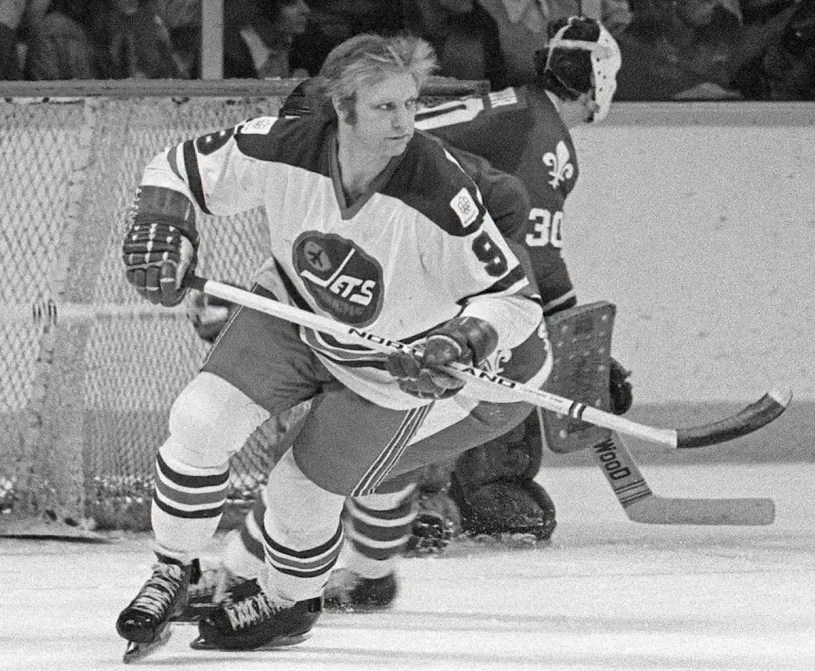
NHL Saturday continues its brief looksies into the WHA’s 1970s adventure, moving on now to the second season of the rogue hockey league that would gift us all the Great One eventually. The Houston Aeros won the championship, and that’s funny in itself. The other humorous item for this season is revealed below, but we don’t want to spoil that for you, even though you will come across it within 15 seconds of reading this.
1974 Gordie Howe Trophy: Gordie Howe, RW, Houston (original); Bobby Hull, LW, Winnipeg (revised)
Yes, at age 45, Detroit Red Wings legend Gordie Howe came out of retirement to play right wing for the Houston Aeros, and he won the award named after him by scoring 100 points. The Aeros finished with the best record in the league, clear of all other teams by 11 points in the standings. Naturally, the voters wanted to make this a significant piece of hardware for the Hall of Fame forward who re-wrote NHL record books.
However … did he really deserve it? We hate to be the spoilsport here, but Howe finished just fourth in goals created per game (0.51), and we have to consider the other top forwards in the league, too: Minnesota Fighting Saints center Mike Walton (0.60); Edmonton Oilers C Jim Harrison (0.55); and Winnipeg Jets left wing Bobby Hull (0.54). Hull won the vote last season; both Walton and Howe had teammates in the Top 10.
So, this comes dow to Harrison or Hull; both Edmonton and Winnipeg made the postseason by a lot, so that’s a wash, although the Oilers finished six points higher in the standings. The goals-created marks are virtually similar; so who do we give the edge to? Hull, as he played more 28 more games and scored 26 more points than Harrison did. That is a significant chunk of the season, and the Jets still finished lower in points.
1974 Dennis A. Murphy Trophy: Pat Stapleton, Chicago (original); Paul Shmyr, Cleveland (revised)
Chicago Cougars blueliner Pat Stapleton (58 points, 44 PIMs) won the vote here, as his team grabbed the final postseason spot in the East Division by one point over Quebec. It will be hard to top that, but we have to look at three other candidates: Cleveland Crusaders journeyman Paul Shmyr (44, 165); Oilers vagabond Al Hamilton (61, 124); and Nordiques veteran J.C. Tremblay (53, 10), who won the vote last year. Dilemma!
Well, with Quebec missing the postseason, Tremblay is out as he loses both that edge and the statistical one to Stapleton. Cleveland finished two points above Chicago, and Shmyr has a big statistical edge on Stapleton. As for Hamilton, he is about even with Shmyr in statistical prowess, and the Oilers had a huge cushion for the postseason—which the Crusaders did not. Thus, we award the hardware to Shmyr for value.
Stapleton had value, too, but Shmyr had more; it’s that simple, based on the statistics and the standings.
1974 Ben Hatskin Trophy: Don McLeod, Houston (original, confirmed)
After minimal net time in the NHL, Aeros goaltender Don McLeod found a job in the WHA and won the vote here after leading the new league with 33 wins in 49 starts. His 2.56 GAA also topped his peers. That GAA mark was almost half a goal better than anyone else in the league; McLeod was second in shutouts. There are no statistics for save percentage; we’re going to confirm this award, as no one else is even close.
McLeod had earned 14 starts with Detroit and four more starts with Philadelphia before joining the Aeros in the first WHA season, where he was fairly average. But the addition of new talent in Houston helped him turn the corner in his age-27 season. It was a magical year for him, as he would never be this good again.
1974 Lou Kaplan Trophy: Mark Howe, LW, Houston (original); Cam Newton, G, Chicago (revised)
At age 18, Houston LW Mark Howe was the reason his dad came out of retirement to play, and the younger Howe (79 points in 76 games) won the ROTY vote here, readily. Sentimental? Maybe. The only other prominent (true) rookies were all goalies, and only Chicago’s Cam Newton (25-18-2, 3.14 GAA) stands out as he helped the Cougars to the last spot in the East Division. But did he have a lot of help? Howe did, yes.
Newton did not, with no skaters in the Top 10 of total points or goals created per game. He did have Stapleton above, and that’s an aid to be sure, but without Newton, the Cougars would have missed the playoffs entirely. He was a mediocre NHL backstop in 16 overall starts (1971-1973 combined with Pittsburgh) prior to his WHA debut season, but he was solid enough in the WHA rokie to make a difference to his team.
1974 WHA Playoff MVP: Larry Lund, C, Houston
The league didn’t vote on this award for another postseason; this is our shot. The Aeros dominated the playoffs with a first-round sweep of Winnipeg, a semifinal victory over Minnesota in six games, and a finals sweep of Chicago. McLeod’s .909 save percentage was good, but he wasn’t dominant (no shutouts). Three skaters led the WHA postseason with 14 assists apiece, and it was age-33 C Larry Lund who scored best.
He only ever played in the WHA, all six seasons with Houston, and this was his moment to shine with 23 total points in 14 games. He also added 56 PIMs to his nine goals and 14 assists. He did it all, with the Howes benefitting from his singular play on the top line with them. He walks away with our hardware here.
 Daily McPlay: (mostly) Historical Sports Analysis with TENACITY & VERVE