
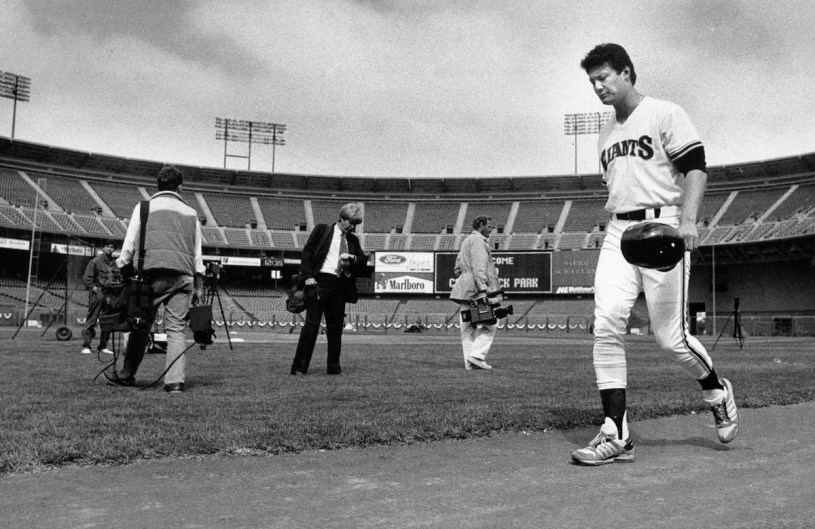
We’ve hit a milestone here on MLB Monday where we have finished (finally) all the award revisions we will be doing for the sport—save the two new pieces every winter to define the prior season. We could do “best teams” and “best players” miniseries for baseball, and some day we will get around to it. But we want to be in the right frame of mind to start that process, and we’re not quite there yet. Maybe soon in 2025? We will see.
In the meantime, we’ve put together a short list here and there of interesting players in MLB history we find worth sharing (our MLB Random Player Analysis pieces). We return to that today with an examination of former San Francisco Giants pitcher Atlee Hammaker. He also pitched for the Kansas City Royals, the Chicago White Sox, and the San Diego Padres in a relatively undistinguished 12-season career in the sport.
Alas, there is this moment in the 1983 All-Star Game that anyone remembering Hammaker’s name is going to recall with ease: giving up the first/only grand slam in the history of the Midsummer Classic. Growing up in the San Francisco Bay Area at the time, we all knew the lingering myth about that Fred Lynn bomb: it was the beginning of the end for Hammaker, who “was never the same after that” for the rest of his life.
Time for a fact-check session, no?
What we see is that this myth is just that: a myth. In a nutshell, Hammaker was never a good pitcher until that 1983 season, and even though he was out of the majors in 1986 entirely before returning to play for many more years, the Giants didn’t give up on him after that infamous ASG mistake. In a modern world where disinformation/misinformation reign, it’s obvious this is nothing new; it’s just magnified more now.
But we digress. Here are the verified statistics:
- His career ERA was 3.66 over 1,078 2/3 innings pitched.
- His combined ERA in his first two seasons (1981 with K.C.; 1982 with S.F.) was 4.37 in 214 IP.
- His 1983 All-Star season ended with a MLB-best 2.25 ERA over 172 1/3 IP and a 1.039 WHIP (NL best).
- His combined ERA in 1984 and 1985 was 3.49 in 203 2/3 IP.
- After missing the 1986 season due to a second rotator cuff injury, he returned to the Giants in 1987.
- His combined ERA from 1987-1990 with the Giants was 3.76 across 457 IP.
- After being released by the S.F. organization midseason 1990, he pitched less than 32 IP more in MLB.
- His ERA in those final 32 IP was 6.25 as his age (32 to 37) and injuries finally caught up with him.
The first thing to mark is that Hammaker wasn’t much of a pitcher before 1983. Yes, he was young and learning, but he was not an immediate phenom. In fact, at the 1983 All-Star break, many people should have assumed his first-half performance (1.70 ERA) was a fluke. When Hammaker coughed up the granny to Lynn, though, the aftereffects were allegedly disastrous. But they were not: 3.38 was his second-half ERA.
Yes, that was twice as high as his season start, but it was still a good number. The difference in record, too, from 9-4 in the first half to 1-5 in the second half, stood out at the time. Today, it just looks like a regression to the mean. Yet the way the myth goes? Hammaker completely fell apart; however, the statistics show that is not the case at all, even in a vacuum. When he needed offseason surgery, though, the myth was complete.
Hammaker would miss most of the 1984 season, returning late to pitch just six times. And when he needed that second surgery, he missed 1986. He did return to be a part of the Giants’ NL West Division championships in 1987 and 1989; he pitched, albeit poorly, in the 1989 World Series for San Francisco. As we see above, the myth was created by his sudden, out-of-nowhere success that fans evidently expected to last.
Some more context: Hammaker has said himself that he was hurt before that 1983 ASG, but he clearly kept pitching through it to the end of the season. That’s an unverifiable piece of oral history, so take it as you will. But the consistency with which he pitched from the All-Star Game on is stunning: 3.38 in the second half of 1983; a 3.49 ERA between his shoulder injuries; and a 3.76 ERA for the duration of his SFG career.
Considering his injuries, that 3.76 mark is pretty good. His career ERA, as noted above, is strengthened the most by the Giants innings from 1983-1989 where he never posted a season ERA higher than that same 3.76 number—and that was in 1989 during his age-31 season. Hammaker actually looks like a serious battler, beast, and machine to us now. Yet his ERA+ for this years in San Francisco is just 101, surprisingly. Yet?
We know better: he battled through injuries and was a true team player. There was no disastrous endgame for Hammaker after the 1983 All-Star Game: there were just injuries and more injuries that he fought through to be an effective part of the pitching staff in San Francisco. Again, his career ERA was 3.66—so that 3.38 ERA in the second half of the 1983 season was better than his career as a whole … not that myth.
Again, what we see is that “they” all saw 1983 first-half Hammaker and expected that to be his new norm; it wouldn’t be the first time a young player gets good out of nowhere, and everyone just assumes he will be that good going forward forever. Even as Hammaker settled into a solid-level career after the 1983 Midsummer Classic, that was seen as “bad” with the grand slam being a convenient coincidence to focus on.
 Daily McPlay: (mostly) Historical Sports Analysis with TENACITY & VERVE