
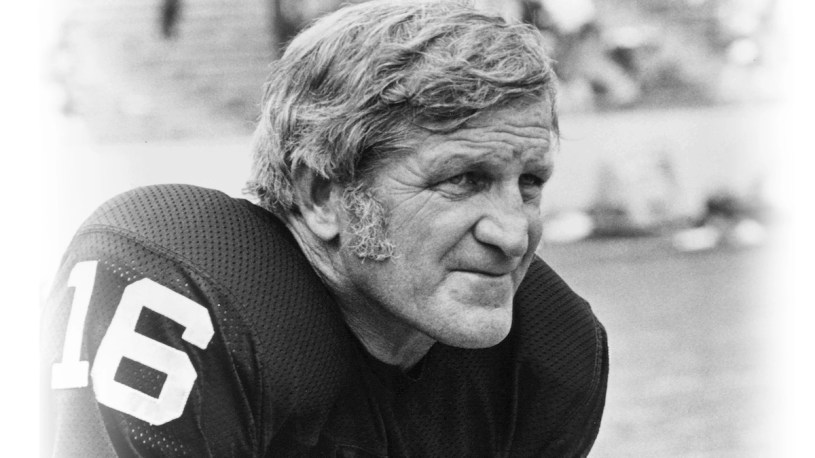
Welcome back to NFL Thursday, one week before Thanksgiving Day … perhaps the best professional football day of the year. But we digress: today, we’re going to look at one of our old-school favorite players: George Blanda. When we were kids growing up in the 1970s, he held the record for most points ever scored in NHL history (2,002)—and today, he’s still seventh on that all-time list, despite retiring in 1975. Shocking.
First, and foremost, Blanda’s NFL career began in 1949, a year before we consider the “modern era” of football to have begun. He was 12th-round draft pick by the Chicago Bears, after playing at the University of Kentucky from 1945-1948. As the starting quarterback his final two college seasons, Blanda played under Head Coach Paul “Bear” Bryant, who would go on to seemingly endless college football fame elsewhere.
In those two seasons as the starter, the Wildcats posted a 13-6-2 record, winning the Great Lakes Bowl against Villanova at the end of his junior season (1947). In an NFL with only a handful of teams, 12th-round draft status meant Blanda was the 119th overall pick—the equivalent, perhaps, of a fourth-round pick today. Even so, he didn’t start at quarterback regularly for the Bears until 1953 when he was 26 years old.
Yet in 10 seasons with the Bears from 1949-1958, Blanda started only 21 times, all of those games from 1952-1954, with a record of 8-12-1. Chicago Head Coach George Halas, another legend, found other ways to use Blanda, though, playing him at linebacker (1951) and using him as the placekicker—where he began to pile up the points, obviously—and occasionally as a punter, too. Blanda did everything, really, as we start to see.
He ran for five touchdowns as the Bears QB, and he scored 541 total points in Chicago over 10 years. And then he abruptly retired. Halas had made it clear he only intended to use Blanda as a kicker, and Blanda still felt he could play QB despite the injuries he had suffered during the 1954 season that curtailed his effectiveness at the time. In addition, the Bears hadn’t won a championship since 1946, and that was rough.
Enter the AFL in 1960: Blanda signed with the Houston Oilers and entered the second phase of his storied career, quarterbacking and kicking in the new league. Overall, in seven seasons with the Oilers, he posted a 44-38 record as a starting signal caller, plus a 2-1 record in the playoffs. We named him the MVP of the first AFL Championship Game, and he won the 1961 AFL MVP vote, as well. He was now the star he knew he was.
Houston reached the first three AFL title tilts, winning the first two and losing the third. Blanda’s 30-9 record as the starter in those trio of seasons was the peak of his QB career, for sure; after that, it sort of went downhill, as he posted just a 16-30 record during the rest of his time with the Oilers. However, he did run for four more TDs with the Oilers, in addition to his placekicking duties: 598 more points for Blanda.
Of course, his career then entered a third phase in 1967 as he joined the Oakland Raiders as an age-40 backup quarterback and regular placekicker (still). For nine more seasons, he would put on the Silver & Black, win one more AFL Championship (1967), and add to his legend in many different ways. He scored another 863 points with the Raiders, as the team was in the playoffs eight times in his nine years there.
While he only started one game at QB for Oakland (a 43-7 win over Denver in 1968), he still played enough at the position to warrant some fame for it: he threw 23 regular-season TD passes for the Raiders, in fact, and in 1970, he finished second in the NFL MVP vote despite throwing only 55 passes and completing 29 of them. He was a valuable player for the Silver & Black, despite not being a starter on the regular offense.
Consider this: in four different contests, Blanda came into the game at QB to help rally the team. In Week 6 against Pittsburgh, Week 8 against Cleveland, Week 9 at Denver, and Week 12 at New York (Jets), Blanda’s play at QB provided the difference. In those last three wins, the Raiders won by a combined 9 points, and Oakland made the playoffs with an 8-4-2 record, one game ahead of the defending Super Bowl champs.
He retired after his age-48 season in 1975: he scored 83 points in that final season, all as a placekicker. No, he never won a Super Bowl, or an NFL title, for that matter. But he was an AFL champion three times, and that counts for something. The fact he is still the NFL’s all-time leader in extra points (943) and extra-point attempts (959) is revealing, too: with all the scoring that goes on these days, he’s still atop the record list.
Yeah, we loved him in the 1970s, and we still love him today.
 Daily McPlay: (mostly) Historical Sports Analysis with TENACITY & VERVE