
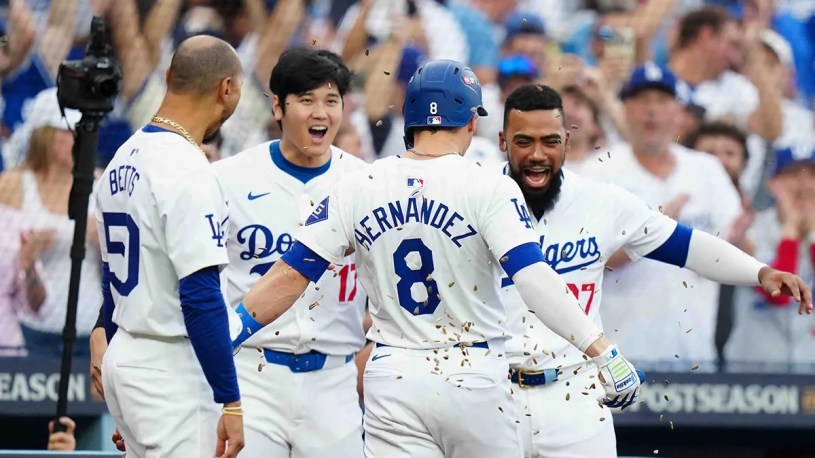
It’s always interesting to see the MLB postseason and its “heroes”: guys who have stunk all year suddenly discovering power strokes in the playoffs always seem to have an impact on the World Series champions’ pathway to success. Yet it’s intriguing to realize that nowhere can it be found that the sport imposes PED testing on its October participants, which raises some alarming questions about many performances.
In this current Fall Classic, for example, we’re going to look at two examples: Los Angeles Dodgers utility player Kiké Hernández and New York Yankees designated hitter Giancarlo Stanton. They’ve both had shockingly good postseasons after relatively average regular seasons as their teams have plowed through the competition on the way to the World Series. One at a time, we will breakdown some inconsistencies.
First, Hernández: in 11 seasons (1,183 games and 3,896 plate appearances, he has a .713 OPS from April to September. Yet in nine postseasons (83 games, 246 plate appearances), that number jumped to .883 overall—which is absolutely crazy. Sports mediots like to claim that “some guys just know what it takes in October” yet that is a load of shit. If they knew what it takes, they’d apply it all year to make sure they made playoffs.
He’s been lucky to basically play for good franchises with better players around him, of course, as eight of his Octobers have come with the Dodgers—currently in their 12th straight year of postseason play—and one playoff run with the Boston Red Sox, a team that has had some dubious success in the twenty-first century, of course. This jump in postseason performance rivals that of “famed” skipper Bruce Bochy, too.
Second, Stanton: certainly a better player than Hernández, he still was not even in the Yankees’ top 12 this year for WAR, coming in with a 0.7-WAR season and a .773 OPS during the regular season (114 games). But in the playoffs, Stanton has come alive, hitting six home runs in just 43 ABs so far for a 1.098 OPS in 11 games. The last time he posted that kind of OPS for a full regular season was in 2017 when he was 27 years old.
Yeah, we know Stanton has had a lot of injuries for his New York tenure, but he still hasn’t shown this kind of bat since the 2020 postseason—when he was 30 years old. Now in his age-34 season, past the generally accepted prime seasons for the average player, it doesn’t make a lot of sense that Stanton is mashing the ball like a much younger man. He was once an elite player, but that time of his career has long since passed.
So, what can we deduce from these two specific examples? The former will be a free agent after this season ends, after taking a pay cut this year of $6M from his salary in 2023; the latter has a guaranteed contract through 2027. Hernández is going to be in his age-33 season next year, so he certainly probably wants some contract stability, but he’s shown the same crazy October prowess for a decade as a fringe UTL player.
We now look to some past situations: the 2014 postseason of former San Francisco Giants pitcher Madison Bumgarner and the 2015 postseason of former New York Mets UTL player Daniel Murphy. We will do the same here as we did above, re-visiting both players’ strange postseason performances that were so out of line with their regular-season efforts hitherto. It’s not hard to see some of the same issues going on there.
First, Bumgarner: we discussed this aplenty before, but let’s lay it out again in basic terms. At the time, he had pitched a career-high 217 1/3 IP during the regular season, to the tune of a 2.98 ERA and 1.090 WHIP. In the postseason that year, he added 52 2/3 IP more to his stat sheet, with a 1.03 ERA and 0.684 WHIP. His arm should have been falling off in the final 50-plus innings of October after his career high during the year.
Interestingly enough, in the 2012 and 2016 postseasons, Bumgarner was nowhere near that good: a 6.67 ERA and 1.294 WHIP in the former; a 1.93 ERA and 1.143 WHIP in the latter. That kind of inconsistency reeks of the mythos, again, that mediots like to create around abnormal performances. What did Bumgarner know in 2014 that he didn’t know in 2012? What did he then forget by 2016? “Logic” laughs.
Second, Murphy: his .755 OPS from 2008-2015 in the regular season for the Mets across 903 games was pretty affirming in terms of his expected success levels at age 30 in October 2015. Yet? Murphy proceeded to seven HRs in just 39 PAs in the National League playoffs. How did that happen? Well, guess who was an impeding free agent at the end of that season? You guessed it. We don’t need to explain much more here.
Interestingly enough, not only did the 2014 Giants have no other decent starters in the 2014 postseason to rely on, Bumgarner was entering his arbitration-eligible seasons in 2015: after making less than $4M in 2014 at age 24, he used that impossible postseason performance as the springboard to $123M more in salary over the rest of his career, which ended humiliatingly in 2023 when he was just 33 years old. Huh.
This 2013 New York Times article delineates all the new testing procedures for MLB—yet never mentions anything about the playoffs or the postseason. The sport certainly doesn’t want any PED controversies to sully the reputations of postseason heroes, and as we know, MLB won’t suspend any player that costs his team money … so why would it police the postseason in any way that would cost the sport itself in any way?
Exactly.
Which is why a PED-enabling manager in the regular season like Bochy is more likely to encourage PED use in the postseason, too, since there will be no consequences for it whatsoever. And therein lies the secret of Bochy’s October success, in all probability. While he may not be a part of this postseason, the spectre of postseason PED use should always hang over abnormal and inconsistent October production from all players.
 Daily McPlay: (mostly) Historical Sports Analysis with TENACITY & VERVE