
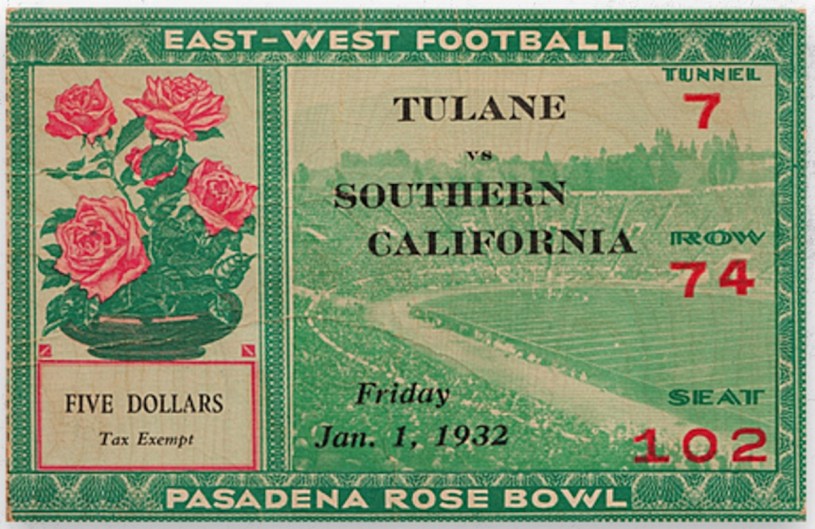
We come back to Rose Bowl Friday to view another memorable moment from afar: the Granddaddy of Them All that featured the Tulane Green Wave coming west to Pasadena to take on the USC Trojans in their own backyard. The Trojans famously featured six All-American players in their lineup, including two quarterbacks (although we’re not sure how that was possible, but hey … it was the 1930s, so whatever).
USC was 9-1 coming into the game, having lost its opener to St. Mary’s College before winning nine straight games: seven victories came against PCC competition by the combined score of 259-13 overall, and the other two triumphs were over Notre Dame on the road and Georgia. The last victory, at home over the Bulldogs from the Southern Conference, was the most impressive: 60-0. And Tulane won that conference.
The Green Wave was undefeated before the Rose Bowl: 11-0 with eight wins in conference, including a 20-7 victory over Georgia. Also, Tulane had played Washington State at home and won by a 28-14 margin, while the Trojans had beaten the Cougars by a 38-6 margin in Los Angeles. The two comparative scores surely mandated this matchup between the “best in the East” and the “best in the West” in the annual bowl game.
Sports reporters were in general agreement that this was a No. 1 (Tulane) versus No. 2 (USC) matchup, and it would decide the mythical national championship of the time period. Whether it was the Trojans’ superiority in sabermetric measurement or the many-times mentioned train ride, USC built a commanding 21-0 lead in the third quarter and cruised to a 21-12 victory to secure the Erskine Trophy, a fledgling title.
Trojans All-American halfback Erny Pinckert scored two touchdowns while All-American guard Johnny Baker converted all three extra-point kicks for USC. Ironically, the Green Wave failed on both their extra-point attempts, which ensured the victory for the Trojans in the fourth quarter. Pinckert was named the game’s MVP by the media at the time, as well. In the end, no one had any doubts about which was No. 1 team.
For the detail-oriented folks out there, USC finished No. 1 in the SRS and No. 1 in the SOS rankings, while Tulane was No. 2 and No. 13, respectively. The Green Wave had played one small-college opponent early in the season, and that hurt in the SOS rankings, while all 11 opponents the Trojans faced were legitimate schools. And for the record, St. Mary’s College went 5-1 against major-college opponents, losing to UCLA.
 Daily McPlay: (mostly) Historical Sports Analysis with TENACITY & VERVE