
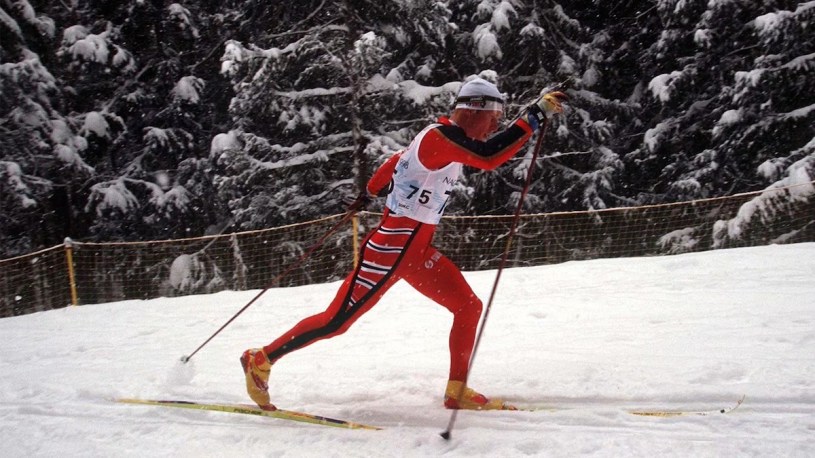
Olympic Wednesday returns to Japan after a 26-year absence since the ’72 Winter Olympiad; this time the site was Nagano, and one new development was the inclusion of NHL players in the hockey competition. Still, almost 2,200 athletes from 72 countries came to the Land of the Rising Sun to take part in 68 medal events contested in 14 disciplines. Even some news like this disgrace couldn’t dampen the mood in Japan.
Germany came out on top of the medal table (29), followed by Norway (25), and the Russian Federation (18). The host nation reached double digits itself (10), one of ten countries overall to achieve that distinction. And in the men’s hockey competition, with NHL players? It was the Czech Republic that took home the gold, thanks to All-World goaltender Dominik Hašek—you can check out his endless achievements here.
Most Outstanding Male Athlete: Bjørn Dæhlie, Norway
He won this hardware in 1992, and he’s back again: Norwegian cross-country skier Bjørn Dæhlie. After winning three golds and one silver in Albertville, he “only” won two golds and two silvers in Lillehammer. Here, he again won three golds (10km, 50km, 4x10km relay) and one silver (10/15km Pursuit). Overall, he took home eight golds and four silvers this decade, which is pretty impressive even with the extra Games.
Most Outstanding Female Athlete: Katja Seizinger, Germany
We might have chosen Russian cross-country skier Larisa Lazutina here, but she tested positive for PEDs before the 2002 Winter Games, so we have to assume that was the reason for her dominant efforts in Nagano. So, that leaves us with some other candidates, but only one woman legitimately won two golds in these Games: German alpine skier Katja Seizinger: first in the downhill and the alpine combined events.
She also took home a bronze in the giant slalom event. After winning a bronze in the 1992 Super G and then a gold in the 1994 downhill, she put it all together in this olympiad to dominant the competition. Notably, she also took sixth at Nagano in the Super G competition, so she was still competitive in her original event.
Most Outstanding Male Team: Japanese Ski Jumping
The ski jumpers from Japan won four of a possible five medals to thrill the home crowd in 1998: Kazuyoshi Funaki took home gold in the large hill competition, while also grabbing silver in the small hill event. His countryman Masahiko Harada won bronze in the large hill, and overall, the Japanese team took gold in the large hill team event. Considering only two jumpers could compete in each individual event … yeah.
Most Outstanding Female Team: German Speed Skating
For the third straight Winter Games, the German speed skaters take home this award, having won six of a possible ten medals in Nagano: Gunda Kleemann-Niemann (3,000m) and Claudia Pechstein (5,000m) won individual golds, while the pair combined for three silvers as well (Gunda in 1,500m and 5,000m; Claudia in 3,000m). Meanwhile, Anni Friesinger (3,000m) added a bronze. Well done, frauleins: drei-peat!
 Daily McPlay: (mostly) Historical Sports Analysis with TENACITY & VERVE