
On Olympic Wednesday this week, we begin the era of the staggered olympiads, when we started alternating the Games every two years, rather than hosting both winter and summer events in the same year. So, everyone converged on Norway: 1,738 athletes from 67 countries, to be exact. There were 61 medal events this time, too, spread among 12 disciplines, so there were plenty of accolades to go around … again.
The host nation also won the medal count, with 26 total, followed by Germany (24) and “the Russian Federation” (23)—representing the still-unsure-of-itself, post-Soviet entity. Italy also earned 20 medals, making this a nicely distributed Games. The United States (13) and Canada (13) were the only other countries to reach double digits in the medal count, as these six countries dominated most of the action.
Most Outstanding Male Athlete: Johann Olav Koss, Norway
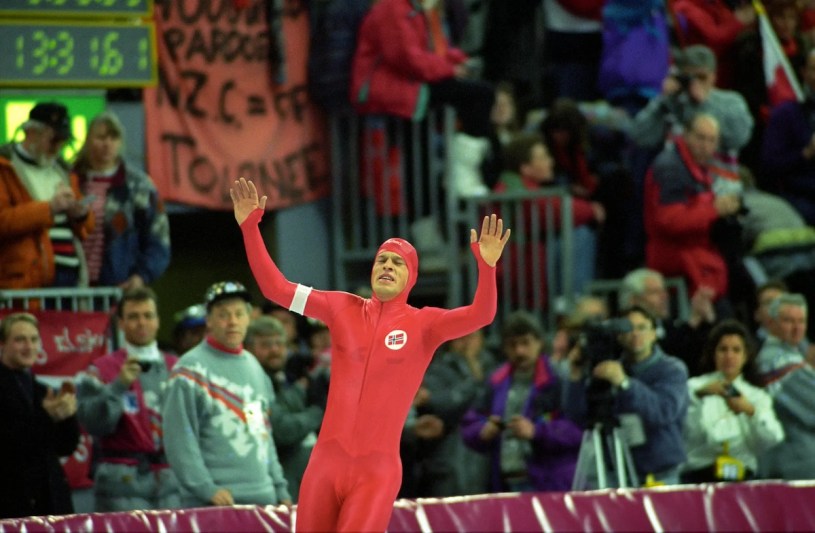
The only male competitor to win three individual gold medals, Norwegian speed skater Johann Olav Koss stole the show on his home track—outdoing his countryman, cross-country skier Bjørn Dæhlie who won this award in 1992. Koss won the 1,500m; the 5,000m; and the 10,000m events after merely taking gold (1,500m) and silver (10,000m) in Albertville. Even if not Heiden-like territory, the range is impressive.
Most Outstanding Female Athlete: Manuela Di Centa, Italy
Just like in the men’s category above, the women’s winner—Manuela Di Centa, Italian cross-country skier—beat out the 1992 winner of this award (Russian cross-country skier Lyubov Yegorova). Di Centa won a total of five medals in Lillehammer: gold in the 15km and 30km events; silver in the 5km and 5/10km pursuit events; and bronze in the 4x5km relay. This was her fourth Olympics of five straight, too. Incredibile!
Most Outstanding Male Team: Russian Federation Figure Skating
This was a strange analysis, as no men’s team truly stood out in Lillehammer, for whatever reason. But the Russian men did well in the figure skating competition: individual gold in the men’s event, in addition to double golds and double silvers in the mixed pairs and mixed ice dancing competitions, respectively. It’s hard to top that, really. For the record, Aleksey Urmanov was the men’s gold medal champion in singles.
Most Outstanding Female Team: German Speed Skating
We have a repeat winner here, as the German women won a medal in all five speed skating events: bronze in the 500m; silver in the 1,000m; bronzes again in the 1,500m and the 3,000m, respectively; and then gold and silver in the 5,000m. Overall, that was six medals out of a possible 10 chances, really, since only two competitors from each nation were allowed in each event: a nice, diverse showing for the German women.
 Daily McPlay: (mostly) Historical Sports Analysis with TENACITY & VERVE