
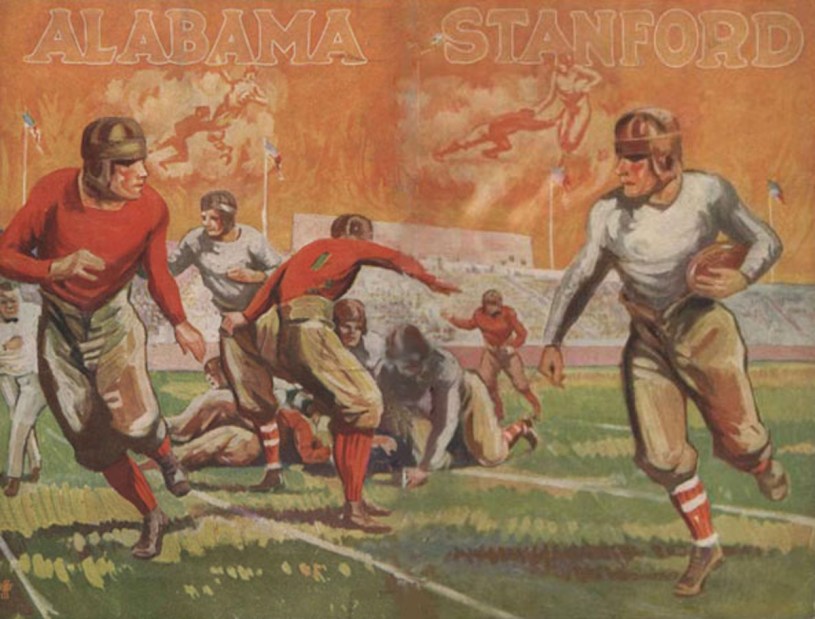
The Alabama Crimson Tide escaped the Washington Huskies by a point on January 1, 1926, and the very next season, the team was invited back to Pasadena to defend its Granddaddy of Them All title. Today on Rose Bowl Friday, we examine that matchup with Stanford University to see if the Tide could become the first repeat Rose champions. Alas, no … the two squads tied in a 7-7 final that showed us something big.
Stanford jumped to a 7-0 lead in the first quarter, which could have been a 10-0 lead except for a missed field-goal attempt. The lead held until late in the game when Stanford was trying to run out the clock; it failed, and when attempting a punt, the Pacific Coast Conference representative had the attempt blocked, setting up Alabama nicely for the tying score—which the Tide earned, kicking the extra point for the tie.
And that was the anticlimactic game result, but it demonstrated how hard it was to win this game twice in a row. Previously, the Mare Island Marines (1919) and the California Golden Bears (1922) had both failed to win two straight Rose Bowls, and with this being the third time, a pattern was established: the first back-to-back winner of the Granddaddy would not arrive for another six years—and proved elusive for many ahead.
The Crimson Tide sure gave it a top-notch effort, though: the team went 9-0 during the 1926 regular season, beating eight conference opponents by a combined 188-20 margin. Alabama played the No. 15-ranked schedule, and it would finish No. 2 in the overall SRS. Thus the significant surprise when Stanford scored early in this matchup and held the Tide scoreless until late in the fourth quarter. That was impressive.
Stanford had posted a 10-0 record in the regular season, although the SOS ranking (55th) was not very impressive. There were only four PCC matchups on the schedule, and Stanford finished No. 11 in the SRS overall. Perhaps the travel took its toll on the Crimson Tide players, as a cross-country train journey from Alabama to Los Angeles surely wasn’t the most conducive to staying physically sharp for a big game.
Either way, the Tide would not return to Pasadena until January 1, 1931, although Stanford would return to Southern California in a year to see if it could win is first Rose Bowl—after losing twice and tying once in its first three attempts.
 Daily McPlay: (mostly) Historical Sports Analysis with TENACITY & VERVE