
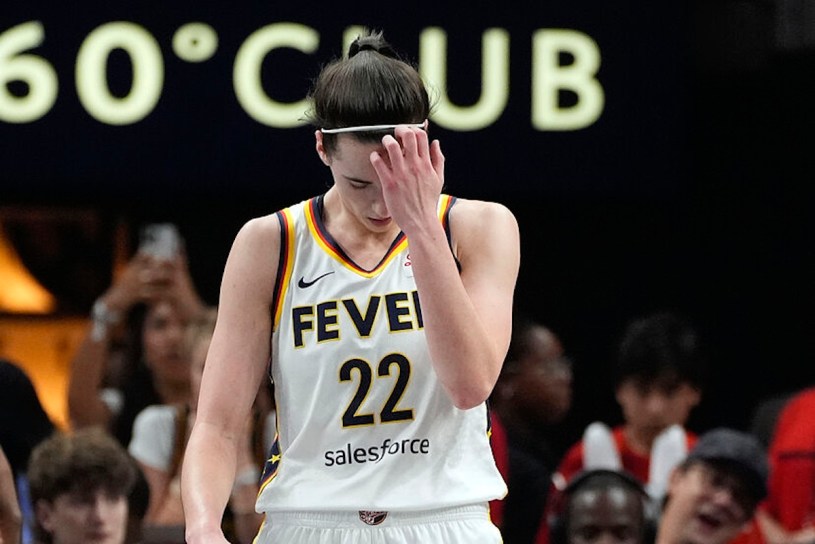
We’re highly amused by the attempts to prop up Caitlin Clark as some sort of savior for the WNBA. Earlier this week, she shot 3-for-12 from three-point range while committing 7 turnovers, but the headlines called her the “hero” of a big win nonetheless. Nothing is worse in basketball than poor ball handling and poor shooting combined, but the mediots just keep force-feeding only Clark’s positives to the readership. Why?
Money. The WNBA is mostly financed by NBA dollars, as it’s been a losing proposition for all of its 28-year existence, dating back to 1997. The NBA is not in the habit of losing money, of course, going as far to fix and rig its own results in order to maximize profits. So, then why would anyone think the WNBA’s attempt to promote Clark, despite her blatant shortcomings as a player, is an honest one? Sadly, the mediots just bite.
And the public swallows it, whole. We know sports fans in general aren’t very capable of critical thinking; it’s why we do not “talk down” to our audience with our historical journalism here. We refuse, since we were trained as journalists before the Internet existed in popular formats—and because we don’t rely on the audience’s money to fund ourselves here. We have the benefit of other revenue streams in our busy lives.
But we digress: Clark’s penchant for turnovers keeps her sabermetric value low, and instead the media speaks as if she is a shoo-in choice for the WNBA Rookie of the Year award—which she is not, if the voters actually knew anything about the sport they cover. Instead, they’re on the take themselves and acting like they’re stuck in the 1990s analysis of basketball: only focusing on the counting stats and not their impact.
Through 32 games of a 40-game season, here are the sabermetric facts about Clark that the lamestream sports media doesn’t want to tell its audience regarding her place on the Indiana Fever roster rankings:
- Second on her own team in PER, trailing a teammate by 1.3 points, which is significant in 32 games
- Second on her own team in True Shooting Percentage (TSP)
- Fourth on her own team in Effective Field-Goal Percentage (eFG)
- Eighth on her own team in Offensive Rating (ORtg), which measures points produced
- Fourth on her own team in Defensive Rating (DRtg), which measures points prevented
- Third on her own team in Offensive Win Shares (OWS)
- Second on her own team in Defensive Win Shares (DWS)
- Third on her own team in Total Win Shares (WS)
- Fourth on her own team in Win Shares per 48 Minutes Played (WS/48)
Clark does lead her own team in usage rate, though, which is the problem: she gets the ball the most yet isn’t the smartest or wisest choice in most situations to deserve that honor. She is tops on her own team in assist rate, which is a big positive—she could also break the single-season WNBA record for assists, but if she does, it will barely be … not by 80 like the turnover record. For every good thing she does, there is much bad.
That’s why the sabermetric numbers tell us more than the counting numbers, too: sure, Clark scores 18.4 ppg, which is second on her own team, by the way. But you’d never know that from the media coverage. She also is shooting under 42 percent from the field right now, which is seventh on her own team. Think about that for a second: that is as inefficient as it comes, really, but everyone claims she’s a great shooter. Nope.
Let’s look at league-wide data, too, now for sabermetrics, because Clark doesn’t hold up well there, either, just like she did not do so in a historical sense during her college career (explored and detailed here months ago). Here are the WNBA sabermetric facts for Clark that the media also likes to ignore:
- Not in the Top 10 for Player Efficiency Rating (PER)
- Not in the Top 10 for TSP
- Not in the Top 10 for eFG—but one of her teammates (Kelsey Mitchell) is!
- Not in the Top 10 for ORtg
- Not in the Top 10 for OWS—Mitchell is fifth!
- Not in the Top 10 for WS
All of this data was predictable, based on her rankings among her own teammates, but it needs to be reiterated: she’s not the Second Coming, despite what the media will spin. This is why she wasn’t on the 2024 Olympic roster, for example: compared to her peers, she’s really just not that good right now. Sure, she’s “popular” like Kobe Bryant was, but we’ve already deconstructed that mythos here so much, too.
As for Clark, we think of a young Randy Johnson, who once led the American League (1992) in both walks and strikeouts. Heck, Nolan Ryan did that six times himself in a seven-year span (1972-1974, 1976-1978). Both guys eventually got much better, too. Johnson, in particularly, learned to control his wildness to the point he was one of the most dominant players in his sport during his prime. Ryan had his own greatness, too, obvi.
Thus, there is hope for Clark that she may develop into a much better player—and then perhaps warrant a sliver of the praise being heaped upon her now undeservedly. But regardless, it is in the best interest of everyone involved here (the WNBA, the NBA, and the media) to keep deceiving readers about the statistical facts in order to profit from it. That helps all the players in the WNBA, so you won’t hear them publicly whine.
Yet we can guarantee you there are probably several dozen players around the league who resent the situation, maybe even on her own team, where she is being given almost all the credit for the group’s “success” when the data above clearly demonstrates she’s not even close to being the most impactful player on her own roster. All it takes is a little digging yourself to find out the facts the media is omitting. Try it!
The slippery-slope fallacy also works upward, as demonstrated in this case. It’s not a guarantee Clark will become an all-time WNBA great, for many reasons. But the mediots are painting her as such already. We get tired of beating the dead horse here, so we won’t say too much more about this topic going forward; perhaps one final check when the regular season is over to find out the concrete data points and publish them once.
We have other fish to fry here, of course … always. Tenacity and verve, as we say in the masthead.
 Daily McPlay: (mostly) Historical Sports Analysis with TENACITY & VERVE