
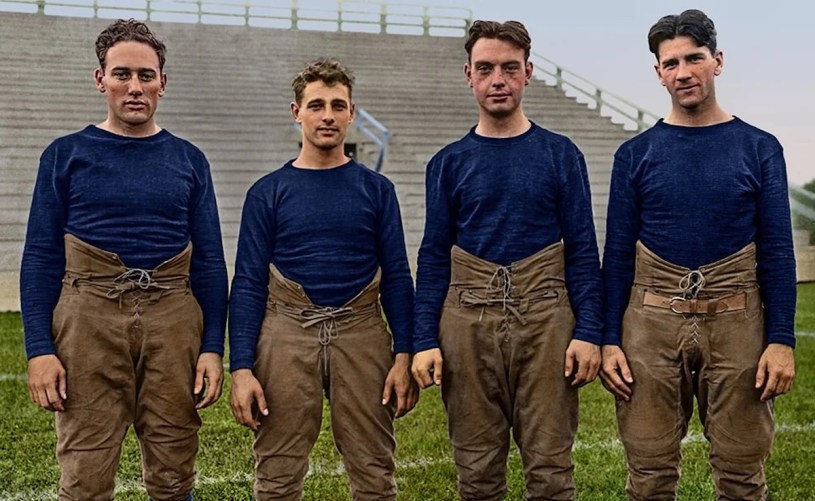
The Fighting Irish of Notre Dame make their first appearance on Rose Bowl Friday today as we look at the 1925 Granddaddy of Them All, the conclusion to the 1924 regular season of college football in America. The Irish took on the Stanford Indians, and there were legends playing in this game—not to mention coaching as well: Knute Rockne and Pop Warner manned the sidelines for Notre Dame and Stanford, respectively.
This was also the first time Notre Dame ever participated in a bowl game, a practice they would not fully embrace for decades. The game featured the Four Horsemen, too, as this was the actual season of their “creation” by sportswriter Grantland Rice:
Outlined against a blue-gray October sky the Four Horsemen rode again. In dramatic lore they are known as famine, pestilence, destruction and death. These are only aliases. Their real names are: Stuhldreher, Miller, Crowley and Layden. They formed the crest of the South Bend cyclone before which another fighting Army team was swept over the precipice at the Polo Grounds this afternoon as 55,000 spectators peered down upon the bewildering panorama spread out upon the green plain below.
Poetic, for sure, as modern mediots wouldn’t dare write something so erudite. But Fighting Irish quarterback Harry Stuhldreher, left halfback Jim Crowley, right halfback Don Miller, and fullback Elmer Layden may have been worthy of the praise. Notre Dame was the top-ranked team in the SRS this season, going 9-0 before the Rose Bowl after playing the eighth-roughest schedule overall.
Meanwhile, Stanford wasn’t exactly a match for the Fighting Irish, with its 7-0-1 record earned against the 23rd-toughest slate in the nation. Obviously, the Indians were good, but Notre Dame was on a different level altogether. Three of the Indians’ opponents were small-school teams, while the Irish only played two “smaller” opponents—both in the first two games as warmups, obviously, for the gauntlet that was to come.
The above words were written by Rice after Notre Dame beat Army on the road by a score of 13-7: on paper that doesn’t seem to warrant the prose that would imprint itself upon the nation, but it is what it is. When it came to this Rose Bowl matchup, the Fighting Irish seemed much more worthy of the descriptors above: they forced eight Stanford turnovers, three of which led to Notre Dame touchdowns, and that was it, really.
The Indians moved the ball just fine, but no team is going to survive that many turnovers: the Indians took an early 3-0 lead, but by halftime, the Irish led 13-3 after two Layden TDs—including one on an interception return. Stanford had its own legend in fullback Ernie Nevers, who ran for 114 yards, which outdid the combined output of the Four Horsemen. But Layden’s second pick six sealed the game late.
Notre Dame won, 27-10, his two INT TD returns totaling 148 yards. The win started a different college football tradition, however: the ND-USC rivalry, which began in 1925 with the Irish traveling to the Los Angeles area again, this time over Thanksgiving week/end. However, Notre Dame would not play in another Rose Bowl until the 2020 season, when they qualified for the College Football Playoff in the Covid season.
Meanwhile, Stanford would return to Pasadena for multiple Rose Bowls over the next few decades and beyond. After playing in the “first” Rose Bowl, the school has played in back-to-back Granddaddies five times overall, which is impressive. We don’t usually think of Stanford as a Rose Bowl regular, but the data says something different, for sure. In the end, due to Notre Dame, the game itself finally was on the map.
 Daily McPlay: (mostly) Historical Sports Analysis with TENACITY & VERVE