
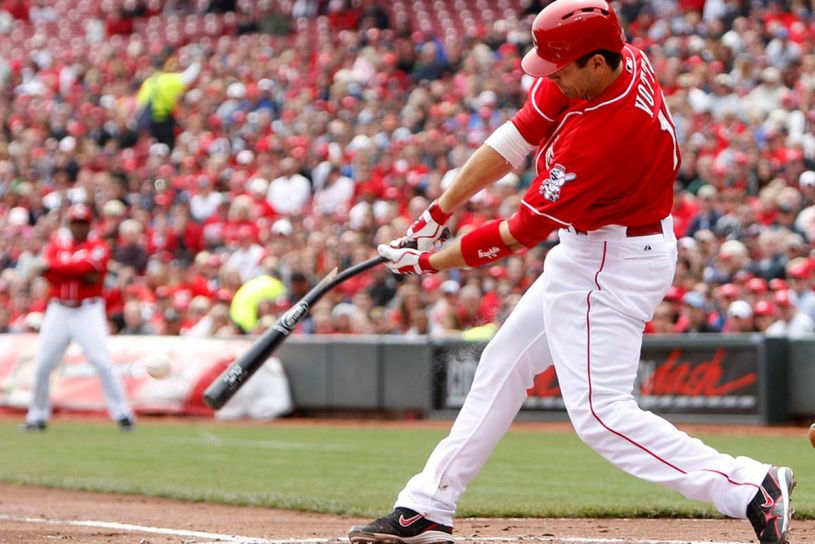
Longtime Cincinnati Reds star Joey Votto announced his retirement Thursday, even though he hasn’t played in the majors this season. He finishes his career with 64.5 WAR lifetime, which puts him 12th all time for the position. That is enough to get him into the Hall of Fame eventually, although we would never label him “first ballot”—his defense was mediocre, and he fell off a cliff at age 35, really, which is normal.
Votto posted a dominant nine consecutive years at the plate from 2010—when he won the NL MVP vote—to 2018, when he last qualified for the All-Star Game at age 34. During those seasons, he topped the National League in OBP seven times, walks five times, and OPS twice. His 144 OPS+ mark is pretty good, as is his lifetime .409 OBP mark. The minus-7.0 dWAR is our major objection to his overall profile assessment.
Somehow, Votto won a Gold Glove in 2011 with a minus-0.2 dWAR mark, which is problematic for us. Interestingly, he posted plus-0.4 dWAR (2012) and plus-0.9 dWAR (2017) in other seasons without winning a GG nod. His only other season with positive dWAR came in 2018, when he squeaked out a plus-0.1 mark. So, he wasn’t a great glove man, but his 8.1 WAR in 2017 was the best effort in the NL (but his team stunk).
Thus, we never awarded him one of our NL MVP trophies, although maybe that is circumstantial. Six times, he finished in the Top 10 voting for the award, which is a good reflection of his production and talent levels. What is also disappointing is his mere 11 postseason games, but playing for a small-market team in Cincinnati his whole career didn’t help him out there. In fact, his .563 playoff OPS is pretty fucking ugly.
Small sample, right? However … we want to single out the 2012 NLDS against the cheating San Francisco Giants, where the Reds took a 2-0 lead on the road against their opponents before collapsing and losing three straight games at home to get eliminated—absolutely inexcusable, really. What role did Votto play in that series, even if it was against a team loaded with PED users? It’s a mixed bag, looking back now, in truth.
He put up an .889 OPS mark in the five games, but he didn’t have a home run, nor did he drive in a run. He scored three times and walked four times, overall, but he was 0-for-2 with two walks in Game 3, a potential clincher the Reds lost in 10 innings. In Game 5, with everything on the line, Votto did go 2-for-4 with a walk. It’s hard to blame him for the series defeat, but he was in his prime, and he didn’t stand out, really.
The primary reason Cincinnati lost that matchup, in truth, beyond the Giants cheating, of course, was the injury to starting pitcher Johnny Cueto—he faced one batter in Game 1 as the starter, got the strikeout, and then came out of the game, never to pitch in the division series again that week. Cueto finished fourth in the NL Cy Young vote that year, and even though the Reds won Game 1, they could have used Cueto later.
Thus, we can’t blame Votto for much in 2012, but the rest of his 6 playoff games—three NLDS games in 2010 against Philadelphia, the 2013 wild-card game against Pittsburgh, and two games against Atlanta in the 2020 wild-card round—were a disaster, for sure, with a combined three hits in 23 official ABs. He managed just one RBI overall in his postseason career and 12 strikeouts in those 11 games. Again, ugly.
We will note that in 2010, however, he did have the misfortune of facing the Phillies’ Roy Halladay, who tossed a no-hit game in the opener of that NLDS matchup. Clearly, the Philadelphia starter was dealing, and we cannot hold that against Votto, but that’s just one game in the collective experience of his MLB postseason career. In theory, the postseason is not equal for all, based on teammate quality, so … yeah.
Holding the Reds’ postseason emptiness during his career against Votto is not fair, nor is it fair to give credit to a lot of guys who win the playoffs when they just happen to be in the right place at the right time—like Cueto later with the 2015 Kansas City Royals. The postseason production, or lack thereof, does not factor into the career WAR marks, anyway. And we’ve already noted Votto’s several positive accomplishments.
So, again, first-ballot Hall of Famer? No. But he should get it in easily by his second or third ballot. And we’re fine with that, as we see no evidence of PED use in his career, either. We see a good hitter (.294 lifetime batting average) with good power (356 HRs) and a great eye for plate discipline who could have been a bit better with the glove in the end. He did strikeout a lot, too, but that was alleviated by the walk totals.
 Daily McPlay: (mostly) Historical Sports Analysis with TENACITY & VERVE