
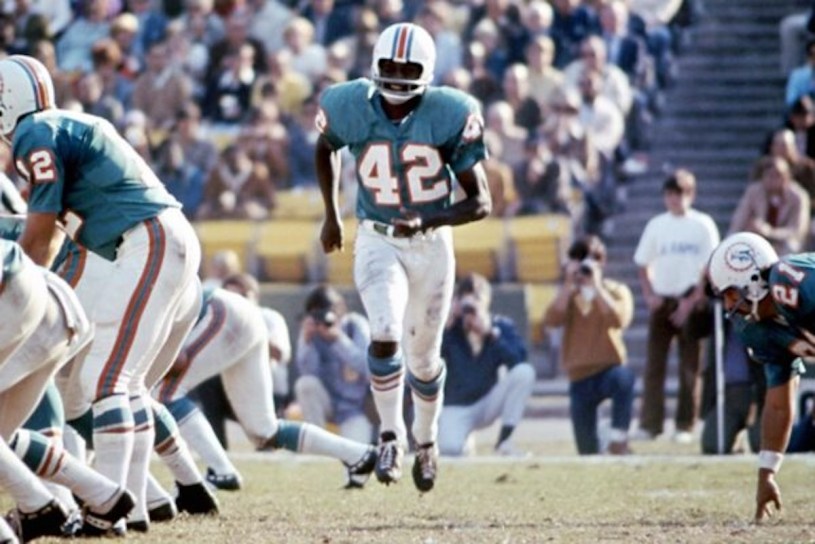
Receivers are a tricky bunch in the sport of football: some are very dependent on a “good” quarterback for their success, not to mention a stellar quarterback/running back combination (i.e., the ‘Triplets” concept). Others can get by with an average QB and a dominant RB, who attracts so much defensive attention that anyone can get open for a pass. And then there are those receivers who can do anything no matter what.
Analysis of receiver greatness starts with the basic statistic: passes caught. We have to start there, because if the player is truly great enough, he is going to see the ball a lot. Then, there are some much better metrics to advance: yards per reception and yards per game. The first helps assess what the receiver can do with the ball after catching it; the second tells us on a game-by-game basis just how much value was added. Facts!
There are always exceptions to these “rules” in history, though: take Super Bowl VIII, for example. Miami Dolphins QB Bob Griese attempted just 7 passes the entire game, completing 6 of them for 73 yards. Of the three receivers who caught balls that day, only one is in the Hall of Fame: Paul Warfield. Playing in a run-dominant era, he only caught 427 passes in his career—but his 20.1 ypc and 54.6 ypg marks tell us more.
Warfield falls into that category above of the receiver possibly dependent on the QB/RB combination he played with during his career; then again, his relevant numbers during his 8 seasons with the Cleveland Browns match up favorably with his relevant numbers while he played 5 seasons with the Dolphins. Perhaps he is one of those receivers who transcends his teammates, the last category defined above?
He was a little better in Miami (1970-1974) than he was in Cleveland (1964-1969, 1976-1977), based on YPC and YPG, although not by a significant amount. In a topical sense, we probably can put Warfield into the latter category of transcendent dominance, as his AV total (138 AV in 157 games) could suggest. He definitely slowed down during his final two seasons, as well, so playing too long damaged that AV/G mark somewhat.
Let’s say 1974 had been his last season, at age 32. His AV would then have been 127 in 131 games, which is outstanding. That AV/G mark becomes our final determinant in the receiver analysis of greatness, really. Longevity can improve the overall reception totals while negatively impacting YPC, YPG, and AV/G numbers. Like any position, of course, the quality will tend to decline as the quantity of games increases.
We have just used Warfield as a relatively random example brought on by our memory of the Dolphins’ 1973 NFL title run, when they have a run game so dominant they didn’t need to use perhaps their best weapon very often. We can’t let volume overwhelm our sense of historical greatness; we challenge readers to pick a favorite receiver and see how he stacks up with this step-by-step analysis. What category does that guy get?!
 Daily McPlay: (mostly) Historical Sports Analysis with TENACITY & VERVE