
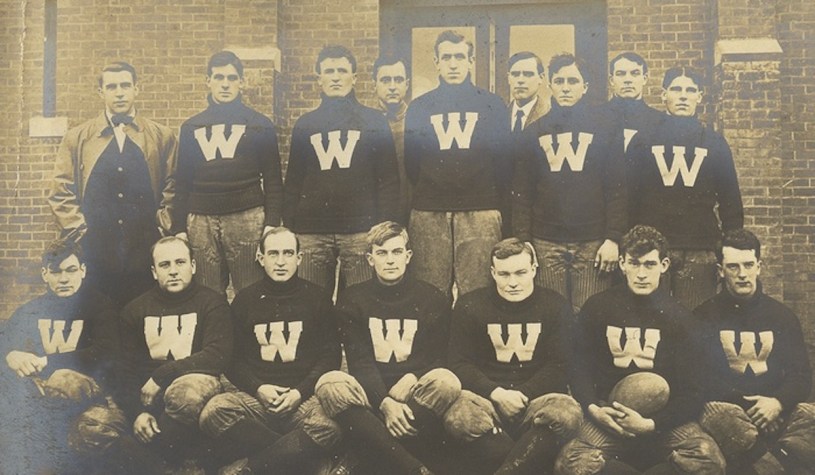
Our second entry in this Rose Bowl Friday miniseries looks at what is now considered the second official Rose Bowl: the then-styled Tournament East-West football game on New Year’s Day 1916. Washington State College defeated Brown University, 14-0, as the WSC team didn’t have an official mascot yet, and the team colors were actually blue and pink. The “Cougars” moniker wasn’t adopted until 1919, interestingly enough.
WSC’s unofficial mascot at the time was a terrier named Squirt; we kid you not. But we digress: there is a badly written and poorly edited book about this game that is barely worth reading with all the typos in it. Still, this was the contest that somewhat established the tradition of a game between an East Coast school and a West Coast school on New Year’s Day, so that alone makes this event noteworthy and special. Check.
Interestingly enough, Washington State’s team isn’t considered “official” in the NCAA record book for the 1915 season, even though the team went 7-0 and beat Idaho, Montana, Oregon, and Oregon State—all future conference opponents—by a combined 125-10 score. The Pacific Coast Conference had just formed in 1915 with only four teams (California, the two Oregon schools, and Washington), and WSC didn’t join until 1917.
Brown, on the other hand, was invited to participate despite its mere 5-3-1 record; in fact, the Bears played just four “major” teams during the regular season themselves, posting a 2-2 record against the likes of Carlisle (W), Harvard (L), Syracuse (L), and Yale (W). The “Rose Bowl” loss to WSC was the second defeat for Brown at the hands of a non-major team during the year. So this matchup was hardly great even at the time.
The game was played in the same location as the 1902 contest, and it really was not as close as the score might indicate. This was still the era of running the ball, as of the five passes attempted in the game combined by both teams, three of them were intercepted—including both attempts by WSC. There were a combined 20 punts, although the Bears’ punts were 8 yards shorter than WSC’s efforts, on average.
Those eight yards made a difference in field position, of course, and after a scoreless first half, WSC pulled away with touchdowns in the third and fourth quarters, respectively. Overall, the Bears were out-gained as well by a 313-86 margin. WSC also earned 19 first downs compared to just 6 first downs for Brown. If we could call it a war of attrition, then it was WSC that really drove the Bears down into the ground in the end.
Perhaps the most significant thing to note about this game was the participation of Brown running back Fritz Pollard, who is in both the College and Pro Football Halls of Fame. He only gained 47 yards in the game for the Bears, but he would go on to great things, obviously, including winning an NFL title in 1920 with the Akron Pros. Perhaps holding him scoreless was WSC’s most impressive accomplishment here.
Note: Washington State has not won a Rose Bowl since this moment in time, losing other matchups in 1931 (Alabama), 1998 (Michigan), and 2003 (Oklahoma).
 Daily McPlay: (mostly) Historical Sports Analysis with TENACITY & VERVE