
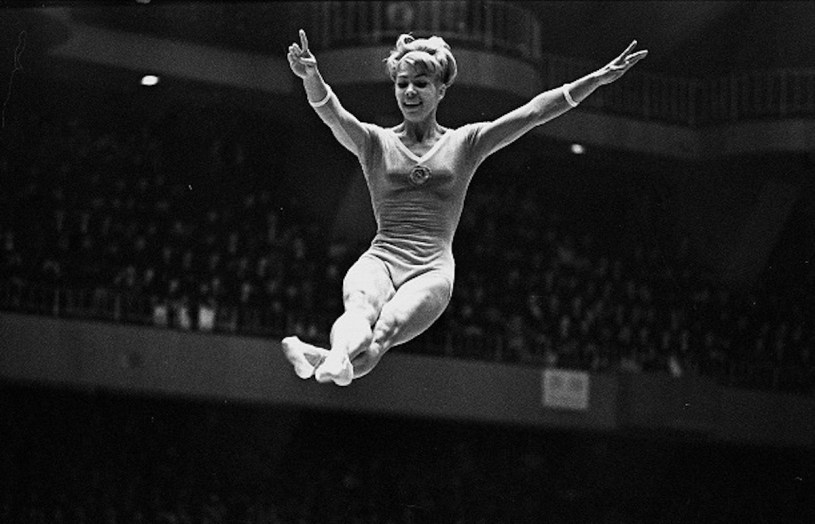
For Olympic Wednesday today, we have a special one: the 1960 Summer Olympics in Rome—our favorite city in the world. Over 5,300 athletes from 84 countries competed in 150 events across 22 disciplines, as plenty of stars shone on the classical stages that the city provided for the spectacle. The Basilica di Maxentius (wrestling) and the Terme di Caracalla (gymnastics) were the two most antiquated venues.
The Soviet Union (103 medals) easily outpaced the United States (71) to claim another medal-table victory, while a unified German team (42) edged out the host nation by 6 medals. Overall, the Soviets won more bronze medals (31) than every other nation won outside the top quartet. That’s pretty incredible, in truth. Individually, a trio of athletes won 6 medals each, as we will explore below. What a spectacle, indeed!
Most Outstanding Male Athlete: Boris Shakhlin, USSR
We once had a swim coach who won a gold medal in these Games; this was also the olympiad where one Cassius Clay first made his name known to the world. Neither will win this award. There are only 2 options, for realsies: Soviet gymnast Boris Shakhlin and Japanese gymnast Takashi Ono. After winning 2 golds in Melbourne, Shakhlin did better this time around, for sure. Same with Ono, really, in terms of better.
A hero in Japan, Ono won a bronze in Helsinki and 5 medals in Melbourne. He won 6 medals in Rome: 3 golds, 1 silver, and 2 bronze. But Shakhlin was slightly his superior with 4 golds, 2 silvers, and 1 bronze. It’s quite incredible when you consider both these men would return in 1964 to win more medals, as well. Just a shame we have to pick between them, but Shakhlin won 4 individual golds and Ono “just” 2 individual golds.
For the record, Shakhlin won the individual all-around, the vault (tie), the parallel bars, and the pommel (tie) events, while Ono won the vault (tie) and horizontal bars events—and took silver in the individual all-around event, even as Japan took the gold in the team all-around competition. What an amazing display of competitiveness it must have been to witness either on television or in person! Oh, how we wish …
Most Outstanding Female Athlete: Larisa Latynina, USSR
The only 2 contenders here are Soviet gymnast Larisa Latynina (3G, 2S, 1B) and American track athlete Wilma Rudolph (3G). Latynina lost a tiebreak for this award in Melbourne, and she clearly has the edge here. We mention Rudolph for other reasons, though ethnocentric ones: her story in overcoming polio and her visibility as a Black woman were tremendous symbols for U.S. progress. Alas, Latynina gets the trophy.
Most Outstanding Male Team: Italian Cycling
Of the 6 cycling events contested on the road and on a track, the host Italians won gold in 5 of them—winning silver in the other (individual road race). Sante Gaiardoni won 2 individual goals (sprint and 1,000m time trial), while the other 3 were in team events. The Italians also picked up a bronze in the men’s sprint event, won by Valentino Gasparella. The aforementioned silver was won by Livio Trapè. Impressive.
Most Outstanding Female Team: Soviet Gymnastics
The Soviet women put on a stunning display here, winning 15 of the available 18 medals in gymnastics. The only medals they did not win? The gold in balance beam, along with the silver and bronze in the team all-around competition, of course. So really, the Soviet women won 15 of 16 medals possible, including 5 golds, 5 silvers, and 5 bronzes. Latynina led the way, obviously, but clearly she was surrounded by amazing talent.
 Daily McPlay: (mostly) Historical Sports Analysis with TENACITY & VERVE