
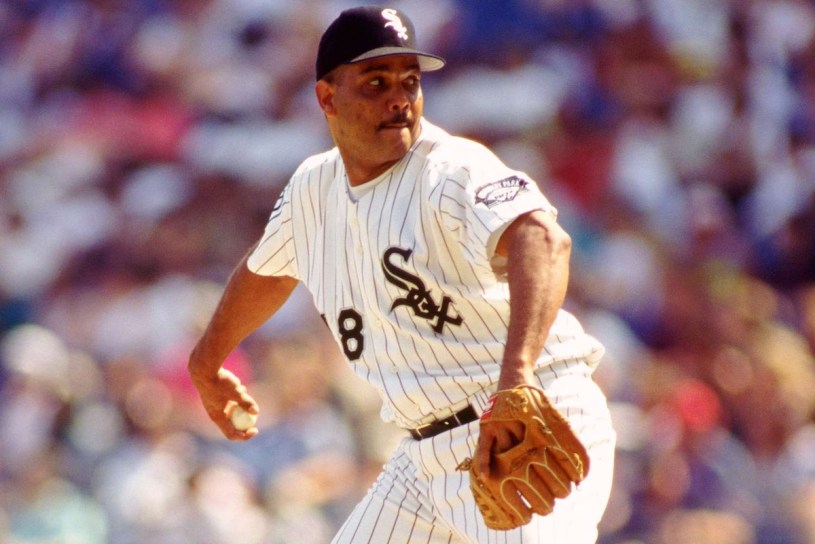
We have something special for you today, on our Random MLB Player Analysis column: José DeLeón, a starting pitcher who threw for 5 different teams in 13 seasons from 1983-1995. We were reminded of him today looking at the stat line for tonight’s Oakland Athletics starter, Ross Stripling (1-8, 5.19 ERA). He’s a candidate to lose 20 games this year, something that hasn’t happened since 2003 when Mike Maroth did it.
The old adage is that you have to be a pretty good pitcher to lose 20 games, and it’s mostly true: it requires anywhere from 25-30 starts in a full season, and to get that, the team has to be bad—and you have to be somewhat decent to get that many starts, even on a bad team. Maroth pitched for a 43-win Detroit Tigers team, and this brings us to DeLeón, who lost 19 games twice in his career, for 2 different teams (1985, 1990).
DeLeón passed away 3 months ago, sadly, and we didn’t see a lot of celebrations of his career achievements: a 3.76 ERA in almost 1,900 innings with almost 1,600 strikeouts and a 1.263 WHIP. Seems like a rather solid line, but his 86 victories pale in comparison to his 119 losses. Yet Maroth’s career ERA was 5.05, and his 5.73 ERA in 2003 certainly wasn’t “good” by any stretch. Those Tigers were just that bad, but DeLeón was a pitcher.
He broke in with the Pittsburgh Pirates in 1983, and his first 2 seasons together he went 14-16 with a combined 3.42 ERA in 300 1/3 IP, including 271 Ks. Yet he had some challenges in 1985, going 2-19 across 31 appearances (25 starts) for a team that won just 57 games. His ERA jumped to 4.70 yet he still notched 149 Ks in 162 2/3 IP. His walks seemed to be the big issue, as he tossed a then career-worst 4.9 BBs per 9 IP.
When DeLeón got off to a rough start in 1986, the Pirates traded him to the Chicago White Sox for Bobby Bonilla, straight up, which seems to be a bad trade in retrospect for the South Siders. Yet the pitcher recovered to toss 79 IP for Chicago to the tune of a 2.96 ERA and 1.152 WHIP for the rest of the season, with 68 Ks. His 1987 season was solid enough, too: 4.02 ERA, with 153 Ks in 206 IP. At age 26, he was stabilizing.
However, the White Sox traded him to the defending NL champions in the offseason, setting DeLeón up for a strong 1988 campaign. At age 27, he posted his first winning MLB season (13-10) while delivering a 3.67 ERA and 1.260 WHIP with 208 Ks in 225 1/3 IP—numbers very much in line with his career marks, actually. He followed that up with a better season: 16-12, 3.05 ERA, NL-best 201 Ks and fewest hits allowed (6.4).
His 1.034 WHIP for the Cardinals that season was very good; he clearly was peaking at age 28. But St. Louis crashed historically in 1990, finishing in last place for the first time since 1918 (!). That is not a misprint: the longtime manager (Whitey Herzog, who just passed away, too) was fired, despite his winning 3 NL pennants in the 1980s (1982, 1985, 1987). It was a rough season for the Cardinals, indeed, psychologically.
And DeLeón took the brunt of it again: 7-19, 4.43 ERA, and a 1.391 WHIP despite 164 Ks in 182 2/3 IP. His walk troubles (4.2 BB/9) returned after a career-best effort the year before (2.9 BB/9). But he still started 32 games for 3 different managers (Herzog, Red Schoendienst, and Joe Torre) as the St. Louis organization scrambled to reorganize under the duress. None of those guys lost faith in DeLeón despite the troubles.
Over the final 5 seasons of his career from then on, DeLeón posted a 18-23 record for the Cardinals (1991-1992), the Philadelphia Phillies (1992-1993), the White Sox again (1993-1995), and the Montréal Expos briefly (1995), across a combined 480 1/3 IP for a 3.67 ERA. Yes, there was some inconsistency, but generally, DeLeón rediscovered his “best” form even as he aged and exited his prime with some injuries along the way.
So, how did DeLeón lose 19 games twice in his otherwise decent career? Bad teams breed bad pitching stats, usually, thanks to porous defense and overall malaise in effort from players who feel defeated even before each game starts. The 1985 Pirates won just 57 games, and the 1990 Cardinals won 70 games—and both were bad seasons for the respective franchises, in general. Pittsburgh would rebound; St. Louis would, too. But …
DeLeón would not be a part of either recovery, of course: the Pirates won 3 straight NL East Division titles from 1990–1992 fueled by stars like Barry Bonds and Bonilla, while the Cardinals eventually would hire Tony La Russa after Torre struggled in St. Louis (.498 winning percentage from 1990-1995), winning World Series again in 2006 and 2011. And that’s how you get labeled “best losing pitcher in baseball” by historians.
It’s also an interesting example of why wins are important in baseball, despite the sabermetric measurements that balance peripherals with the bottom line. A pitcher needs to be mentally tough, even if his team is having a bad day behind him. The elite pitchers find a way to win, no matter what, because they’re mentally tough. In the end, you have to be 1 run better than the other pitcher(s), really, right? Bingo.
DeLeón was good enough to get a combined 57 starts for historically bad teams in 1985 and 1990, and thus he posted a 9-38 record for those 2 teams. Take those 2 years out of his career stat line, and his W/L record is 77-81, which looks a lot better. And his ERA would be much better, too (3.58). Alas, in the end, he just didn’t have that psychological makeup to match his decent stuff (7.6 Ks/9 career). Those are the waters, as they say.
Perhaps it’s appropriate then that the only postseason appearances for DeLeón came in 1993 with the White Sox, in relief: he tossed 4 2/3 IP in the ALCS loss to the Toronto Blue Jays, posting a 1.93 ERA and a 1.714 WHIP with 6 Ks. We can only wonder what kind of career he might have had with some better fortune in playing on winning teams. To throw out another baseballism, you’d rather be lucky than good in the end.
Editor’s Note: It’s amusing to us that the second pitcher on his similarity-score list is longtime San Francisco Giants starter Matt Cain—another guy who finished his career with a losing record. Cain was 104-118 in his career with a 3.68 ERA and 1.228 WHIP while his teams ended up winning 3 World Series. Compared to DeLeón’s 3.76 ERA and 1.263 WHIP, it’s clear to see how much some guys benefit from strong (ahem) teammates. It really can make the difference in the legacy left behind.
 Daily McPlay: (mostly) Historical Sports Analysis with TENACITY & VERVE