
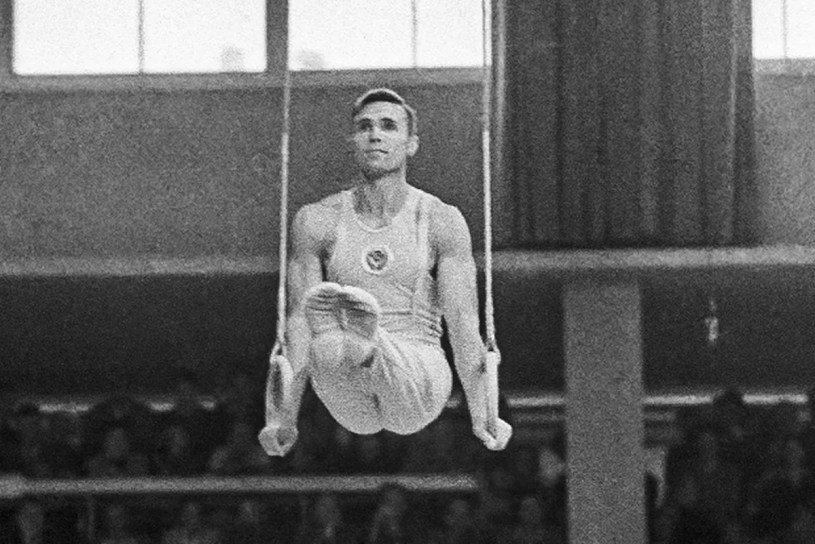
For Olympic Wednesday this week, we head to the Summer Olympiad in Melbourne, Australia, as the world went below the equator into the Southern Hemisphere for the first time ever. Due to that fact, the “summer” events were held in November and December for optimal weather. Almost 3,200 athletes from 67 countries went down under to participate in 145 events across 20 disciplines (equestrian events were held in Sweden).
The Cold War continued raging in athletics as the Soviet Union ended up atop the medal table with 98 total awards, followed by the United States (74) and host Australia (35). Four other nations won at least 20 overall medals as well. However, the top 3 nations were the only ones to secure double-digit gold medals, and attendance was lower than usual due to the travel challenges and logistics of getting to Australia, generally.
Most Outstanding Male Athlete: Viktor Chukarin, USSR
Four men stood out at these Games for varying degrees of medal-winning success, and each of them won 2 individual golds apiece: Soviet gymnast Viktor Chukarin, his teammate Valentin Muratov, Australian swimmer Murray Rose, and American track & field star Bobby Morrow. They each won 3 golds overall, either in team competition or in relay events. So, how do we choose here, when Chukarin won this in 1952?
He’s hard to beat this time, too, with 4 medals overall in individual events. Meanwhile, both Rose and Morrow went 3-for-3 with gold medals in every event they entered. Muratov was in the middle with an extra individual silver. Yet we have to give credit to Chukarin for his breadth of talent, nabbing gold in the all around and the parallel bars, in addition to silver in the floor exercise and bronze on the pommel horse.
Most Outstanding Female Athlete: Ágnes Keleti, Hungary
Two women stood out here, each winning 6 overall medals to top all athletes at this Olympiad: Hungarian gymnast Ágnes Keleti (3 individual golds) and Soviet gymnast Larisa Latynina (same). When it comes down to something this close, it matters that Keleti had 4 overall golds and 2 silvers while Latynina earned 4 overall golds, 1 silver, and 1 bronze. We give the edge to Keleti for that reason and one other significance.
First, Keleti won her golds in the floor exercise, the balance beam, the uneven bars, and the team apparatus event, taking silver in the individual all around and the team all around. Second, right before the Games, Soviet troops invaded Budapest to quell political uprisings in Keleti’s country. With that surely weighing heavily on her heart and mind, she (and her teammates) had more to overcome here than anyone else.
Most Outstanding Male Team: Australian Swimming
We’re going with the home nation swimmers here, as the Aussie men took home 5 of the 7 gold medals available in Melbourne, while claiming an additional 3 medals as well. Individual champions included Jon Henricks (100m freestyle), Rose (400m and 1500m freestyles), and David Theile (100m backstroke), while the nation claimed the 4×200 freestyle relay as well. Quite a showing down under for the guys in Speedos.
Most Outstanding Female Team: American Diving
American women took 5 of this 6 available medals in the two diving events, led by double-gold winner Pat McCormick (platform, springboard). The other medals were won by Jeanne Stunyo (silver, springboard), Juno Irwin (silver, platform), and Paula Jean Myers (bronze, platform). McCormick’s achievement still resonates in U.S. Olympic lore, of course, but overall, the team did an amazing job in Melbourne together.
 Daily McPlay: (mostly) Historical Sports Analysis with TENACITY & VERVE