
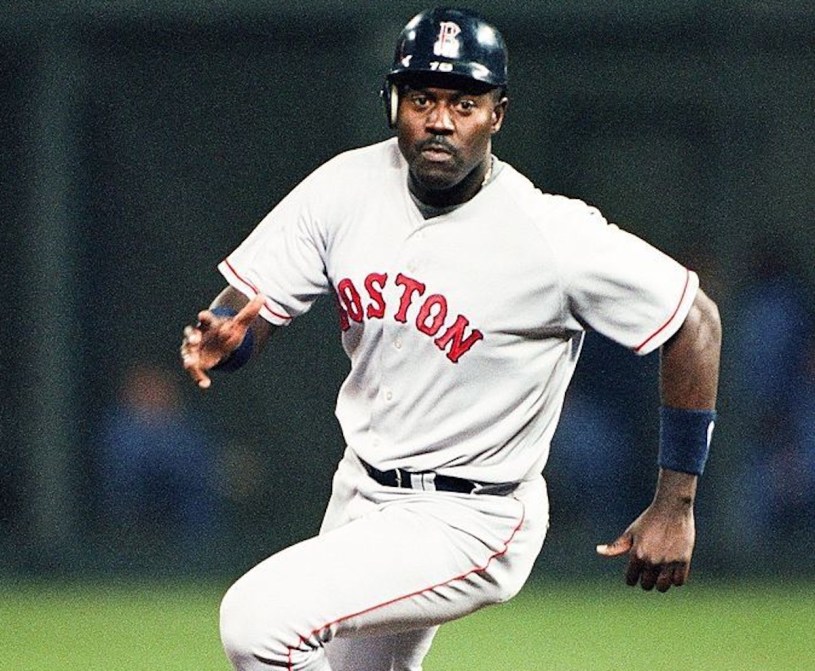
In this third entry on Random MLB Player Analysis, we take a peek at one of a group of players that always fascinates us: guys who hit .300 for their career and probably will never be in the Hall of Fame. Today, that player is 9-year MLB veteran Reggie Jefferson. In over 2,100 ABs across 680 games with 4 different teams, he hit .300 overall with 72 home runs, 300 RBI, an .823 OPS, and exactly zero All-Star designations. Hmm.
A lot of interesting tidbits in his statistical profile stand out to us. To wit:
- He made his MLB debut in 1991 with the Cincinnati Reds, who were the defending World Series champions that year. A third-round draft pick in 1986, Jefferson went 1-for-7 with the Reds before being traded to the Cleveland Indians.
- In the equivalent of a full season with the Cleveland organization (163 games in 1991-1993 combined), he hit just .254 with 13 HRs, 52 RBI, and a .654 OPS. Admittedly, he never seemed to get the consistent playing time often required to get into a groove, but at his positions (first base, designated hitter), he still wasn’t generating the expected numbers. The fans seemed to like him, however.
- Before the 1994 season, Jefferson was flipped to Seattle for Omar Vizquel, a significant part of Cleveland’s American League championship teams in 1995 and 1997. With the Mariners in 63 games, he finally found his swing during his age-25 season, hitting .327 with 8 HRs, 32 RBI, and a .935 OPS.
- Despite the short-season success in 1994, the Mariners let Jefferson walk, and he signed with the Boston Red Sox for the 1995 season as he entered his prime. In 449 games over the final 5 seasons of his career, all with the BoSox, he hit .316 with 50 HRs, 215 RBI, and an .868 OPS.
- Despite being a fan favorite in Boston, the organization chose not to re-sign him after the 1999 season, and he played 1 season in Japan before retiring at age 31. In his final 6 years in MLB, during his age 25-30 seasons, Jefferson hit .317 with 58 HRs and 247 RBI in 512 games, roughly 3 full years of games.
There is no hint of PED use in his career, despite his success with the Red Sox. He hit a career-best .347 in 1996 with Boston during his age-27 season. He followed that up with .319 and .306 averages, respectively, in the subsequent 2 years, before dropping down to a .277 average in his age-30 season. That pattern (and the associated statistics) fit the norm of the average MLB player’s prime from age 27 to age 31, approximately.
His biggest flaw was that despite being a switch hitter, he struggled mightily against left-handed pitchers: he hit .316 against righties (1,771 ABs) and only .219 against lefties (352 ABs) across his entire career. By 1999, when the Red Sox were starting to get serious about their pursuit of the New York Yankees, Jefferson hit only .182 against lefties (in a mere 11 ABs, though) and was left off the postseason roster, allegedly for this.
However, usually, it’s the righty batter who can’t hit righties that is left out of such a postseason situation. Jefferson was never a great glove man (minus-5.7 dWAR for his career, including minus-4.0 in Boston), but his bat should have been viewed as much more valuable in the DH/PH role that invariably would arise in the playoffs. According to a source, however, Jefferson may have been unliked in the clubhouse; that matters.
Without knowing that for sure, we might surmise that the Red Sox organization saw his 1999 decline to a .760 OPS as problematic for a guy at age 30, and the front office didn’t see him improving without some … ahem … help. And maybe Jefferson didn’t want to do that in order to stay with the team. But that doesn’t explain why no other MLB team was willing to offer him a worthy contract for the 2000 season, either.
He made $3.4M in 1999, so it’s hard to believe another team wouldn’t have offered something in the $2.5M range for an effective dominant-side platoon DH. Of course, the Red Sox may have been right about his decline since he played just a single season in Japan (2000), hitting only .260 there at age 31. The Boston organization scenario outlined above, therefore, makes the most sense to us. He was done; they knew it.
And Jefferson wasn’t interested in artificially extending his career, as so many others in his situation with the Red Sox (and other organizations) have done. Good for him, even if it cost him his career. Alas, he did retire as a .300 hitter, though, despite never making an All-Star team and having no shot at making Cooperstown. As noted above, we love analyzing the careers of .300 hitters not in the Hall of Fame. It’s fun!
Final thoughts on Jefferson, though: 1) he had no speed, stealing just 2 bases in his MLB career; 2) he never learned to draw a walk, effectively, which also could have hurt his status with the Boston organization at the time; 3) that 1999 team had “better” players with the same rough skills set (Brian Daubach, Mike Stanley); and 4) the free-agent market always has guys who can do what Jefferson was capable of doing, more cheaply.
Still, kudos to Reginald Jirod Jefferson for being a career .300 hitter in major-league baseball. Fantastic! He may not have been David Ortiz (who would fill his role with the Boston organization within a few seasons of Jefferson leaving) … but that’s a good thing.
 Daily McPlay: (mostly) Historical Sports Analysis with TENACITY & VERVE